Do Racial Disparities in Probation Revocation Signal Unfair Supervision?
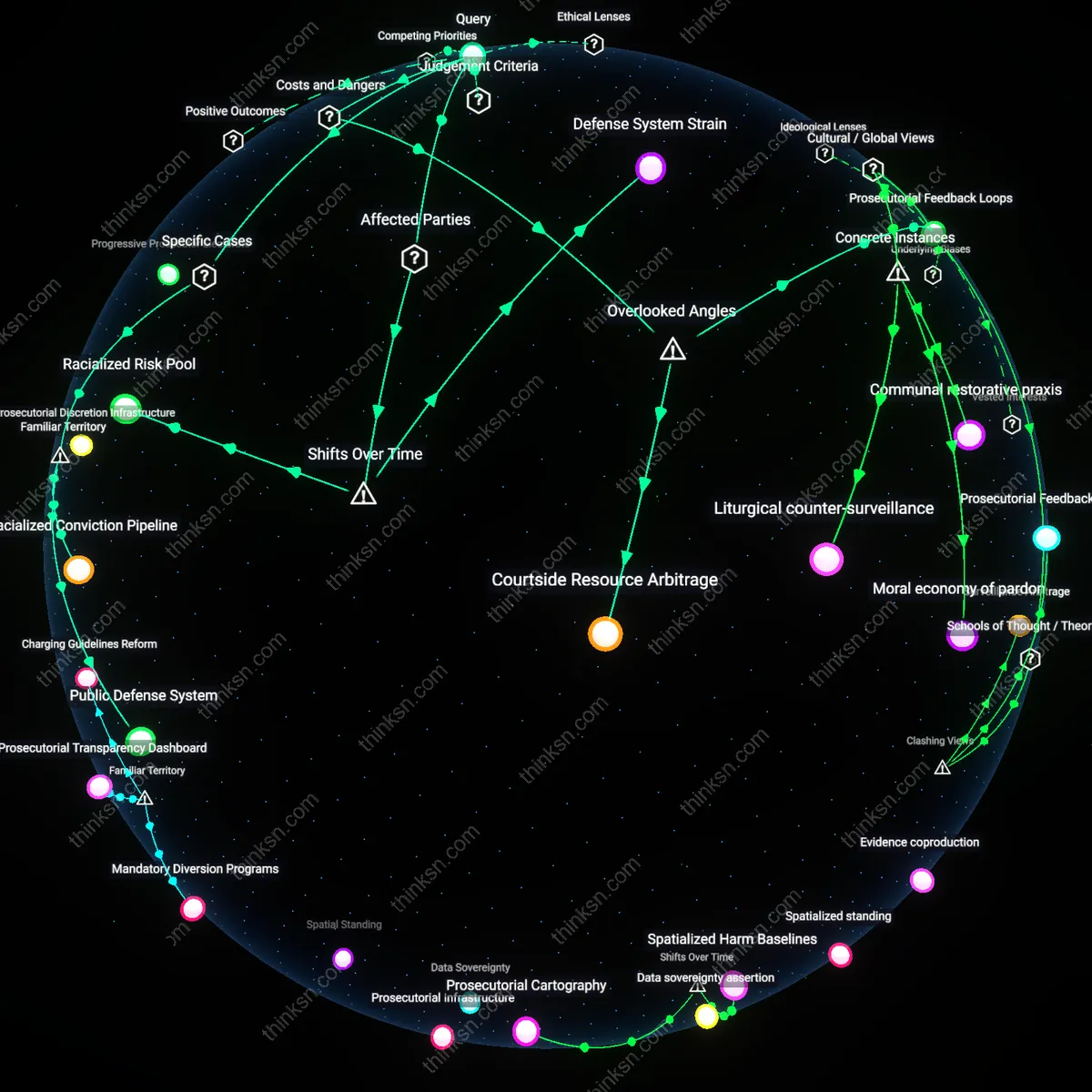
Analysis reveals 6 key thematic connections.
Key Findings
Normalizing Surveillance
Racial disparity in probation revocation rates does not indicate flawed implementation but reflects the intended function of supervision to intensify social control in marginalized communities. Probation systems operate through expansive monitoring regimes—frequent check-ins, curfews, drug testing, and behavioral mandates—that generate technical violations more often among low-income populations of color due to structural constraints like unstable housing and precarious employment. The non-obvious truth is that revocation disparities are not system failures but evidence of a design calibrated to absorb and punish structural vulnerability, thus expanding carceral reach without requiring new legislation or incarceration policies.
Compliance Overjustice
High revocation rates for Black and Brown probationers expose how fairness has been redefined within supervision practices as compliance with procedural demands rather than equitable treatment or rehabilitation outcomes. The mechanism operates through risk assessment tools and judicial discretion that prioritize behavioral monitoring—such as attendance and documentation—over addressing root causes of criminalization, embedding bureaucratic performance as the metric of success. This reveals that the system is not failing to be fair; it has systematically displaced fairness with administrative predictability, punishing those whose lives cannot conform to rigid scheduling due to labor instability or caregiving duties.
Managed Marginality
Disparities in revocation rates suggest that probation functions not as a rehabilitative alternative but as a mechanism for managing populations rendered ungovernable by economic disinvestment, where racialized outcomes emerge from the intersection of supervision demands and neighborhood-scale deprivation. The system leverages individualized accountability—blaming probationers for missed appointments or failed tests—while obscuring how public service retrenchment, underfunded transit, and health disparities make compliance mechanically unattainable for many. The dissonance lies in recognizing that revocation is less about criminal risk than about enforcing order in zones of state abandonment, revealing supervision as a tool of spatial containment rather than personal correction.
Judicial Discretion Asymmetry
Racial disparity in probation revocation rates suggests that supervision practices are shaped by uneven applications of judicial discretion, where judges in counties like Cook County, Illinois, consistently impose harsher technical violation penalties on Black probationers compared to white counterparts for similar non-compliant behaviors. This pattern persists not due to differential violation rates but because informal norms and cognitive biases within local court cultures enable discretion to amplify racial hierarchies under the guise of neutral risk assessment. The analytical significance lies in exposing how legal structures presumed to correct bias instead embed it through localized norms of 'risk' and 'compliance' that are racially coded. What is underappreciated is that reforming formal policies alone cannot correct this—because the mechanism operates through tacit, place-specific judicial routines shielded from oversight.
Probationary Debt Spiral
Racial disparity in probation revocation rates reveals that supervision practices are sustained by financial infrastructures that disproportionately penalize low-income communities of color, as seen in jurisdictions like Ferguson, Missouri, where municipal courts systematically used probation to extract fines and fees, leading to higher revocation rates when individuals could not pay. The mechanism hinges on the institutional dependence of city budgets on revenue-driven probation enforcement, which treats failure to pay not as economic hardship but as noncompliance deserving incarceration. This exposes how fiscal insolvency at the municipal level transforms probation into a debt collection tool, with race-correlated poverty serving as the enabling condition. The non-obvious insight is that revocation inequity is less about behavior than about the monetization of supervision in financially distressed cities.
Surveillance Density Feedback
Racial disparity in probation revocation rates indicates that supervision practices are intensified in neighborhoods subject to higher policing density, such as majority-Black communities in cities like Baltimore, where probation officers draw on frequent police contact to report technical violations like curfew breaks or associating with prohibited individuals, even when such behaviors pose no public safety threat. The mechanism operates through feedback loops between community-level surveillance and probation enforcement, where over-policing generates more detectable violations among supervised individuals, increasing revocation likelihood independent of actual risk. This reflects a systemic dynamic in which geographic targeting amplifies compliance burdens for certain racial groups, making revocation a structural outcome rather than an individual failure. The underappreciated reality is that supervision fairness is contingent on neighborhood-level state presence, not just individual conduct.