Does Civilian Oversight of Police Truly Enhance Accountability?
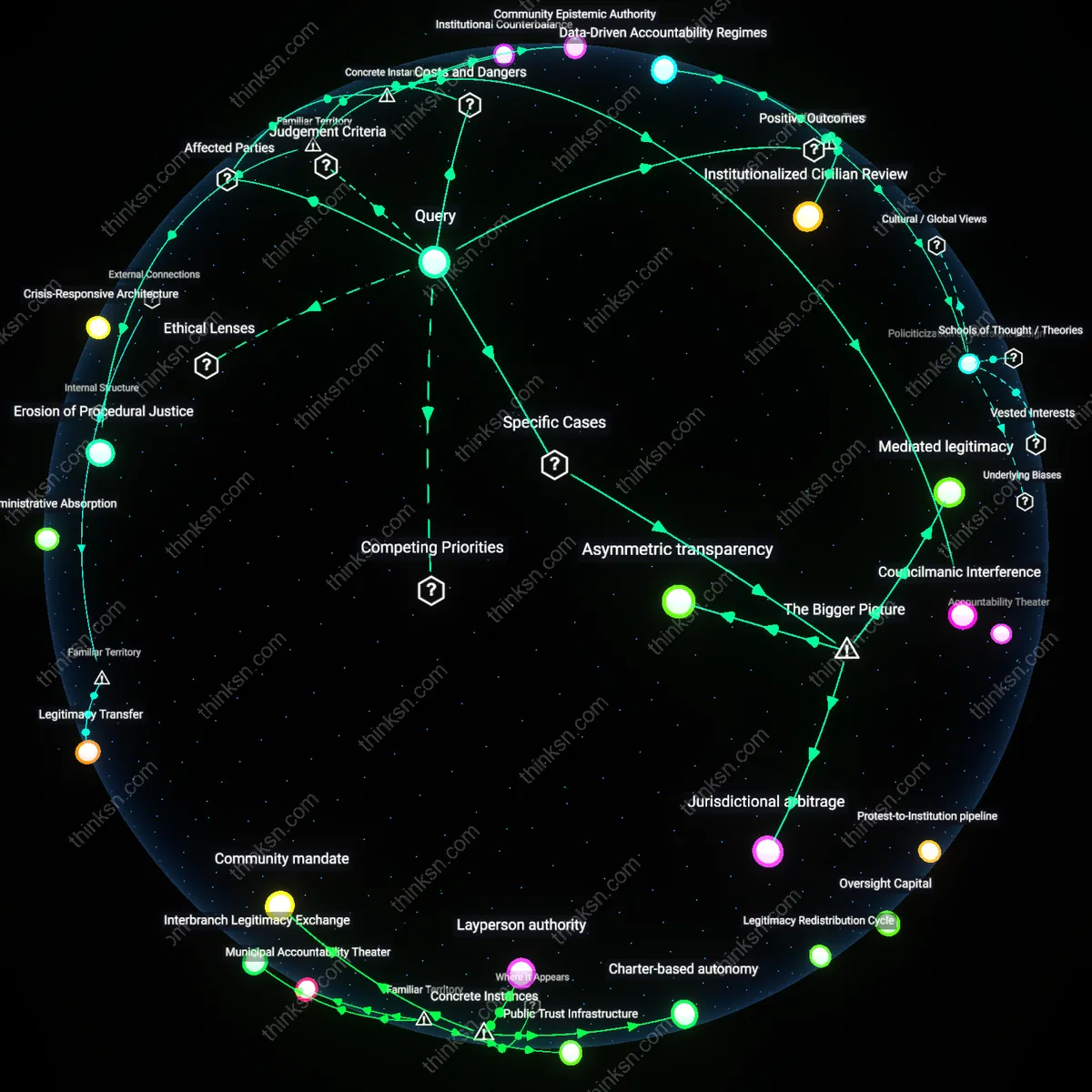
Analysis reveals 12 key thematic connections.
Key Findings
Institutional Counterbalance
The creation of the Civilian Complaint Review Board (CCRB) in New York City in 1993 directly improved police accountability by establishing a permanent mechanism through which affected residents could formally contest officer misconduct, thereby shifting power from internal disciplinary systems dominated by police unions to an externally accountable body. The CCRB’s authority to subpoena evidence and recommend disciplinary outcomes introduced a check on the NYPD’s insular disciplinary culture, which historically dismissed or minimized civilian complaints; this shift reveals that civilian oversight functions not merely as symbolic reassurance but as an institutional counterbalance when vested with investigative autonomy and enforcement adjacency. The non-obvious insight here is that accountability improves not because civilians are inherently more impartial, but because the oversight body disrupts entrenched bureaucratic loyalty through structural asymmetry in enforcement priorities.
Political Shielding
In Chicago, the 2016 federal consent decree following the Laquan McDonald killing led to the empowerment of the city’s Civilian Office of Police Accountability (COPA), yet Mayor Lori Lightfoot’s public micromanagement of high-profile cases revealed how oversight entities can become instruments of political damage control rather than independent arbiters. By selectively releasing COPA-related video evidence and timing appointments to coincide with election cycles, city leadership instrumentalized the appearance of transparency to absorb public outrage while insulating the broader political establishment from systemic critique. This instance demonstrates that civilian oversight does not eliminate politicization but can instead formalize a new mechanism for political shielding, where the visibility of investigation replaces the substance of structural reform.
Community Epistemic Authority
In Richmond, California, the establishment of the Office of the Independent Police Auditor (OIPA) in the early 2000s coincided with a grassroots coalition of Black and Latino neighborhood councils that used audit findings to pressure the city council for redirected public safety funding, illustrating how oversight bodies can empower historically marginalized communities to assert epistemic authority over policing norms. Rather than merely reacting to incidents, residents leveraged OIPA data to co-define what constituted 'accountability'—expanding it beyond individual officer discipline to include deployment patterns and use-of-force thresholds—thereby altering the terms of engagement between police and community. This dynamic reveals that when oversight frameworks are coupled with organized civic capacity, they enable a transfer of interpretive power, making community epistemic authority a constitutive element of accountability itself.
Institutionalized Civilian Review
Civilian oversight of police improves accountability by institutionalizing external scrutiny through formally empowered review boards, a shift crystallized in U.S. cities like New York and Los Angeles during the 1990s amid federal civil rights investigations into systemic abuse. This mechanism replaced ad hoc complaints with structured investigations, embedding community representation in disciplinary feedback loops and altering the power geography within police governance. The non-obvious outcome of this historical transition—from reactive public outrage to codified oversight—is not just greater transparency but the normalization of civilians as legitimate arbiters of police conduct, reshaping legitimacy itself as a shared jurisdiction.
Policiticization of Oversight Design
The expansion of civilian oversight after the 2020 George Floyd protests introduced elected or politically appointed oversight members in cities such as Minneapolis and Austin, marking a shift from technocratic models toward democratic accountability. While this increased responsiveness to community demands, it also embedded oversight within electoral cycles, enabling city councils and mayors to shape board mandates, budgets, and priorities—transforming oversight from an independent audit function into a contested governance arena. This transition reveals how democratization of oversight, though well-intentioned, has rendered law enforcement accountability susceptible to partisan alignment, exposing a structural trade-off between representational legitimacy and operational neutrality.
Data-Driven Accountability Regimes
Beginning in the late 2000s, civilian oversight entities like the Oakland Police Monitor increasingly adopted data analytics and performance metrics to evaluate police behavior, shifting from narrative-based complaint reviews to systemic pattern recognition. This transformation, fueled by federal consent decrees and advances in open data infrastructure, enabled oversight bodies to detect racial disparities and use-of-force trends that internal affairs divisions historically overlooked. The underappreciated effect of this shift is not merely enhanced accountability, but the redefinition of civilian oversight as a technical-administrative function—one that depends less on confrontation and more on evidence curation, thus producing a new mode of governance where legitimacy flows from analytical rigor rather than political voice.
Oversight Theater
Civilian oversight boards create the appearance of accountability without altering police disciplinary outcomes, because they lack subpoena power and enforcement authority in cities like Chicago and Los Angeles. This dynamic allows mayors and city councils to point to oversight structures as proof of reform while insulating departments from meaningful consequence, turning public hearings into ritualized performances of responsiveness. The underappreciated risk is not just inefficacy but the legitimation of the status quo through the very mechanisms designed to challenge it.
Councilmanic Interference
Local politicians exploit civilian oversight processes to insert partisan influence into policing by appointing allies to review panels in cities such as New York and Baltimore, where council members have redirected investigations toward politically convenient targets. Because oversight bodies depend on municipal funding and political goodwill, their agendas often reflect electoral calendars rather than patterns of misconduct, transforming accountability into a tool of retribution or favor. The danger lies not in outsider meddling but in how democratic access is weaponized from within established governance channels.
Erosion of Procedural Justice
Repeated publicized failures of civilian oversight—such as in Minneapolis before 2020—to prevent repeated abuses despite documented complaints conditions communities to distrust both police and the institutions meant to check them. When oversight processes are seen as performative or captured, residents withdraw cooperation from both law enforcement and reform efforts, accelerating a legitimacy spiral in neighborhoods already alienated by over-policing. The systemic cost is not merely reduced accountability but the collapse of shared faith in institutional fairness as a governing principle.
Mediated legitimacy
Civilian oversight bodies in Oakland, California improve police accountability by institutionalizing community input into internal affairs investigations, which pressures the Oakland Police Department to alter disciplinary outcomes or admit procedural flaws under public scrutiny; this mechanism holds because the Civilian Police Review Commission controls access to investigative records and public hearings, creating a platform where community activists, families of misconduct victims, and city officials jointly scrutinize case files—transforming localized grievances into formal organizational feedback. The non-obvious element is that accountability emerges not from direct disciplinary power, but from the oversight body’s role as a broker of legitimacy between the department and the governed, altering behavior through reputational risk rather than enforcement authority.
Jurisdictional arbitrage
Civilian oversight in New York City has intensified political interference in law enforcement because the Civilian Complaint Review Board (CCRB) operates under mayoral appointment and city council funding, enabling elected officials to adjust the board’s scope and leadership in response to crime spikes or backlash from police unions; this dynamic became visible when Mayor Eric Adams sought to weaken the CCRB’s subpoena power after disagreements over disciplinary trends, revealing how oversight structures with dependent budgets and appointments are vulnerable to executive manipulation during periods of public safety panic. The overlooked insight is that accountability mechanisms can become arenas for power renegotiation between city executives and law enforcement, where civilian oversight gets reconfigured not to correct abuse but to rebalance political control.
Asymmetric transparency
In Denver, Colorado, the Office of the Independent Monitor improved investigative rigor within the Denver Police Department not by increasing civilian disciplinary authority, but by producing detailed, publicly released annual reports that compare early intervention data with sustained complaints, forcing the department to justify discrepancies in internal review outcomes; this causal pathway depends on the monitor’s statutory autonomy to access real-time data and hire forensic auditors, creating a persistent informational asymmetry where the department must respond to public discrepancies it cannot control. The underappreciated dynamic is that accountability functions most effectively when oversight generates unignorable public records that expose organizational contradictions, even in the absence of direct punitive powers—turning transparency into a structural disruptor of bureaucratic inertia.