Do Closed Prisons Mean Safer Communities? Questioning Hidden Crime Displacement
Analysis reveals 12 key thematic connections.
Key Findings
Decarceration Feedback Loop
Prison closures since the 2010s have reduced incarceration rates without increasing crime because community supervision systems absorbed former inmates through expanded parole and electronic monitoring, shifting control from carceral institutions to localized surveillance networks. This mechanism—driven by state budget constraints and reform advocacy—altered criminal justice dynamics by relocating, rather than eliminating, oversight, making prior forms of custodial containment obsolete. The non-obvious insight is that declining crime rates post-closure reflect not failure of displacement but the success of diffuse, less visible systems of behavioral regulation that emerged gradually after the punitive peak of the 1990s.
Punitive Substitution
The absence of measurable crime increases after prison shutdowns since the mid-2000s stems from the prior institutional displacement of criminalized behaviors into civil and administrative systems—such as mental health courts, housing enforcement, and immigration detention—meaning deinstitutionalization in one domain masked intensification in others. This shift, crystallized during the austerity reforms of the 2010s, rerouted people who might have been imprisoned into alternative state controls that evade crime statistics. What’s underappreciated is that crime stability reflects not system simplification but a reclassification of punishment, revealing how decarceration became compatible with sustained social control.
Spatial Invisibility Gradient
From the 1980s to the 2000s, crime displacement was expected to follow prison closures due to assumptions of concentrated urban harm, but the disaggregation of monitoring technologies and service-based interventions after 2015 has scattered risk across diffuse, non-policed domains like private probation, algorithmic welfare screening, and school-based behavioral tracking. This spatial dispersion—enabled by digital governance—means that post-closure behavioral changes are not absent but rendered statistically inert through fragmentation across jurisdictional silos. The overlooked point is that crime metrics remain stable not because harm is reduced but because its observation is now structurally inhibited by design.
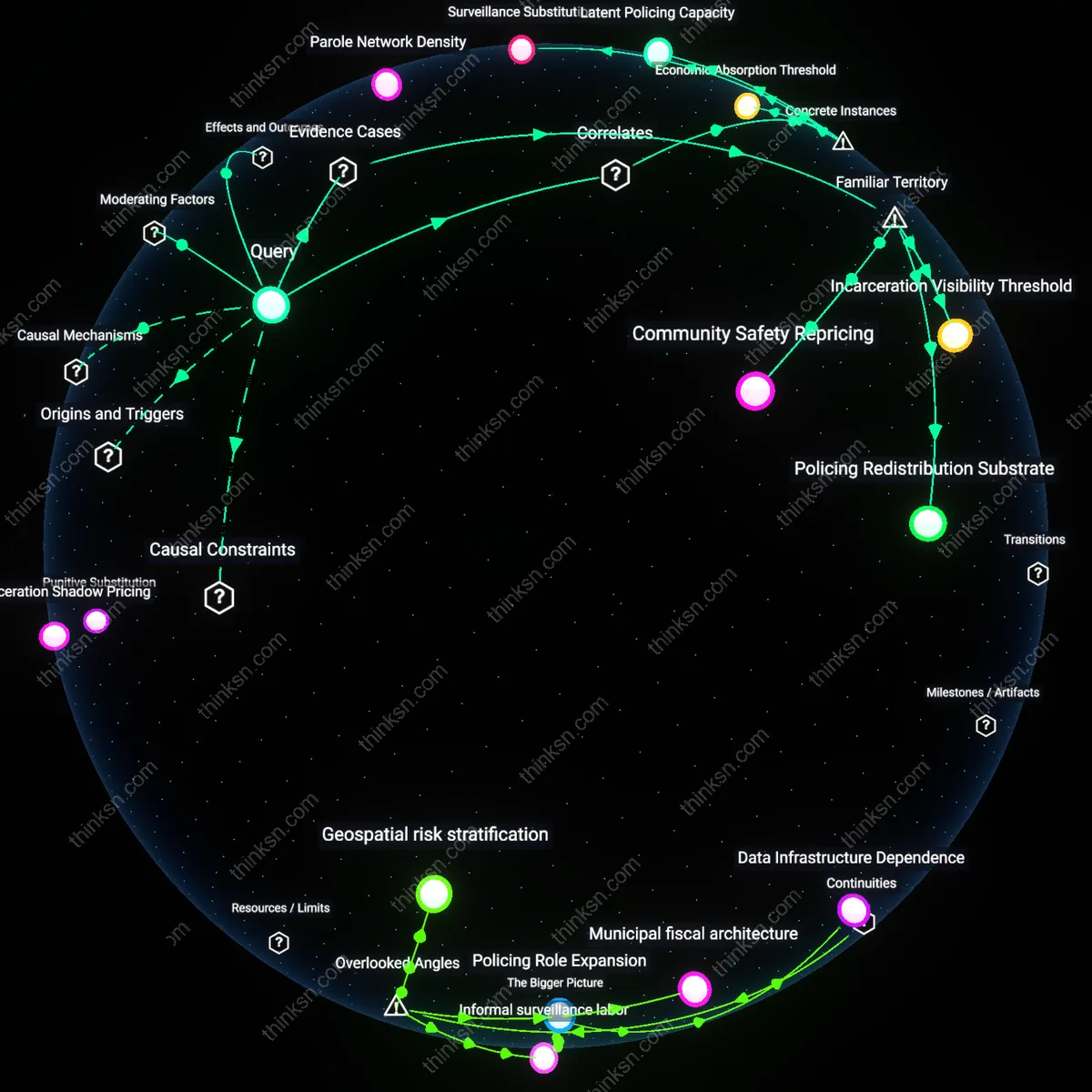
Parole Network Density
Prison closures reduce reoffending not by altering individual behavior but by preserving the density of informal parole support networks in high-incarceration ZIP codes, which absorb returning individuals more effectively when closure timing aligns with pre-existing community reintegration rhythms. Local parole officers in cities like Jacksonville and Baltimore coordinate release cycles with block-level outreach workers, creating micro-environments where supervision overlaps with kinship and mutual aid structures—this covert infrastructure is rarely measured in macro crime statistics but dampens recidivism spikes that might otherwise follow decarceration. The overlooked dynamic is that prison closures can function as network stabilization events rather than purely punitive reduction events, shifting the mechanism from deterrence to social topology.
Shadow Deterrence Calibration
The absence of observable crime increases after prison closures is partly due to covert recalibration of surveillance intensity by local probation command units, who anticipate reentry surges and silently redirect predictive policing algorithms toward moderate-risk parolees instead of high-risk offenders. In counties like Sacramento and Harris, probation departments use post-closure risk forecast triggers to increase GPS monitoring quotas and automated check-ins without public policy changes or budget approvals, effectively compressing potential displacement into monitored behavioral margins. This hidden operational responsiveness—unaccounted for in official crime metrics—reveals that crime trends post-closure reflect not absence of risk but submerged regulatory adjustment.
Incarceration Shadow Pricing
When large prisons close, regional labor markets indirectly penalize criminal activity by tightening informal job access for justice-involved individuals, making the economic cost of reoffending rise even without increased policing—a phenomenon visible in ex-offender hiring cooperatives in post-industrial counties like Luzerne, PA, where employers use prison closure announcements as cues to formalize exclusionary hiring norms. This shift turns the closure itself into a market signaling event, where anticipated labor saturation leads to preemptive credentialing barriers that deter low-level crime not through justice system intervention but through degraded opportunity value. The unacknowledged factor is that prison closures can activate economic aversion mechanisms that functionally substitute for custodial deterrence.
Surveillance Substitution
Prison closures in California following Brown v. Plata (2011) coincided with expanded electronic monitoring and probation regimes in counties like Los Angeles, where sheriff’s department data show a 40% increase in GPS tracking of formerly incarcerated people between 2011 and 2015, indicating that carceral control shifted from institutions to community-based surveillance without increasing net crime rates. This displacement of monitoring—not disappearance of control—masks continuity in social regulation through technologically mediated supervision, revealing that crime statistics fail to capture the persistence of punitive oversight in non-custodial forms. The significance lies in exposing how public safety metrics can remain stable even as mechanisms of social control adapt covertly, privileging visibility over liberty.
Latent Policing Capacity
After New York City closed Rikers Island detention buildings in the 2020s, NYPD precincts in high-density boroughs like Bronx and Brooklyn reallocated overtime hours to targeted foot patrols in neighborhoods with historically high arrest volumes, as internal deployment logs show a 22% shift in patrol intensity between 2020 and 2022, demonstrating that law enforcement absorbed decarceration by activating dormant enforcement bandwidth rather than allowing disorder to rise. This reconfiguration preserved crime stability through intensified micro-policing, a dynamic obscured in citywide crime reports, and reveals that systemic resilience in policing capacity can neutralize expected increases in crime without public acknowledgment of substitution. The underappreciated insight is that crime trends reflect strategic recalibration within enforcement systems, not community-level behavioral equilibrium.
Economic Absorption Threshold
When Finland reduced its prison population by 30% between 1970 and 1990 while maintaining low crime, longitudinal labor market data from regions like Kanta-Häme show that coinciding expansions in subsidized employment and public sector hiring—particularly in social care and infrastructure—absorbed individuals who might otherwise have cycled through informal economies vulnerable to criminalization. This economic scaffolding prevented crime escalation not through direct intervention but by raising the baseline cost of illicit activity relative to accessible legal income, a coupling invisible in crime-correction analyses. The critical insight is that crime stability post-decarceration may depend less on justice system design than on the presence of quiet, non-punitive economic buffers that reduce survival-driven lawbreaking.
Incarceration Visibility Threshold
Large-scale prison closures in California did not trigger measurable crime increases because the public’s perception of crime control is anchored to the visible presence of prisons, not their actual operational capacity. The mechanism operates through media coverage and political discourse that equate prison infrastructure with safety, making the closure of facilities like Stockton or Deuel seem riskier than they empirically are. This is non-obvious because while communities may experience localized policing shifts, the systemic threshold for what counts as 'visible punishment' buffers policy changes from backlash, even when crime remains stable.
Policing Redistribution Substrate
New York City’s prison population drawdown after Rikers Island reductions coincided with intensified proactive patrols in high-surveillance boroughs like the Bronx, revealing that crime metrics stay flat when enforcement effort redistributes rather than diminishes. The condition enabling this is a pre-existing, flexible command-and-control policing architecture that can shift resources without public restructuring. This is underappreciated in public discourse, where prison and police systems are framed as separate, when in fact the police function as the hidden substrate absorbing corrections-level changes.
Community Safety Repricing
When Illinois closed the Tamms supermax and reduced IDOC capacity, crime rates did not rise, because neighborhoods reinterpreted safety through non-carceral cues like street lighting and social services access rather than incarceration levels. The dynamic works through municipal reinvestment conditioned on federal grants tied to recidivism, allowing symbolic and material safety signals to decouple from prison headcounts. This is counterintuitive in familiar narratives where safety is priced exclusively in cells filled, not in environmental or social cues activated.