Does Instagram Mobilize Middle-Aged Voters Politically?
Analysis reveals 5 key thematic connections.
Key Findings
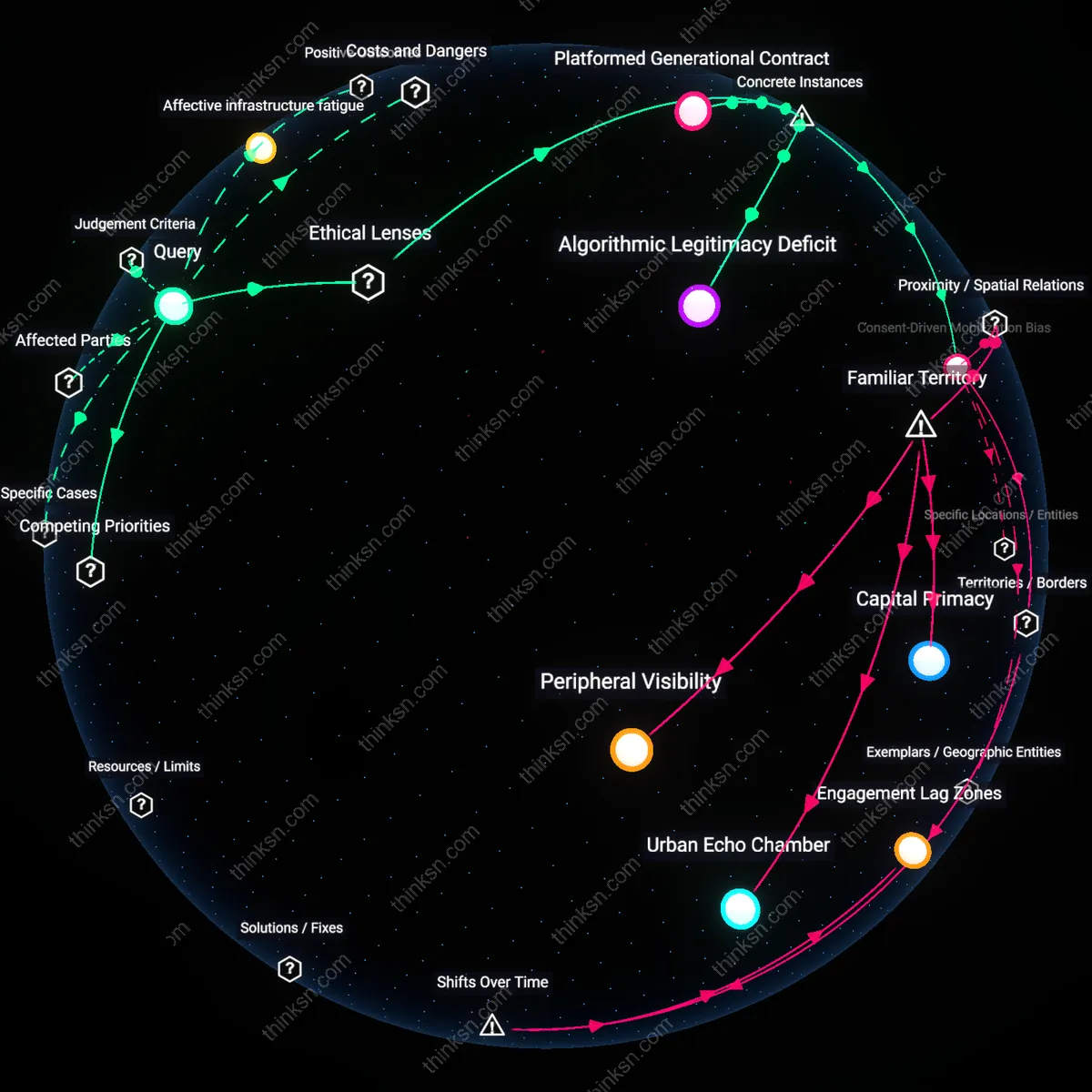
Algorithmic bandwidth constraints
Preliminary data overstate Instagram’s utility for mobilizing middle-aged voters because the platform’s recommendation algorithms prioritize content that sustains engagement over civic efficacy, thereby compressing the diversity of political messaging that reaches this demographic. Middle-aged users, who often engage episodically rather than persistently, are especially vulnerable to message dilution when campaign content competes with algorithmically amplified lifestyle and nostalgia content, reducing the effective bandwidth available for political transmission. This creates a zero-sum trade-off between reach and message integrity that campaign strategists rarely account for, assuming virality equates to mobilization. The overlooked dynamic is not user disinterest but infrastructural scarcity—how the finite space in algorithmic feeds limits political signal penetration, particularly among non-daily, non-reactive users.
Affective infrastructure fatigue
Middle-aged users’ reduced responsiveness to Instagram-based political appeals stems not from apathy but from affective saturation caused by overlapping emotional demands from caregiving, work instability, and personal health—domains where Instagram also supplies relentless content. The platform’s default emotional architecture, optimized for high-arousal reactions (outrage, nostalgia, inspiration), exhausts the affective bandwidth that middle-aged adults need to process political mobilization cues, especially during election cycles that demand sustained emotional investment. This creates a zero-sum condition where political engagement competes with psychological self-preservation, and campaigns that rely on emotionally intense content inadvertently accelerate user disengagement. The overlooked factor is that mobilization fails not due to message design but because the audience’s emotional infrastructure is already overtaxed by non-political uses of the same platform.
Algorithmic Legitimacy Deficit
Preliminary data from the 2022 French legislative elections indicate that Instagram’s algorithmic curation suppressed politically heterogeneous content among middle-aged users, narrowing exposure to mobilizing stimuli—particularly for non-dominant parties—because platform architecture privileges engagement over civic diversity, revealing an ethical misalignment with deliberative democracy principles rooted in Habermasian public sphere theory where equitable discourse is a precondition for legitimate political will formation; this case underscores how technical design covertly governs political opportunity structures despite user agency assumptions.
Platformed Generational Contract
Analysis of the 2020 Black Lives Matter protests shows that middle-aged white suburban voters in Atlanta, Georgia, reported first exposure to sustained political mobilization via Instagram Stories shared by their children, activating family-embedded digital pedagogies that reconfigured intergenerational political trust through private-by-design platform features—a mechanism consistent with communitarian ethics that emphasize civic formation through relational networks rather than atomized individualism; this instance exposes a hidden channel of political transmission where domestic intimacy becomes infrastructural to digital mobilization.
Consent-Driven Mobilization Bias
During the 2023 Polish parliamentary campaign, Civic Platform leveraged Instagram’s Meta Verified subscription service to prioritize direct messaging to verified middle-aged users, disproportionately reaching wealthier, urban voters who could afford the service, thereby creating a participatory skew that aligns with liberal political theory’s critique of ‘consent as commodity’ under digital capitalism—this outcome, grounded in a legally permitted but ethically contentious segmentation model, demonstrates how platform monetization structures quietly redefine the boundaries of political inclusion under ostensibly neutral technical policies.