When Losing Interest at Work Signals a Career Change?
Analysis reveals 13 key thematic connections.
Key Findings
Temporal Dissonance
A loss of interest in one’s job signals a need for fundamental career change when the worker’s internal temporal horizon diverges irreversibly from the employer’s project cycle rhythm. Most analyses treat waning motivation as an affective or skill-mismatch issue, but overlook how professionals whose innate planning cycles—measured in years of deep immersion—operate at cross-purposes to employers demanding quarterly deliverables begin to pathologize their own pacing as disengagement, when it is actually a mismatch in temporal orientation; this dissonance erodes agency not through dissatisfaction but through chronic misalignment in how progress is experienced, making short-term interventions like sabbaticals ineffective because they compress long-cycle thinkers into the same extractive time logic. The overlooked mechanism is not emotional fatigue but the collapse of narrative continuity in work, where meaning derives from sustained authorship over time—a condition disrupted when organizational time moves too quickly or too slowly relative to self-perceived developmental arcs.
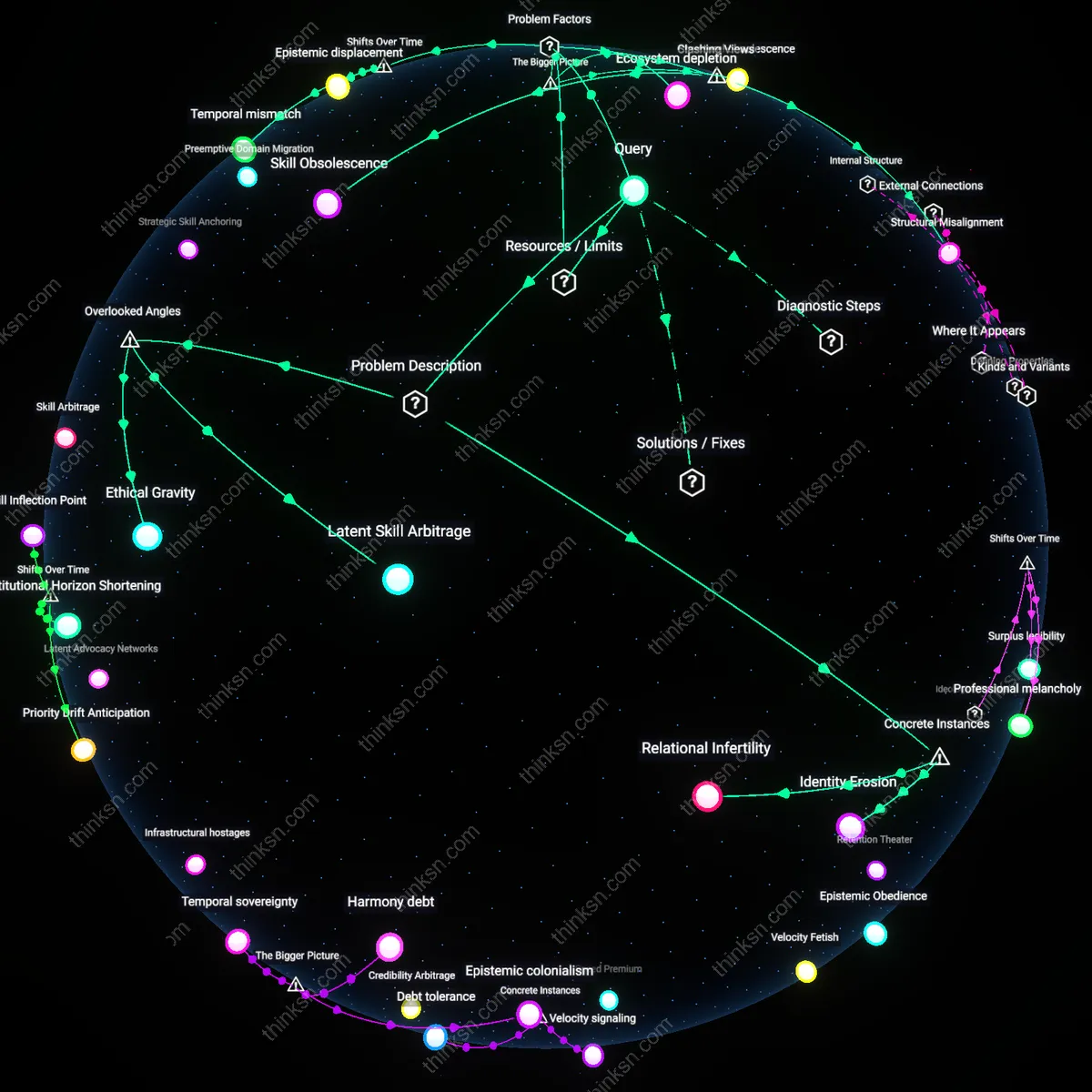
Latent Skill Arbitrage
A career change becomes necessary when an individual’s accumulating expertise enables silent exit from organizational dependency, not because of burnout but through the quiet accumulation of transferable leverage. Standard models emphasize emotional cues like boredom or stress, but miss how professionals begin to mentally reclassify routine work as ‘subsidized training’ once they recognize that their skill set, when reassembled in another context, would yield disproportionate returns; this shift—from seeing job tasks as ends to viewing them as covert skill extraction—transforms disinterest into strategic detachment, where underperformance is not apathy but reallocation of cognitive surplus toward unseen opportunities. The non-obvious dynamic is that disengagement can be a symptom of successful competence development, not its failure, rendering motivational interventions misdirected when the worker has already crossed an invisible threshold of market arbitrage potential.
Ethical Gravity
A fundamental career shift is indicated when small moral compromises in daily work accumulate into a perceptible shift in self-conception, altering identity more than effort. Typical frameworks focus on workload or recognition deficits, yet neglect how professionals absorb incremental ethical distortions—such as misrepresenting product capabilities to clients or optimizing for engagement over safety—as gravitational forces that slowly pull them away from a previously held self-image as ethically coherent actors; once this ethical drift reaches a threshold where continued participation feels like self-betrayal, the loss of interest is not fatigue but disidentification, rendering motivational fixes ineffective because the wound is ontological, not transactional. This overlooked dependency on moral continuity reveals that people endure hardship for meaning, but exit silently when work undermines the narrative of who they take themselves to be.
Identity Erosion
A loss of interest in one’s job signals a need for career change when continued performance contradicts one’s core identity, as seen when Dr. Mona Hanna-Attisha, a pediatrician in Flint, Michigan, shifted from clinical routine to public health advocacy after uncovering the Flint water crisis; her medical training initially demanded patient-level care, but systemic betrayal of community health made individual treatment feel complicit in injustice, revealing that professional actions conflicting with moral identity cannot be resolved by motivation alone. The mechanism here is identity dissonance—when daily work undermines a person’s fundamental sense of self, especially in roles involving ethical stewardship, the gap is not temporary demotivation but an existential misalignment, a condition often masked as burnout but actually rooted in irreconcilable role-person value conflict.
Structural Obsolescence
A career change becomes necessary when the entire occupational framework loses functional relevance, exemplified by Kodak’s film engineers in the early 2000s whose expertise in chemical emulsion and optical precision became inert amid digital photography’s dominance; their waning motivation stemmed not from personal disengagement but from operating within a dying technological paradigm where mastery yielded diminishing returns. The mechanism is structural obsolescence—when external technological or market shifts nullify the core value of one’s accumulated skills, no amount of renewed effort can restore impact, revealing that the problem is not individual morale but systemic devaluation of expertise.
Relational Infertility
A fundamental career shift is indicated when a worker can no longer generate meaning through professional relationships, as observed in senior teaching staff at Chicago Public Schools during the 2012–2015 period of top-down reforms that replaced collaborative curriculum development with standardized scripts and punitive evaluations; veteran educators like those in the United Neighborhood Parents network reported not fatigue, but grief over severed mentorship and peer-trust networks, rendering classrooms emotionally sterile. The mechanism is relational infertility—when institutional changes destroy the social fabric that once made work generative, the loss of interest reflects the collapse of meaning-making ecosystems, not just personal energy levels, exposing how career vitality often depends on unseen networks of mutual recognition.
Structural Misalignment
A loss of interest in one's job signals the need for a fundamental career change when the individual's cognitive rhythms no longer sync with the organization's operational tempo, such as a deep-time thinker trapped in a sprint-driven tech startup; this mismatch persists regardless of motivation or effort because it is baked into the workflow architecture of agile development cycles, stand-up meetings, and quarterly deliverables that privilege speed over depth. The real issue isn't waning passion but the collision between personal cognition and corporate pacing mechanisms—what appears as disengagement is often a rational response to a chronically incompatible thinking environment. This reframes burnout not as emotional failure but as systemic incompatibility, revealing that the problem lies not in the worker but in the temporal design of the work itself.
Skill Obsolescence
Loss of interest indicates the need for a career shift when an individual's core competencies are being actively devalued by technological substitution, such as a tax accountant displaced by AI-driven compliance tools, and retraining within the field no longer extends career viability. Conventional wisdom sees disengagement as psychological, urging resilience or attitude shifts, but here the disinterest is a rational recognition of eroded market relevance—the skill base has been hollowed out by automation, not motivation by effort. This reveals that what feels like personal stagnation may instead be professional extinction, where continued effort only deepens irrelevance.
Temporal mismatch
A loss of interest indicates the need for a fundamental career change when an individual’s developmental timeline diverges irreversibly from the career structure they inhabit, a rupture intensified by the post-2008 erosion of linear professional trajectories. Previously, careers in fields like law, academia, or engineering assumed stable progression from apprenticeship to mastery within a single domain, but the rise of gig economies and project-based work has compressed or abolished those stages. Now, experienced workers face a system designed for serial entry-level engagement, making sustained depth feel professionally obsolete. The non-obvious insight is that waning motivation stems not from disengagement but from a misalignment between psychological maturation—seeking integration and legacy—and a labor market optimized for disruption and renewal.
Epistemic displacement
A loss of interest in one's job reveals the need for a fundamental career change when the knowledge that once defined professional legitimacy is rendered peripheral by technological reconfiguration, as seen in the 2010s automation of routine expertise in fields like radiology, accounting, or legal discovery. Workers trained in analog decision frameworks find their judgment supplanted by algorithmic systems that redefine accuracy as compliance with data patterns rather than interpretive skill. The shift lies not in job loss per se but in the decentering of the professional as epistemic authority, transferring cognitive sovereignty to backend developers and data scientists. The underappreciated consequence is that demotivation arises not from overwork or underpay but from the silent obsolescence of one’s intellectual identity, a displacement that precedes formal redundancy.
Structural obsolescence
A loss of interest in one’s job signals the need for a fundamental change when the role itself has been rendered peripheral by industry-wide automation and consolidation, as seen in sectors like print journalism or manufacturing clerical work. In these cases, declining relevance isn’t due to personal disengagement but to systemic devaluation of entire job categories through capital reallocation and technological substitution, where employers under pressure to cut costs redirect investment toward scalable digital platforms. This dynamic removes opportunities for professional growth regardless of individual motivation, making continued effort a misallocation of human capital. What’s underappreciated is that personal resilience becomes structurally irrational when the job’s ecosystem no longer rewards sustained contribution.
Institutional drift
A career change becomes necessary when an individual’s core competencies fall into sustained misalignment with an organization’s shifting strategic priorities, such as when a research-driven engineer in a pharmaceutical company is increasingly steered toward compliance bureaucracy due to regulatory intensification and shareholder demands. This misalignment emerges not from personal fatigue but from macro-level institutional changes—tighter FDA oversight, private equity ownership, or risk-averse governance—that reconfigure roles around risk mitigation rather than innovation. The erosion of motivation is a symptom of a deeper incompatibility between professional identity and operational imperatives. The non-obvious insight is that demotivation can index a career’s declining strategic fit within an evolving organizational logic, not personal inadequacy.
Ecosystem depletion
When regional economic ecosystems collapse—such as in Rust Belt manufacturing towns or rural healthcare districts—loss of interest reflects not personal burnout but the absence of viable professional futures due to drying mentorship networks, vanishing advancement pipelines, and shrinking cross-sector collaboration. Workers remain capable but operate within a depleted environment where skill development yields diminishing returns because infrastructure investment, policy support, and private venture have relocated to urban innovation hubs. The disengagement signals a rational response to geographical immobility and opaque transition pathways. Crucially, this condition reveals how motivational attrition can function as an early indicator of spatial mismatch in labor-market adaptation.