Are We Fishing for Short-Term Gains at Future Oceans Expense?
Analysis reveals 6 key thematic connections.
Key Findings
Temporal Sovereignty
Future marine ecosystems should be denied legal consideration in fishing quota decisions because recognizing their rights would override the temporal sovereignty of present-state fisheries governance, a system designed around annual or decadal biological assessments and national harvest cycles. Coastal states and regional fisheries management organizations (RFMOs) operate within legislative and electoral timeframes that privilege immediate economic stability and food security over speculative ecological futures; integrating rights for ecosystems that cannot be empirically measured or politically represented reorders accountability away from voters and toward abstract biotic potential. This shift would collapse the operational logic of quota-setting, which relies on measurable, contestable, and renegotiable stock data, not ontological claims about ecosystem futures — revealing that the conflict is not scientific but jurisdictional over which temporal scale gets political enforcement.
Epistemic Exclusion
Incorporating future marine ecosystem rights into quota decisions would require privileging precautionary models over empirically observed stock trends, thereby dismantling the legitimacy of state-certified science institutions like ICES or NOAA Fisheries that anchor current assessments in retroactive data. These institutions confer authority through reproducible, peer-reviewed metrics that dismiss future-scenario modeling as non-binding, ensuring that fishing limits remain negotiable within known variance bands rather than locked by irreversible ecological thresholds. When rights are extended to non-present systems, the criterion for validity shifts from observational consensus to predictive ethics — a rupture that exposes how scientific neutrality functions not as objectivity but as a mechanism of exclusion, silencing futures that don’t yet generate data streams.
Resource Constitutionalism
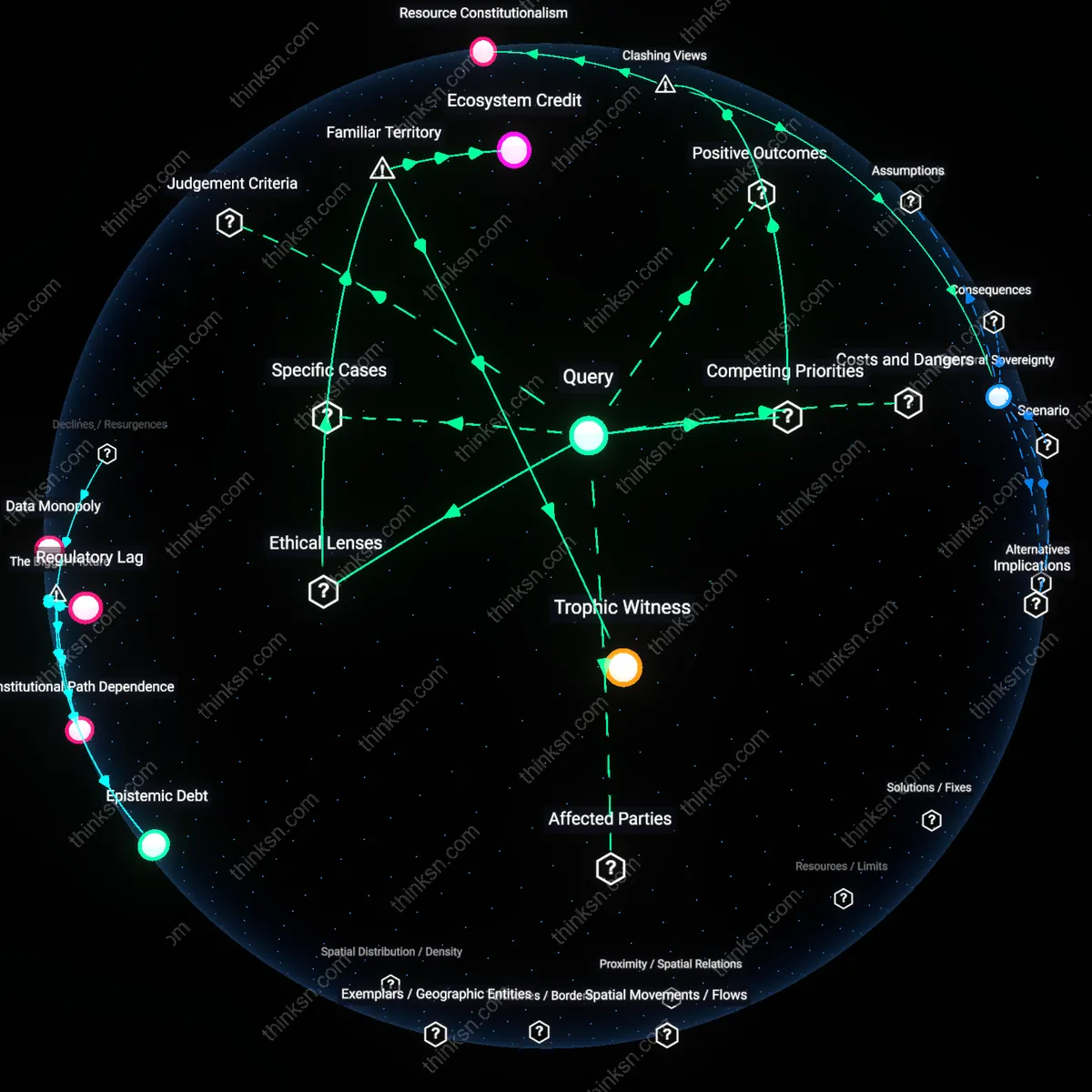
Fishing quota systems must actively exclude future ecosystem rights to preserve resource constitutionalism — the principle that access to natural assets is governed by codified, human-centric legal agreements subject to renegotiation and reciprocity. International treaties like the UN Fish Stocks Agreement or the Common Fisheries Policy are structured on mutual obligation among existing sovereigns, not intergenerational or interspecies equity, making the inclusion of future ecosystems an illegitimate claimant class within negotiated apportionment. This constitutional order treats ecosystems as managed stock, not right-bearing entities, and admitting otherwise would dissolve the legal coherence of quotas by injecting non-negotiable, non-revocable claims into a system built on compromise — underscoring that the real conflict is not ecological but jurisdictional, over who or what counts as a legitimate party to resource law.
Precautionary Entitlement
Fishing quotas must be reduced below levels suggested by short-term stock assessments to preserve ecosystem resilience for future generations. This approach follows from intergenerational equity in environmental ethics, particularly as codified in the Rio Declaration and the United Nations Fish Stocks Agreement, which bind states to avoid irreversible harm despite scientific uncertainty. The mechanism operates through international fisheries management bodies like regional fisheries management organizations (RFMOs), where binding quotas are negotiated under legal frameworks that recognize future ecological rights. What is underappreciated is that even data-driven, scientifically reviewed assessments legitimize overharvesting by normalizing recent baselines, thus eroding expected future ecosystem states under a guise of objectivity.
Ecosystem Credit
Fishing quotas should be allocated based on a system of ecosystem credits that account for long-term marine health as a form of natural capital. Rooted in utilitarian cost-benefit analysis and neoliberal environmental economics, this model treats future ecosystem services—such as carbon sequestration, biodiversity, and fish recruitment—as quantifiable assets that can be traded or reserved. Implemented via market-like mechanisms in national or regional systems such as the EU’s Common Fisheries Policy, credits would constrain current harvests by assigning measurable value to future ecological productivity. The non-obvious insight is that framing ecosystem rights in financial terms makes them legible to policy institutions, transforming abstract intergenerational duties into budgetable, auditable accounts.
Trophic Witness
Future marine ecosystems should be represented in quota decisions through formal guardianship roles modeled on legal personhood doctrines, such as those applied to rivers in New Zealand or the Amazon rainforest in Ecuador. Drawing from environmental jurisprudence and deep ecology, this approach appoints independent trustees—scientists, Indigenous stewards, or nongovernmental advocates—to act as legal proxies for marine food webs, ensuring that stock assessments do not override broader ecological coherence. Situated in national courts or transnational environmental tribunals, these actors can challenge quotas that violate systemic integrity. The overlooked implication is that personhood is not limited to cultural or spiritual entities but can extend to future biospheric functions through procedural standing, making ecosystems silent co-participants in governance.