Are Traditional Degrees Failing Adults as Micro-Credentials Surge?
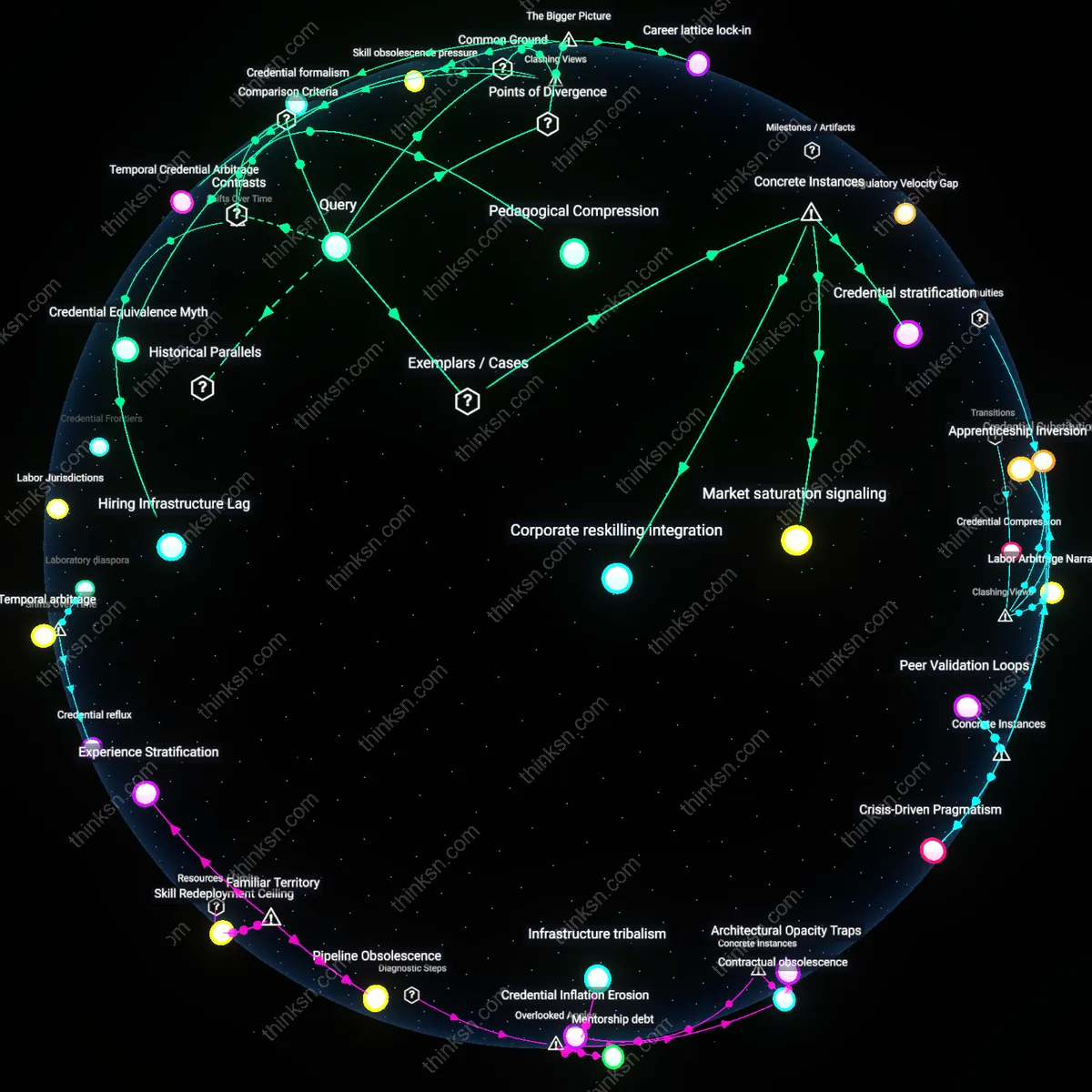
Analysis reveals 6 key thematic connections.
Key Findings
Credential Fragmentation
Rising micro-credential programs reveal that employer-driven skill atomization, not learner demand, is eroding the coherence of traditional degrees. Corporations and platform providers—such as Google and Coursera—actively decompose job requirements into discrete competencies, which are then repackaged as stackable badges; this bypasses the integrative curricula of universities and rewards granular, just-in-time training over deep disciplinary mastery. The mechanism is a shift in credentialing authority from accredited institutions to labor market intermediaries who prioritize signal efficiency over educational depth. This challenges the intuitive view that micro-credentials respond to individual upskilling needs, exposing instead how labor commodification fragments learning into disposable units.
Credential Inflation Pressure
Rising micro-credential programs reveal that employers increasingly distrust the labor market signaling of traditional degrees. This shift manifests in hiring practices at tech firms and mid-tier service industries, where stackable badges from platforms like Coursera or Udacity are now used to validate specific competencies—such as Python scripting or Agile workflow management—that four-year degrees no longer reliably indicate. The mechanism is a breakdown in employer-university information symmetry, where degree completion no longer correlates tightly with job-ready skills, prompting firms to demand finer-grained, verifiable proof of capability. What’s underappreciated is that this isn’t just about skills gaps—it’s a quiet erosion of the degree’s symbolic monopoly on workforce readiness, which accelerates demands for alternative validation systems in hiring pipelines.
Time-Value Misalignment
Micro-credentials are gaining traction because traditional degree programs fail to accommodate the time sovereignty of working adults, particularly in urban labor markets like Atlanta or Seattle where gig and contract work dominate. The fixed duration and rigid scheduling of semester-based education lock out those who cannot afford to pause income generation for two or four years, pushing them toward on-demand, self-paced modules offered by bootcamps or professional associations. This reflects a structural mismatch between the industrial-era education calendar and the just-in-time learning needs of a contingent workforce. The overlooked insight is that the core complaint isn’t cost alone—it’s the temporal inflexibility of degrees, which treats learning as a discrete life stage rather than an ongoing operational requirement.
Policy Modularization Pull
The proliferation of micro-credentials exerts upward pressure on federal and state education agencies to restructure funding and accreditation around portable, component-based learning units—seen in pilot programs like the U.S. Department of Education’s Experimental Sites initiative that allows Pell Grants to be used for short-form training. This shift enables public policy to move from supporting whole programs to subsidizing learning atoms—individual courses or skill blocks—that can be mixed across institutions. The consequence is a quiet redefinition of what counts as ‘eligible education,’ which, while framed as expanding access, subtly incentivizes the decomposition of curricula into market-responsive pieces. What’s rarely acknowledged is that this modular logic, borrowed from software and supply chain management, risks privileging recombinant skill assembly over holistic intellectual development in public learning strategy.
Credential Fragmentation Pressure
Rising micro-credential programs reflect employer demand for task-specific competencies that traditional degrees fail to deliver in timely or targeted ways, exposing a misalignment between academic curricula and labor market evolution. As tech sectors and agile industries prioritize demonstrable skills over generalized knowledge, hiring entities increasingly bypass degree requirements in favor of stackable certifications, accelerating a feedback loop where educational institutions respond by fragmenting credentialing. This shift is amplified by platform economies and credentialing infrastructures like digital badges and blockchain-based verification, which lower barriers to recognition and portability, thereby institutionalizing modular learning. The non-obvious consequence is not just diversification of learning pathways but systemic pressure to decompose knowledge into discrete, market-responsive units—transforming credentials themselves into fluid, recombinant assets rather than fixed milestones.
Policy Temporal Mismatch
Micro-credential growth reveals a temporal misalignment between lifelong learning policy frameworks—typically tied to academic calendars, funding cycles, and national qualification levels—and the continuous, just-in-time learning needs of a shifting workforce. Most national upskilling initiatives are structured around discrete retraining events (e.g., unemployment-to-education transitions) rather than sustained, incremental skill acquisition, leaving individuals without financial or institutional support for modular, intermittent learning. This gap is exploited by private providers who operate outside public funding streams but offer flexible payment models and employer-aligned content. The underappreciated systemic effect is that policy inertia turns access to lifelong learning into a path-dependent advantage for those already embedded in employer-sponsored ecosystems, exacerbating stratification unless governance models adapt to recognize and subsidize microlearning as legitimate public good infrastructure.