Does Online Presence Bias Undermine Remote Work Flexibility?
Analysis reveals 5 key thematic connections.
Key Findings
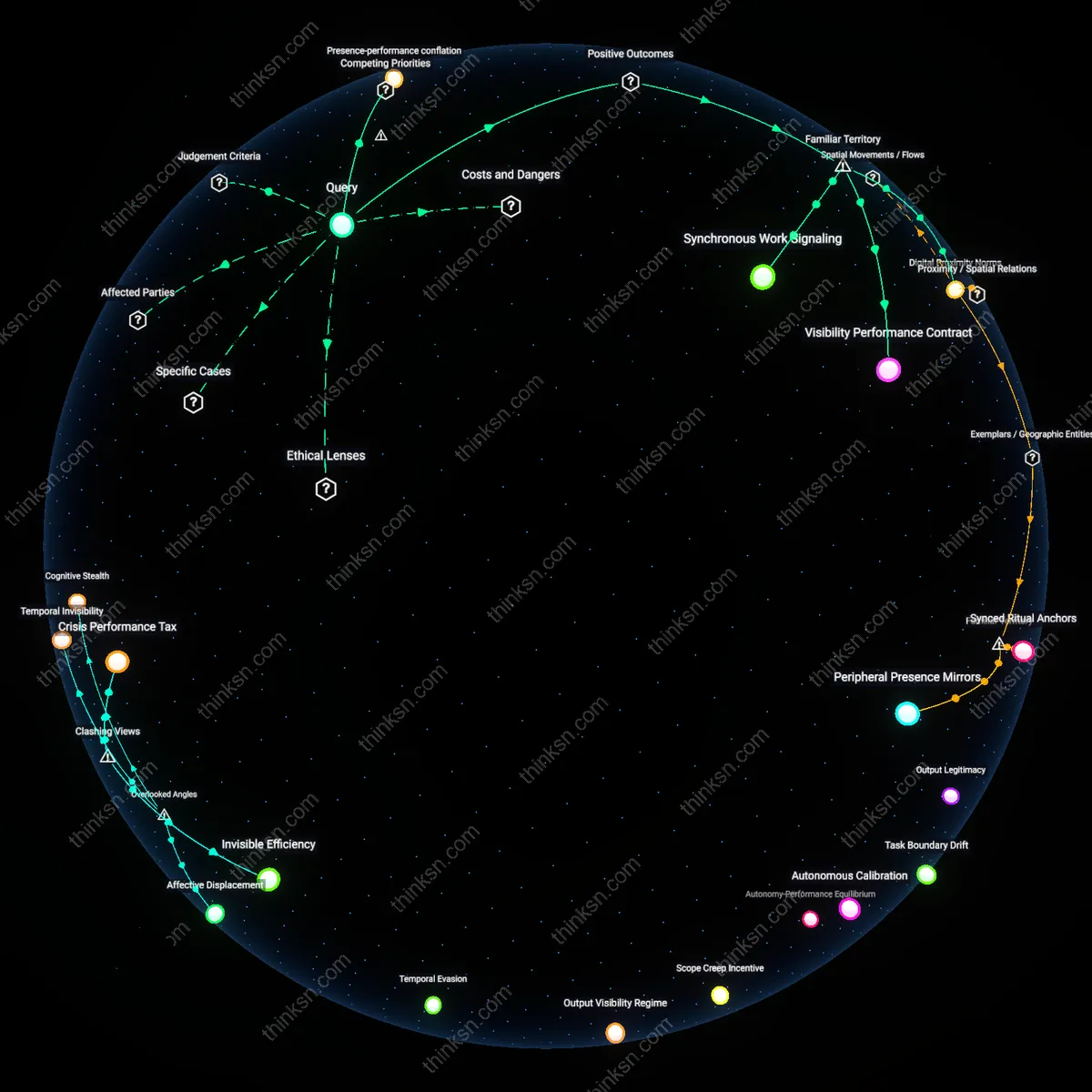
Visibility Performance Contract
Measuring remote employees by online presence reinforces a shared understanding between employers and workers that availability equates to accountability, particularly in industries like tech support or customer service where real-time responsiveness is mission-critical. This contract operates through persistent digital traces—such as active status on Slack or Microsoft Teams—which managers interpret as proxies for diligence, especially when output metrics are hard to quantify. The non-obvious aspect is that this perceived transparency reduces anxiety around oversight in distributed teams, even when actual productivity varies, thus stabilizing trust in remote arrangements without formal time-tracking.
Synchronous Work Signaling
Online presence metrics serve as a common signal of commitment in knowledge-based companies where collaboration rhythms depend on predictable availability, such as marketing agencies or software development teams using agile sprints. By maintaining visible participation during core hours, employees demonstrate alignment with team tempo, and managers use these cues to coordinate tasks without micromanaging. The overlooked dynamic is that this signaling reduces cognitive load in scheduling and decision-making, functioning as a low-friction coordination tool that preserves some flexibility while ensuring alignment.
Digital Proximity Norms
Frequent online presence fosters a sense of closeness in remote environments, mimicking the incidental interactions of office life, which organizations like distributed nonprofits or hybrid consultancies rely on to sustain culture and informal learning. These norms emerge through repeated exposure on video calls or messaging platforms, where being 'seen' builds social cohesion even in the absence of physical proximity. What’s underappreciated is that this perceived closeness increases psychological safety and inclusion, helping retain engagement across time zones when formal flexibility might otherwise erode team bonds.
Presence-performance conflation
Measuring remote employees by online presence institutionalizes a historical shift from industrial-era visibility norms to digital-era surveillance metrics, where logged activity substitutes for output. In pre-pandemic corporate environments, performance was assessed through periodic evaluations and observable workplace engagement, but the post-2020 surge in remote work prompted firms like Amazon and Salesforce to adopt tools like Microsoft Viva Insights and Workplace Analytics, which equate active keystrokes or login duration with productivity. The non-obvious consequence of this shift is that it re-embeds factory-floor time discipline into knowledge work through algorithmic oversight, privileging signal over substance and disadvantaging neurodivergent or asynchronous workers who deliver value outside monitored channels.
Asynchronous penalty
The adoption of online presence metrics to evaluate remote staff reflects a rupture in the evolution of workplace temporality, privileging synchronicity in a context originally designed to transcend it. Before 2015, remote work was often associated with global teams leveraging time zone differences for continuous progress, as seen in open-source development or distributed tech startups like GitLab; however, post-pandemic hybrid models in legacy institutions—from university administrations to federal agencies—have recalibrated expectations around immediate responsiveness, using tools like Hubstaff or Time Doctor to flag offline periods as performance gaps. The overlooked effect is the systematic devaluation of deep, unscheduled work and the penalization of employees in Global South time zones or with caregiving responsibilities, converting temporal diversity into a liability under the guise of accountability.