Do Regulatory Fees Undermine Public Interest?
Analysis reveals 4 key thematic connections.
Key Findings
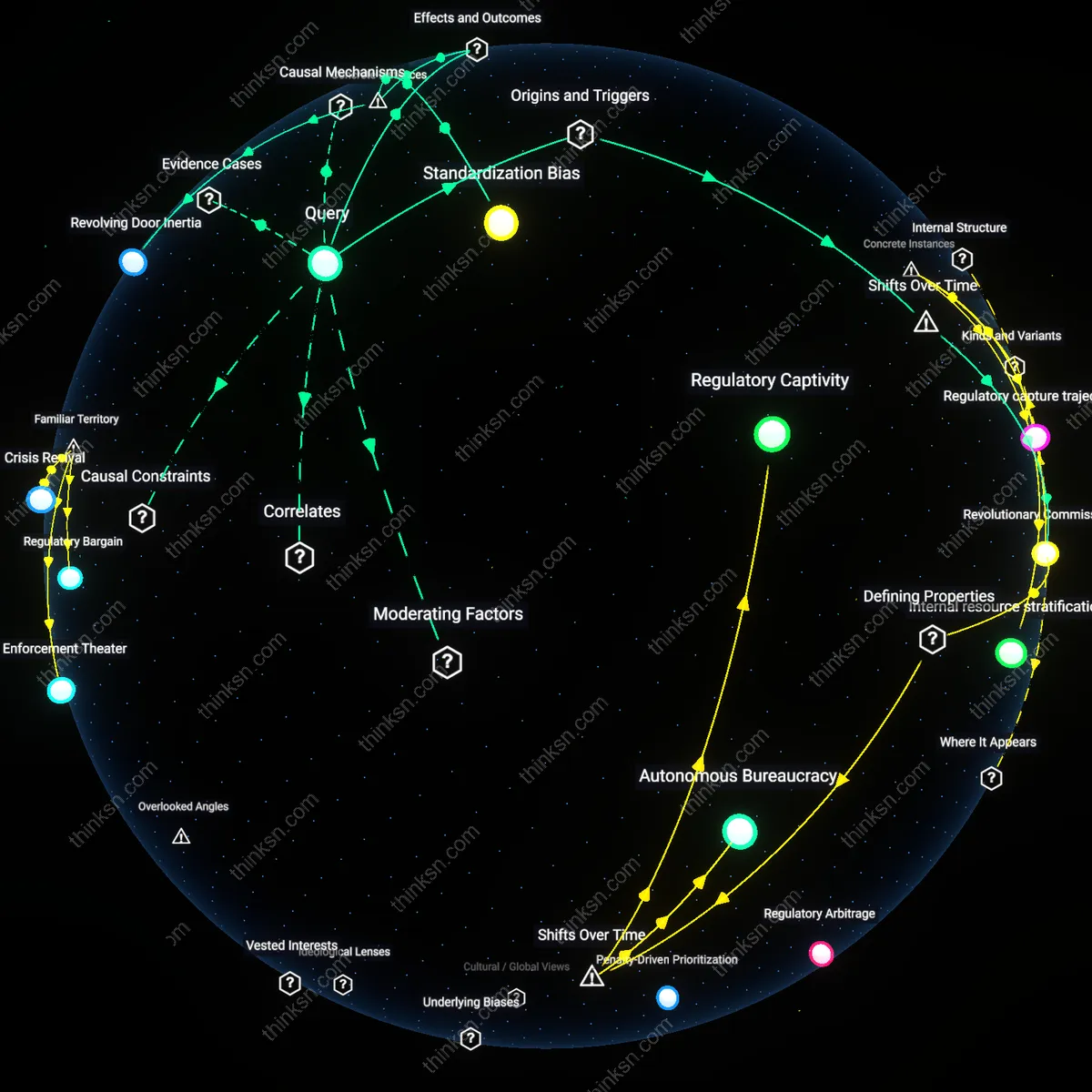
Revolutionary Commissions
In the 1930s, New Deal-era agencies like the SEC were initially insulated from fee dependence, deriving authority from broad statutory mandates and congressional funding; their purpose was investigative and quasi-judicial. But the deregulatory turn of the 1980s reframed agency success not as enforcement but as stable market function, leading to the adoption of user fees as a ‘neutral’ financing mechanism. This shift transformed commissions from adversarial monitors into service providers, where maintaining industry cooperation became essential to budgetary survival. The non-obvious legacy is that public-interest objectives are not undermined by sudden capture but by the quiet replacement of adversarial neutrality with institutional reciprocity.
Regulatory Paralysis
The U.S. Food and Drug Administration’s dependence on pharmaceutical user fees under the Prescription Drug User Fee Act (PDUFA) creates pressure to expedite drug approvals, directly compromising its capacity to enforce stringent safety reviews. Since PDUFA ties a significant portion of the FDA’s drug review budget to fees paid by drug manufacturers, reviewers face institutional incentives to maintain high approval rates and avoid actions that might deter future applications—and thus fee revenue—leading to weakened post-market surveillance and risk-management enforcement. This dynamic was evident in the accelerated approvals of Alzheimer’s drugs like aducanumab despite marginal efficacy and serious safety concerns, revealing how funding dependence can induce paralysis in regulatory caution, even in the face of scientific dissent. The non-obvious consequence is not mere bias, but an institutional erosion of discretionary authority to say no.
Standardization Bias
The European Aviation Safety Agency (EASA) relies heavily on industry-funded technical experts for certification processes, which systematically privileges manufacturer-defined testing protocols in aircraft safety evaluations. In the case of the Boeing 737 MAX certifications, EASA delegated significant assessment responsibilities to Boeing-designated engineers, using methodologies and simulation criteria provided by the company itself, thereby normalizing a feedback loop where safety standards reflect industry convenience rather than independent risk modeling. This produced a standardization bias—where regulatory criteria evolve to mirror internal corporate procedures—obscuring systemic risks like MCAS override vulnerabilities that were inadequately tested under real-world flight conditions. The underappreciated effect is not corruption, but the quiet colonization of technical standards by proprietary frameworks.
Revolving Door Inertia
In the U.S. Federal Communications Commission’s spectrum allocation decisions, the consistent hiring of telecom industry lawyers and executives into senior policy roles has normalized regulatory outcomes that favor incumbent providers over public broadband access. This was demonstrated in the 2017 repeal of net neutrality rules, where key architects of the decision—including FCC Chairman Ajit Pai—had prior affiliations with firms like Verizon, and afterward returned to industry-funded think tanks, cementing a feedback loop where regulation is shaped by anticipated post-service employment. Because technical expertise is concentrated in the private sector and regulatory careers are often short-term, the FCC’s policymaking reflects a structural inertia toward deregulatory frameworks, regardless of public interest mandates. The overlooked mechanism is not individual misconduct, but institutional dependency on a talent pool whose experience is exclusively industry-constructed.