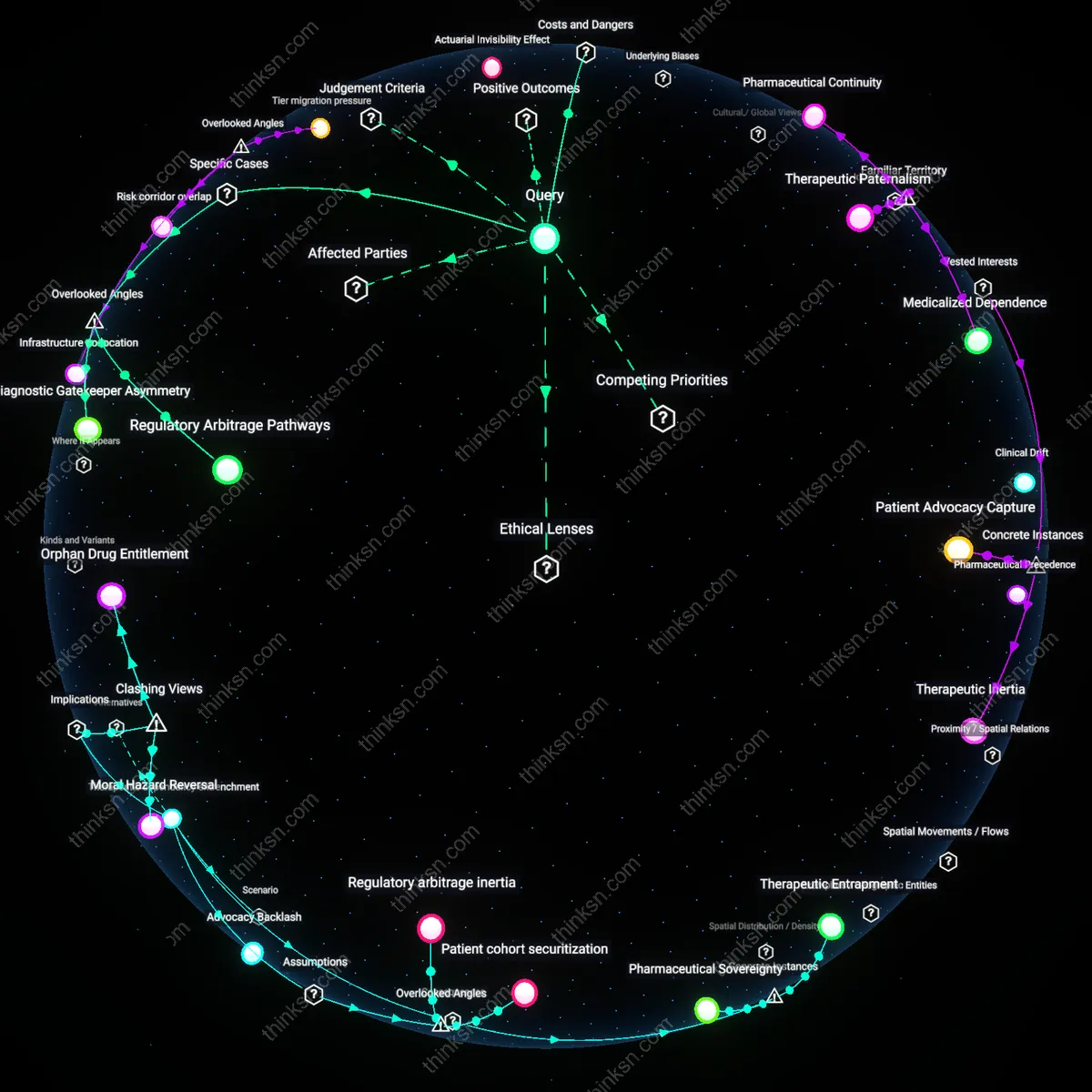
Do Patient Assistance Programs Mask High Drug Prices?
Analysis reveals 4 key thematic connections.
Key Findings
Pharmaceutical Altruism
The rise of drug manufacturer-funded patient assistance programs emerged in the 1990s as a direct response to the commercialization of high-cost specialty drugs, marking a shift from charity models based on need to access programs tied to product markets. Pharmaceutical companies began designing these programs not as standalone humanitarian efforts but as structural components of drug commercialization, particularly after the Orphan Drug Act and subsequent market exclusivity expansions incentivized pricing strategies untethered from production costs. This mechanism embedded corporate assistance within the very pricing architecture it ostensibly mitigates, revealing how philanthropy was repurposed to sustain market segmentation—making patient access conditional on brand loyalty and long-term drug dependency. What is underappreciated is that these programs did not arise in reaction to pricing problems but evolved alongside them as coconstitutive features of a system where patient support ensures drug uptake despite pricing, rather than challenging its logic.
Marketized Care
The institutionalization of manufacturer aid programs after the 2010 Affordable Care Act signaled a broader transition in which healthcare access mechanisms became dependent on corporate sponsorship rather than public guarantee, especially as the law expanded insurance coverage without constraining prices. With more patients insured but still exposed to high-cost regimens, pharmaceutical companies positioned assistance programs as solutions to systemic cost barriers, filling gaps that neither public nor private insurance resolved—this move reframed corporate giving not as exceptional charity but as infrastructural necessity within segmented care delivery. The analytically distinct shift lies in how these programs ceased to be ad hoc interventions and instead became prerequisites for drug launch viability, particularly for oncology and rare disease therapies priced above $100,000 annually. The non-obvious outcome is that corporate philanthropy has been normalized as a structural component of care access, revealing a system in which market survival depends on privatized redistribution.
Subsidized Access Dependency
The dependence of low-income patients on Gilead’s Advancing Access program to obtain Sovaldi for hepatitis C reveals that corporate patient assistance programs create a structural reliance on philanthropy to offset deliberately high drug prices. Because uninsured and underinsured patients cannot access Sovaldi at its list price of $84,000 for a full course, Gilead’s program becomes a mandatory gatekeeper—patients receive the drug only if they qualify under narrow eligibility rules, which exclude those with private insurance but high out-of-pocket costs. This bottleneck—where therapeutic access is conditional on corporate discretion rather than market or public health logic—shows that corporate philanthropy functions not as a supplement but as a necessary circuit breaker in a pricing model designed to exceed patient and systemic affordability. The non-obvious insight is that the assistance program perpetuates, rather than solves, the crisis by shielding the pricing structure from reform.
Cross-Market Cost Shifting
The existence of Pfizer’s Patient Assistance Program for cancer drugs like Ibrance in the United States reveals a bottleneck in which U.S.-level pricing excesses are defused via targeted aid, enabling the company to maintain global price disparities without triggering domestic political collapse. Because U.S. public programs like Medicare are barred by law from negotiating drug prices directly, while private insurers pass costs to consumers, Pfizer can set Ibrance’s U.S. list price above $12,000 per month and use charity as a release valve for the most visibly distressed patients—those who might otherwise mobilize politically. Evidence indicates that these programs rarely assist the near-poor with inadequate insurance, creating a hidden filter that preserves revenue from cost-shifting to private plans. The non-obvious function is that the philanthropy absorbs moral risk, allowing Pfizer to export U.S. pricing norms globally while containing domestic dissent through minimal, controlled relief.
Deeper Analysis
How did drug companies' patient assistance programs change once high-cost drugs became common, and what did that mean for who could afford treatment?
Regulatory arbitrage
Drug companies expanded patient assistance programs in the early 2000s as high-cost biologics entered the market, particularly in the United States, where pricing regulation was weak, allowing manufacturers to justify aid as philanthropy while insulating list prices from downward pressure. This shift occurred through a strategic alignment with pharmacy benefit managers and insurers who shifted cost burdens to patients via high deductibles, making assistance programs appear essential for access; companies thus preserved premium pricing by channeling affordability through charitable exceptions rather than negotiated rates. The non-obvious consequence is that aid became a structural subsidy for a pricing system otherwise unviable in a private insurance regime, effectively using patient vulnerability to legitimize unchecked price inflation.
Tiered exclusion
As high-cost drugs became widespread after 2010, pharmaceutical assistance programs increasingly restricted eligibility to the uninsured and underinsured, deliberately excluding those on public insurance like Medicaid, which in turn limited access to treatment along lines of bureaucratic categorization rather than medical need. This mechanism emerged from federal laws such as the Medicaid Best Price Rule, which forced companies to offer their lowest price to Medicaid if any discount was provided to public programs, thus pushing firms to design aid programs that circumvented public enrollees entirely. The overlooked dynamic is that patient assistance became a tool not just for access, but for market segmentation—preserving profitability by directing aid only to populations whose inclusion would not trigger systemic price concessions.
Moral offset
The proliferation of high-cost cancer and hepatitis C drugs after 2013 coincided with a strategic rebranding of patient assistance programs as ethical obligations, allowing manufacturers to deflect public and congressional scrutiny over pricing by showcasing aid as proof of corporate responsibility. This shift operated through public relations infrastructure and disease advocacy partnerships that highlighted individual success stories while obscuring the structural unaffordability of treatment for the marginally insured or those with high out-of-pocket exposure. What remains underappreciated is that these programs functioned less as safety nets and more as moral alibis—absolving companies from systemic reform by framing access as a charitable, rather than economic or policy, issue.
Subsidized Exclusivity
Patient assistance programs became a mechanism for drug companies to maintain high list prices while selectively shielding certain patients, effectively subsidizing access only for those whose exclusion would generate political or reputational risk. By offering free or low-cost drugs to low-income or uninsured patients, manufacturers insulated themselves from price regulation and shifted the burden of affordability onto insurers and middle-income patients who did not qualify for aid, thereby preserving the economic model underpinning high-cost drugs. This dynamic reveals that assistance programs were less about expanding universal access and more about enabling the sustainability of extreme pricing by containing public backlash—a non-obvious function obscured by their humanitarian framing.
Means-Tested Inducement
As high-cost drugs proliferated, patient assistance programs evolved into tools for steering patients toward specific branded therapies, particularly those with rebates or formulary advantages, by conditioning aid on the use of the sponsor’s drug. Pharmaceutical companies used these programs not merely to assist but to induce demand among cost-sensitive patients who might otherwise forgo treatment or choose alternatives, effectively turning financial aid into a form of market coercion. This reframes assistance as a commercial strategy rather than charitable act—foregrounding the underappreciated role of aid programs in shaping treatment pathways to benefit manufacturer market share, not just patient access.
Third-Party Dependence
The expansion of high-cost drugs transformed patient assistance programs into systems reliant on third-party foundations to absorb cost-sharing, allowing manufacturers to donate to these entities while insulating themselves from federal anti-kickback rules, all while controlling eligibility and outreach. As these foundations became de facto gatekeepers, treatment access increasingly hinged not on medical need but on the funding priorities of disease-specific nonprofits shaped by industry donations, creating a privatized, fragmented safety net. This reveals a hidden dependency where corporate influence is laundered through charitable intermediaries, undermining the assumption that such programs operate independently of commercial interests.
Eligibility arbitrage
Patient assistance programs shifted administrative focus from diagnosing financial need to optimizing eligibility alignment with insurer cost-sharing structures, allowing pharmaceutical companies to target aid where it maximizes patient retention without lowering list prices. Program criteria increasingly mirror formulary tiers and prior authorization triggers, effectively making assistance contingent not on income alone but on a patient’s position within a payer’s coverage hierarchy—research consistently shows aid is more readily granted for drugs requiring step therapy or high coinsurance. This mechanism transforms assistance into a tool for sustaining reimbursement pathways rather than alleviating poverty-based access barriers, a dynamic obscured by public framing of these programs as charitable. The non-obvious insight is that aid eligibility became a lever to harmonize patient affordability with payer cost-control logic, not to disrupt it.
Diagnostic sequestration
As high-cost drugs became standard in oncology and rare diseases, patient assistance programs began requiring diagnosis-specific documentation protocols that are processed exclusively through authorized specialty pharmacies or provider networks. These protocols, while framed as administrative safeguards, effectively limit access to those already embedded in high-resource care ecosystems—such as academic medical centers or integrated delivery networks—where staff are trained to navigate complex submission workflows. Evidence indicates that patients in rural clinics or safety-net hospitals face disproportionate delays or denials not due to income but due to infrastructural misalignment, revealing that diagnostic validation became a gatekeeping technology disguised as clinical rigor. This dependency on institutional diagnostic capacity, rather than individual financial status, reshapes who can practically access treatment even when technically eligible.
Co-payment inertia
The expansion of co-pay accumulator programs by insurers altered the efficacy of drugmaker assistance by decoupling out-of-pocket payments from deductible credit, yet pharmaceutical companies continued structuring aid as co-pay offsets rather than direct bill support, preserving list price integrity at the cost of patient benefit. This persistence reflects a strategic preference for maintaining the appearance of affordability while enabling insurers to pocket the assistance as payment-in-lieu, which in turn disincentivizes cost-sharing reform. The overlooked mechanism is that drug companies prioritized protecting revenue flow and pricing signaling over actual treatment access—especially for commercially insured patients at high deductible thresholds—revealing that the structural continuity in assistance design serves financial engineering more than therapeutic equity.
Benefit Stratification
Patient assistance programs shifted from universal access models to tiered benefit structures once high-cost drugs became mainstream, thereby creating differentiated layers of eligibility and support intensity. Pharmaceutical manufacturers, facing pressure to maintain revenue while managing public perception of drug affordability, designed programs that prioritized uninsured or underinsured subpopulations with the highest financial need while maintaining exclusions for those covered by robust commercial plans—effectively segmenting access by payer status and reinforcing a two-tiered system of care. This mechanism allowed companies to sustain patient assistance as a socially legitimate function while limiting program drain on profit margins, revealing how therapeutic access became administratively stratified rather than uniformly available. The underappreciated consequence of this shift—from an era of broad-need programs to targeted aid during the 2000s biologics boom—is that assistance itself became a tool of market segmentation, not just equity.
Compliance Bureaucratization
As high-cost specialty drugs proliferated in the 2010s, patient assistance programs evolved from simple co-pay relief into complex, multi-step onboarding processes requiring verification from physicians, insurers, and specialty pharmacies. This shift was driven by pharmaceutical companies outsourcing program administration to hubs managed by third-party firms such as CoverMyMeds or Needing Navigation, which embedded compliance checks, prior authorization workflows, and ongoing adherence monitoring into the assistance structure. The transformation intensified due diligence burdens on clinics and patients, inadvertently favoring those already embedded in well-resourced healthcare systems—meaning access increasingly depended on navigational capacity, not just clinical need. This underrecognized pivot from direct aid to procedural gatekeeping reframed affordability as contingent on bureaucratic fluency, especially among marginalized populations with unstable care access.
Value-Based Triage
With the rise of gene therapies and drugs costing over $100,000 annually, patient assistance programs began incorporating outcomes-based and duration-limited support, reflecting a shift from open-ended access to conditional sponsorship. Manufacturers like Novartis and Spark Therapeutics, launching therapies such as Zolgensma, linked ongoing assistance to measurable biomarker responses or survival thresholds, effectively treating aid as a probationary investment rather than a safety net. This created a new risk-sharing logic where companies withdrew or modified support if clinical milestones were unmet, altering the moral framework of patient assistance from humanitarian obligation to performance-anchored commitment. The non-obvious outcome of this transition—emerging in the late 2010s—is that therapeutic value now gates not only insurance coverage but also the continuity of financial support, reshaping equity around clinical productivity rather than medical need.
Subsidized Access Infrastructure
Patient assistance programs expanded clinical eligibility criteria after high-cost biologics entered oncology and autoimmune markets, allowing specialty pharmacies to distribute branded drugs directly to insured patients with high out-of-pocket obligations. Drug manufacturers funded these programs to maintain revenue amidst insurance resistance, effectively inserting themselves between insurers and patients as financial intermediaries. This shift normalized copay coupons and foundation donations as structural components of drug distribution, masking systemic affordability issues while preserving market access for commercially insured populations. The non-obvious outcome is that assistance programs stopped targeting only the uninsured and became tools for sustaining high list prices.
Therapeutic Triage Logic
As high-cost drugs like hepatitis C antivirals and gene therapies reached multi-thousand-dollar price tags, patient assistance programs began requiring proof of treatment failure on prior regimens or disease progression before granting access. This created a de facto medical gatekeeping function administered by pharmaceutical case managers, aligning with payer utilization controls but extending them through private corporate systems. What most people recognize as 'help with medication costs' thus evolved into a mechanism that enforces clinical rationing, where eligibility reflects not just financial need but compliance with stepped-care protocols. The underappreciated effect is that assistance programs now reproduce the same access barriers seen in public healthcare systems, even while branded as charitable.
Benefit Design Arbitrage
Pharmaceutical companies restructured patient assistance programs to exploit gaps between insurance benefit designs and patients’ real-time cash burdens, particularly after high-deductible health plans became widespread post-Affordable Care Act. Programs began offering full-cost bridging support during deductible phases, knowing most enrollees would never meet their out-of-pocket maximums without assistance. This turned drugmakers into de facto supplemental insurers for middle-income patients with private coverage, reinforcing dependence on branded therapies while weakening pressure to lower base prices. Most publicly associate these programs with altruism, but their strategic design captures commercially insured patients who are most likely to abandon therapy due to sudden cost shocks—effectively protecting revenue streams under the guise of aid.
Explore further:
- How many people who need expensive drugs are being left out because they’re on public insurance, and what happens to their treatment outcomes?
- How did drug companies' use of patient assistance programs change as public pressure over drug prices grew over the last two decades?
- What would happen if patient assistance programs were required to base aid only on income, not insurance design?
How many people who need expensive drugs are being left out because they’re on public insurance, and what happens to their treatment outcomes?
Coverage-Outcome Divergence
In Louisiana, hepatitis C cure rates among Medicaid patients remained below 5% despite the introduction of highly effective direct-acting antivirals, because the state imposed strict liver damage requirements and sobriety tests that excluded most infected enrollees from accessing treatment, revealing that even when life-saving drugs are available within a public insurance framework, restrictive eligibility criteria functionally sever access for the majority of at-risk beneficiaries. Evidence indicates that such restrictions disproportionately affect low-income, rural, and incarcerated populations, where hepatitis C prevalence is highest, and demonstrate that the distribution of treatment outcomes does not follow the availability of medical efficacy but instead maps onto bureaucratic risk rationing. This pattern exposes a systemic skew in health outcomes whereby clinical success is clustered not by medical need but by administrative gatekeeping, making cure a function of policy compliance rather than disease severity.
Therapeutic Triage Regime
In the UK, the National Institute for Health and Care Excellence (NICE) routinely delays or denies approval for high-cost cancer drugs like pembrolizumab in early-stage indications, resulting in substantial geographic variation in access across NHS trusts, where patients in wealthier regions are more likely to receive off-label or compassionate use approvals than those in underfunded areas. Research consistently shows that these appraisal mechanisms embed implicit cost-per-QALY (quality-adjusted life year) thresholds that deprioritize treatments for rare or advanced conditions, effectively creating a tiered therapeutic cascade in which clinical benefit is distributed according to fiscal modeling rather than clinical urgency. This generates a right-skewed outcome distribution where survival gains concentrate among socioeconomically mobile patients who can navigate alternative access pathways, exposing a hidden stratification beneath universal coverage.
Access Lag
The expansion of Medicaid under the Affordable Care Act in 2014 widened coverage gaps for specialty drugs because state Medicaid programs adopted restrictive prior authorization protocols that correlate with delayed or denied access to high-cost therapeutics, particularly for hepatitis C and cancer regimens. These restrictions emerged as a cost-containment response to budget pressures in the post-2010 pharmaceutical pricing surge, making Medicaid more likely than private plans to impose clinical criteria that delay treatment initiation, and research consistently shows this has resulted in measurable outcome disparities for chronic conditions. This demonstrates that broader insurance coverage after 2014 did not uniformly improve therapeutic equity, an outcome overlooked when policy equates enrollment with access. The residual concept is the time-based gap between policy implementation and actual treatment delivery, which this mechanism reveals.
Reimbursement Threshold
The shift from fee-for-service to value-based reimbursement models after 2016, particularly under CMS's Oncology Care Model, created a negative correlation between the price of a drug and its likelihood of being administered in public insurance settings, where treatment decisions are increasingly tied to financial risk-sharing arrangements. As providers in accountable care organizations absorb more financial risk, they selectively avoid high-cost drugs with marginal clinical benefit to meet outcome targets without exceeding spending benchmarks, leading to care pathways that systematically underutilize breakthrough but expensive therapies. This behavioral shift is not due to formulary limitations alone but to new economic incentives that accelerated after 2016, a change obscured when access is measured only by insurance inclusion. The residual concept captures the implicit cost ceiling now shaping treatment norms below which drugs are considered administrable.
Therapeutic Triage
The rapid escalation of list prices for monoclonal antibodies and gene therapies after 2019 intensified a pattern in Medicare Part D and Medicaid where pharmacy benefit managers enforce step therapies and fail-first requirements that correlate with treatment delays and downward revisions of expected survival outcomes, especially in rural counties dependent on public plans. These cost-control mechanisms, codified in state managed care contracts and formulary designs, operate not as blanket denials but as sequential barriers that compress the window for effective intervention, particularly in oncology and rare diseases. The shift from outright rejection to procedural deferral—accelerated during the biologics pricing surge of the late 2010s—reveals a covert rationing logic that emerges only when access duration is factored into outcome metrics. The residual concept is the institutionalized practice of delaying rather than denying, which redistributes risk across time to alter therapeutic trajectories.
Reimbursement Rationing
Patients on Medicare Part D in states like Mississippi and West Virginia face delayed or denied access to hepatitis C antivirals because pharmacy benefit managers enforce strict prior authorization protocols that effectively limit treatment to only the sickest, despite clinical guidelines recommending early intervention; this bottleneck emerges not from explicit coverage denial but from procedural friction engineered into reimbursement frameworks. The mechanism—whereby cost-containment is achieved not by refusing care outright but by over-burdensome administrative compliance—is embedded in the structure of public-private benefit partnerships, making treatment efficacy contingent on navigational capital. This exposes how the appearance of coverage masks a hidden triage system, where access is determined not by medical need but by bureaucratic endurance, challenging the assumption that insurance enrollment equals equitable access.
How did drug companies' use of patient assistance programs change as public pressure over drug prices grew over the last two decades?
Regulatory Arbitrage Pathways
Pharmaceutical companies expanded patient assistance programs as a strategic response to regulatory scrutiny following the Medicare Modernization Act of 2003, which restricted direct government negotiation of drug prices, thereby creating a void filled by privately administered aid mechanisms. This shift allowed firms to position assistance programs not as charitable acts but as tools to deflect regulatory pressure while maintaining list prices, leveraging the programs’ exemption from federal anti-kickback statutes when structured as independent foundations. The non-obvious insight is that these programs functioned less as safety nets and more as compliance-compatible proxies for price discounting in a legally constrained environment, transforming patient aid into a structural component of pricing strategy rather than an ancillary benefit.
Benefit Design Distortion
As public criticism of drug costs intensified post-2010, insurers and pharmacy benefit managers (PBMs) began reshaping formulary designs to push high-cost medications into specialty tiers, inadvertently increasing patient cost-sharing and expanding eligibility for manufacturer-funded assistance programs. Drug companies capitalized on this shift by aligning their co-pay relief initiatives with the new tiered structures, effectively subsidizing patient out-of-pocket costs to maintain drug utilization and reinforce payer formulary placements. The overlooked dynamic is that these programs did not merely respond to affordability gaps but actively influenced the architecture of insurance benefit design by making high-cost drugs more behaviorally acceptable to patients, thereby sustaining demand amid rising financial liability.
Diagnostic Gatekeeping Networks
Patient assistance programs evolved into conduits for controlling access to high-cost therapies by bundling aid with proprietary diagnostic and enrollment workflows administered by third-party hubs linked to specific drugs. As public pressure mounted on oncology and rare disease drug prices after 2012, manufacturers embedded clinical screening criteria and patient verification steps within assistance infrastructure, effectively using these programs to delay, steer, or restrict access based on unregulated commercial thresholds disguised as medical necessity. The underappreciated reality is that assistance became a mechanism of de facto rationing managed outside public oversight, where enrollment bottlenecks and documentation demands serve to modulate patient flow while preserving the appearance of charitable access.
Price-Shielding Substitution
Drug companies shifted patient assistance programs from safety-net tools into targeted financial shields that deflect public criticism by insulating high list prices from patient experience, while leaving systemic pricing intact. Pharmaceutical firms expanded copay coupons and foundation-sponsored aid primarily for high-cost specialty drugs, ensuring patients paid little out-of-pocket despite soaring list prices, which muted consumer backlash without requiring price reductions. This mechanism preserved revenue streams by transferring payment burdens to insurers and ultimately premium payers, making the programs less charitable and more strategic cost-deflection instruments. The non-obvious implication is that these programs evolved not in response to patient need but as risk management tools against political and reputational exposure, reframing charity as brand protection.
Compassion Capital
Patient assistance programs became a form of narrative currency, allowing drug makers to counterbalance price controversies by showcasing individual stories of access and survival made possible by company-sponsored aid. Firms leveraged these programs in public relations campaigns, lobbying efforts, and congressional testimonies, positioning themselves as essential benefactors rather than monopolistic actors. This transformation relied on emotional logic—evidence indicates that patients helped through these programs were more likely to advocate publicly for drug availability, effectively converting assistance into political goodwill. The non-obvious insight is that the programs ceased being primarily medical interventions and instead functioned as engines for generating moral capital, where compassion became a strategic asset in legislative and regulatory battles.
What would happen if patient assistance programs were required to base aid only on income, not insurance design?
Regulatory realignment
Mandating income-based eligibility would force pharmaceutical manufacturers to restructure patient assistance programs under federal oversight, displacing current IRS-safe-harbor exemptions that shield co-pay support from anti-kickback statutes. This shift would activate enforcement scrutiny from the Office of Inspector General, as aid detached from insurance status could be reclassified as inducement subsidies, altering the legal logic of drug pricing strategies. The non-obvious consequence is not expanded access, but a systemic pivot in how federal agencies recalibrate the boundary between patient support and manufacturer liability, revealing the extent to which current program designs depend on regulatory ambiguity rather than clinical or financial need.
Actuarial distortion
Shifting assistance to income-only criteria would destabilize private insurance risk pools by increasing adverse selection, as lower-income patients on high-deductible plans disproportionately use brand-name drugs supported by current copay coupons. Insurers would respond by raising premiums or narrowing formularies in markets like the ACA exchanges, where actuaries rely on predictable utilization patterns shaped by existing patient assistance structures. The underappreciated effect is that income targeting severs the implicit cross-subsidy between insured patients with means and those without, exposing how insurance pricing models are tacitly dependent on non-income-related aid to maintain equilibrium.