How Much Is Public Health Worth When Medication Costs Soar?
Analysis reveals 6 key thematic connections.
Key Findings
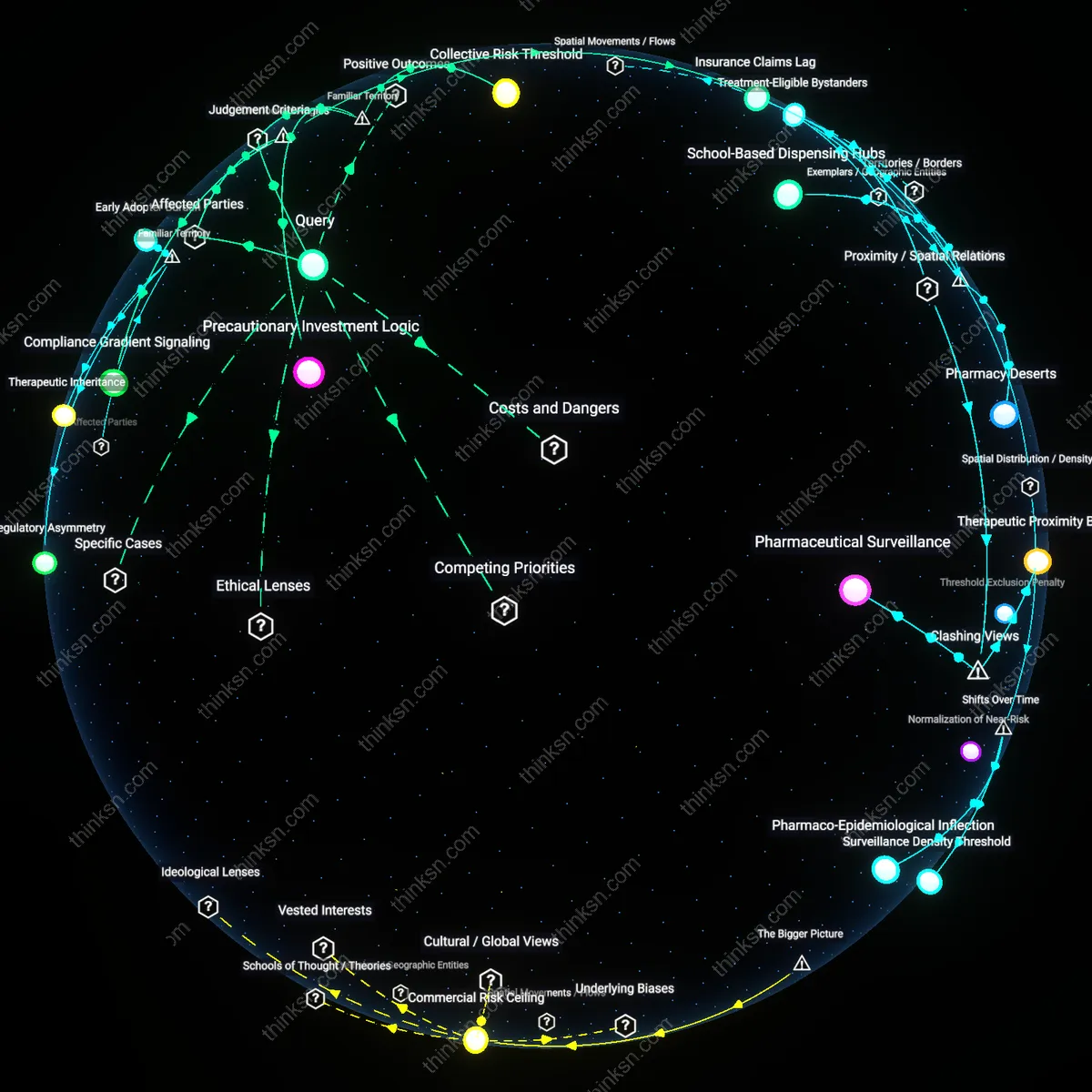
Treatment-Eligible Bystanders
Individuals should prioritize uptake of preventive medication when their compliance produces diagnostic clarity for undiagnosed populations with overlapping symptom profiles. In diseases like early-stage Alzheimer’s or latent autoimmune diabetes, widespread use of preventive regimens among confirmed at-risk groups generates population-level biomarker data that improves differential diagnosis for middle-aged patients with ambiguous clinical presentations, a benefit rarely priced into cost-effectiveness analyses; this spillover value accrues primarily to diagnostically stranded patients and overburdened primary care providers who rely on probabilistic reasoning in the absence of definitive tests, revealing a hidden feedback loop between prevention and diagnostic precision.
Pharmaco-Surveillance Asymmetry
Individuals should treat preventive medication decisions as dual-use contributions to post-authorization safety infrastructure, especially in populations excluded from clinical trials such as pregnant adolescents or patients on polypharmacy regimens. Because post-market surveillance relies disproportionately on passive reporting from majority-user groups, early adopters in demographically stable cohorts (e.g., insured white males aged 50–65) de facto shape adverse event databases that will later inform treatment guidelines for marginalized groups, making personal risk-benefit calculations co-determinants of pharmacovigilance equity—a dynamic obscured by the assumption that safety monitoring is institutionally neutral and temporally separate from individual uptake.
Compliance Gradient Signaling
Individuals in high-adherence social networks should treat preventive medication use as a reputational signal that recalibrates community risk perception, particularly in vaccine-hesitant or medically marginalized communities such as rural Appalachian populations or diasporic religious enclaves. When trusted figures initiate regimens with modest individual benefit, their sustained adherence becomes observational data that reconfigures local cost-benefit heuristics, not through persuasion but through metacognitive calibration—this creates a non-pharmacological externality where adherence patterns function as informal evidence, altering treatment thresholds for neighbors who distrust formal health institutions but monitor peer behaviors closely.
Collective Risk Threshold
Individuals should adopt the medication when public health metrics indicate community transmission rates exceed a defined epidemiological tipping point. This calculus shifts personal decision-making into a civic duty framework, where thresholds like R0 or hospital capacity activate shared responsibility; most people intuitively link prevention to 'waves' or 'outbreaks,' yet overlook how discrete risk thresholds—rather than vague notions of danger—can trigger binding ethical obligations. The non-obvious insight is that public health benefit isn't cumulative but threshold-dependent, making adherence rational only beyond specific population-level indicators.
Distributed Burden Benchmark
Individuals ought to accept modest personal costs if the aggregate burden of non-adoption disproportionately falls on structurally vulnerable populations. This judgment relies on equity-based ethics—principles of distributive justice—where familiar associations with fairness and 'protecting the weak' dominate discourse; yet the underappreciated mechanism is how individually rational avoidance compounds into systemic harm, especially when high-risk groups (e.g., immunocompromised, elderly) rely on spillover protection. The real system at work is risk layering across social strata, not just biological exposure.
Precautionary Investment Logic
People should treat preventive medication like insurance against low-probability, high-impact systemic disruptions, even with modest individual benefit. This mirrors widespread intuitions about preparing for rare disasters—pandemics, hurricanes—where familiar frameworks of preparedness and resilience justify small recurring sacrifices; the non-obvious aspect is that cost-effectiveness here operates not through individual health gains but through macro-scale stabilization of healthcare infrastructure and economic continuity. The mechanism is intertemporal risk pooling, managed via public-private coordination channels like national stockpiles or subsidized access programs.