Fear and Choice in Managing Autoimmune Disease Flare-Ups?
Analysis reveals 6 key thematic connections.
Key Findings
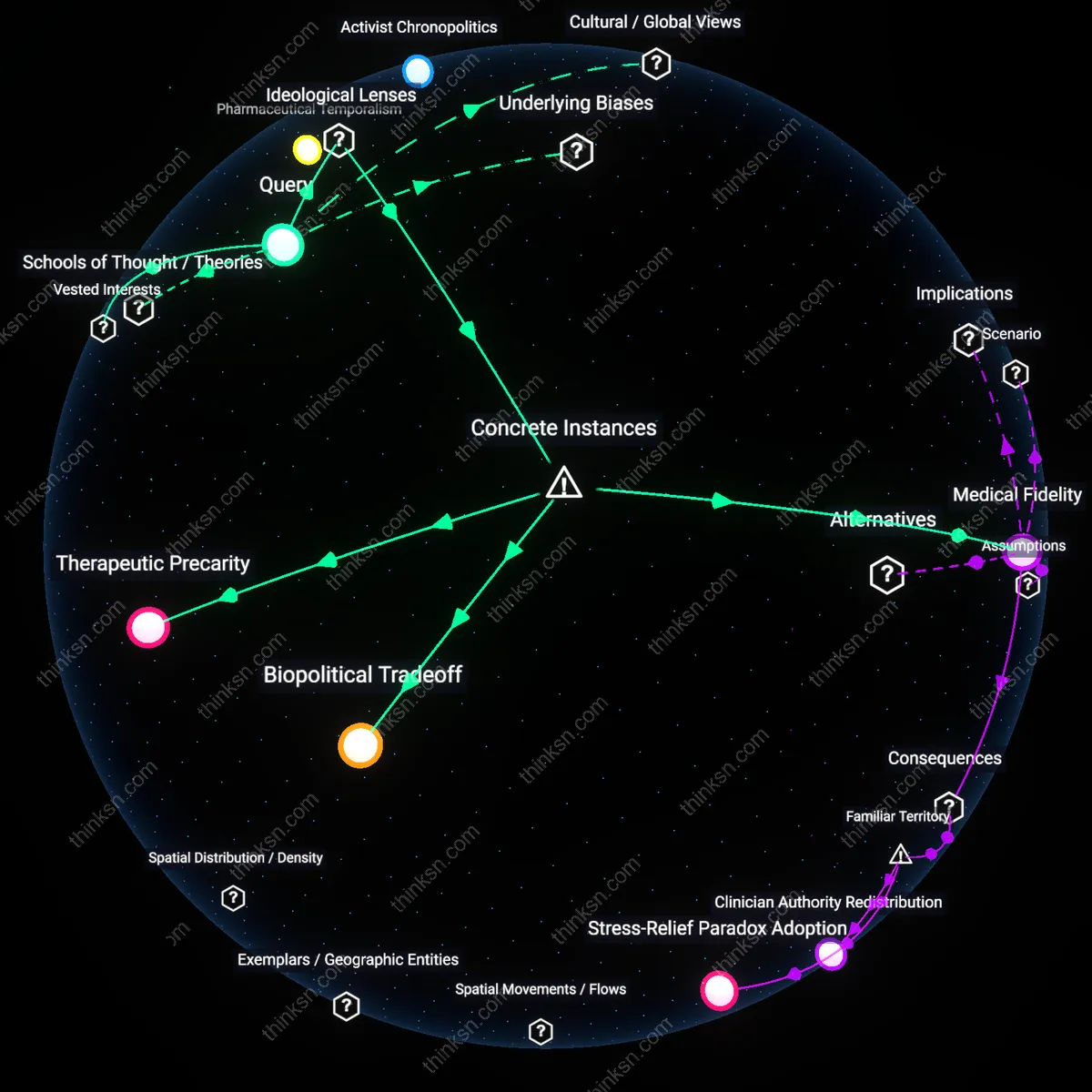
Biopolitical Tradeoff
In France during the 2010s, patients with systemic lupus erythematosus navigated state-covered but highly regimented immunosuppressive protocols that required surrendering autonomy over flare-up management to public health authorities, revealing that liberal social contract models frame disease control as a negotiated relief of individual burden in exchange for medical compliance, where psychological distress is structurally minimized through institutionalized care access but not eradicated, exposing a concealed calculus in which state-managed risk redistribution legitimizes patient vulnerability as collective cost containment.
Medical Fidelity
At the Mayo Clinic in 2018, a cohort of rheumatologists observed that patients adhering to long-term cyclophosphamide regimens for severe vasculitis internalized therapy adherence as a moral duty akin to religious devotion, illustrating how U.S. conservative ideologies recast chronic disease management as an act of personal resilience and disciplined responsibility, where enduring psychological strain from flare anticipation becomes a badge of character, thus transforming clinical loyalty into a virtue upheld by individual fortitude rather than systemic support.
Therapeutic Precarity
In post-Soviet Ukraine, where immunosuppressants became intermittently available after 2014 due to healthcare fragmentation and donor-dependent supply chains, patients with Crohn’s disease experienced chronic anxiety not as an individual psychological condition but as a structurally imposed rhythm of care disruption, exposing how Marxist analyses interpret therapeutic adherence under capitalism’s peripheral crises — where the stress of flare-ups is inseparable from geopolitical economic dependency, rendering deliberate continuation of therapy an act of resistance against material abandonment rather than personal medical choice.
Pharmaceutical Temporalism
Corporations balance psychological stress against therapy continuation by reframing flare-up anticipation as a market opportunity, which intensified after the 2010 commercialization of biologic DMARDs in autoimmune diseases. Post-2010, pharmaceutical companies shifted from symptom management to long-term patient retention by engineering treatment regimens that pathologize disease unpredictability while positioning their drugs as essential for temporal control, thereby converting anxiety into adherence. This mechanism reveals how patient psychology became a structured input in drug lifecycle planning, a non-obvious transformation from earlier models where compliance was seen as a behavioral outcome, not a designed feature.
Activist Chronopolitics
Patient advocacy groups redefined the ethics of immunosuppressive risk by organizing collective narratives around treatment time in the late 2000s, moving from isolated patient support to strategic alliance with regulators during the FDA’s 2012 guidance on patient-reported outcomes. These groups leveraged historical distrust of medical abandonment—rooted in HIV/AIDS activism’s 1980s time-based protests—to reframe flare-up anticipation not as an individual burden but as a temporally structured injustice that demands sustained therapy access. This shift made visible how patient movements treat therapeutic duration not just as medical necessity but as a political claim over biological time, revealing a hidden timeline dependency in care legitimacy.
State Care Rationing
National health systems manage psychological burden by deferring therapy decisions to post-crisis thresholds, a practice institutionalized in European public programs after the 2008 austerity turn reshaped chronic disease funding. Following fiscal constraints, governments shifted from preemptive immunosuppression to reactive care models, effectively outsourcing stress management to patients while maintaining cost-contained access, which made anticipatory anxiety a silent proxy for budgetary limits. This transition exposed how state responsibility for mental tolls of chronic illness diminishes precisely when treatment intensity is most needed, revealing a residual logic where physiological control is traded for fiscal temporality.