Who Pays When Public Plans Fail? Political Risks Revealed
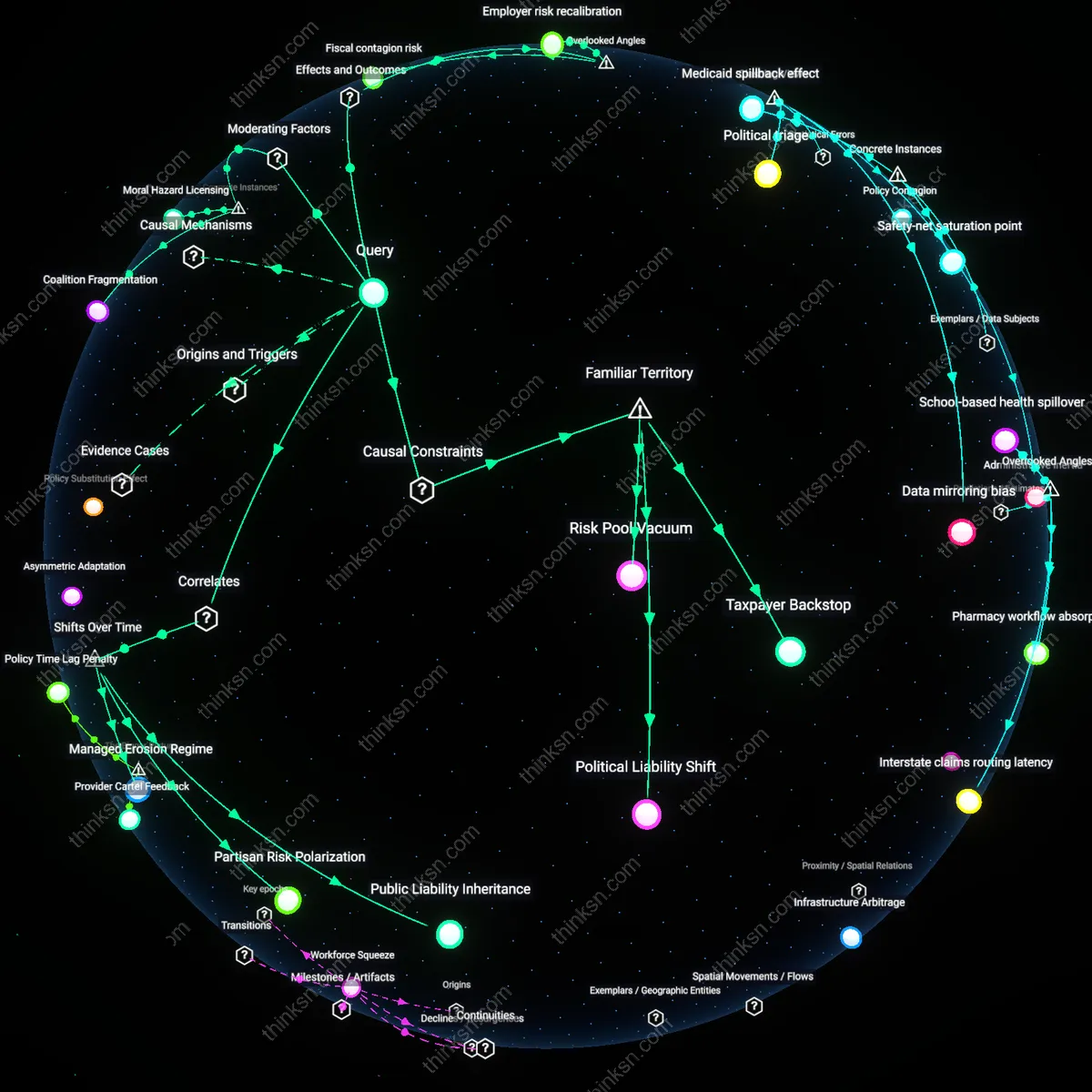
Analysis reveals 12 key thematic connections.
Key Findings
Fiscal contagion risk
When a public-option health plan lacks private participation, the federal Treasury ultimately bears the residual financial risk due to backstop obligations embedded in legislative design, particularly through implicit deficit financing permissions that activate when enrollee revenue falls short of actuarial projections. This risk is operationally managed by the Office of Management and Budget, which reclassifies shortfalls as contingent liabilities, delaying recognition but increasing long-term fiscal exposure—especially in swing states with volatile enrollment. The non-obvious aspect is that financial risk does not merely shift to the government but becomes a stealth driver of inter-agency budgetary conflict, altering political support as Treasury and HHS negotiate blame over unmet solvency triggers, thereby weakening inter-administration cohesion rather than provoking immediate partisan backlash.
Medicaid infrastructure strain
State Medicaid directors inherit unplanned administrative burden when public-option plans fail to attract private insurers, as their existing eligibility and claims processing systems are repurposed to absorb unmet demand under federal waiver provisions. This creates a secondary bottleneck in care coordination, particularly in rural counties where IT modernization is already delayed, causing downstream delays in service delivery that are misattributed to provider shortages rather than structural overload. The overlooked dynamic is that political opposition grows not from elected officials but from mid-level technocrats in state health agencies whose capacity erosion reduces their ability to advocate for program expansion, quietly undermining bipartisan implementation support in otherwise cooperative states like Minnesota or Colorado.
Employer risk recalibration
Large self-insured employers indirectly assume financial risk when public-option plans fail, because absent competitive downward pressure on premiums, they face higher stop-loss insurance costs and increased claims volatility within their own plans due to suppressed market innovation. This occurs through reinsurance markets concentrated in hubs like Bermuda and Chicago, where underwriters adjust pricing based on aggregate risk pool fragmentation, which worsens without private-plan participation in public options. The underappreciated consequence is that employer coalitions—traditionally neutral or supportive—begin lobbying against public options not on ideological grounds but to preserve actuarial stability, shifting corporate political alignment in ways invisible to conventional voter-based political analysis.
Fiscal Backstopping
The U.S. federal government bore the financial risk when private insurers declined to participate in Affordable Care Act co-ops, leading to taxpayer-backed bailouts of plans in states like Arkansas and North Carolina. In these cases, federally guaranteed loans intended to stabilize new nonprofit insurers were not repaid due to low enrollment and actuarial miscalculation, forcing the Department of Health and Human Services to absorb hundreds of millions in losses. The mechanism—federal loan guarantees contingent on participation without sufficient risk adjustment—transformed expected private innovation into public liability, revealing how the absence of private actors activates implicit government backstopping. This non-obvious transfer of risk undermined political support among fiscal conservatives who had conditionally accepted the public option logic but not direct exposure to financial failure.
Coalition Fragmentation
In Vermont’s 2014 single-payer retreat, Governor Peter Shumlin abandoned Green Mountain Care after private hospitals and insurers withheld cooperation, leaving the state unable to control cost projections. With no private insurer participation, Vermont faced solo responsibility for catastrophic risk pooling and premium setting—tasks for which it lacked infrastructure and bonding capacity. The collapse occurred not because of public opposition but because moderate Democrats and business allies withdrew support once financial exposure shifted entirely to the state treasury. This pivot—from broad coalition backing under shared risk to abandonment under full public liability—demonstrates how political sustainability depends on risk diffusion, not just policy design, an insight obscured in debates centered on ideology rather than fiscal agency.
Moral Hazard Licensing
When Germany introduced its 2009 'Bürgerversicherung' reforms enabling public expansion into statutory insurance, private insurers strategically withdrew from high-risk markets, knowing the public fund could not refuse coverage. This selective non-participation transferred actuarially disproportionate risk to the public tier, which law required to balance books across all enrollees—leading to premium increases that galvanized middle-class defection from political support. The mechanism—private actors exploiting public obligations to offload adverse selection—reveals how competitive coexistence licenses moral hazard when regulatory symmetry is absent. The underappreciated dynamic is not mere underfunding but engineered risk dumping, where private absence functions as a form of indirect sabotage rather than market failure.
Public Liability Inheritance
The federal government assumes financial risk by design when private insurers withdraw from public-option markets, a shift crystallizing after the Affordable Care Act’s implementation revealed that public plans operate as residual claimants during market failures. As private participation fluctuated post-2010, especially in rural counties and red-state exchanges, the federal backstop absorbed coverage shortfalls through risk corridors, reinsurance adjustments, and direct subsidy expansions—mechanisms that redistributed fiscal exposure to taxpayers. This revealed a latent structure of public liability that had been obscured during earlier, more optimistic phases of health reform, where bipartisan discourse presumed hybrid public-private risk-sharing. The non-obvious implication is that withdrawal of private capital doesn't collapse the system but activates a default public absorption logic, retroactively defining the public option as a fiscal sinkhole for disengaged markets.
Partisan Risk Polarization
Political support for public-option plans eroded among Republicans after 2010 as private-sector retrenchment exposed the fiscal burden shifting toward federal responsibility, transforming the debate from insurance competition to interregional redistribution. As blue states retained more private insurer engagement and stable premiums, red states—where carriers exited en masse—saw higher federal outlays per enrollee, reinforcing perceptions among conservative legislators that the public option subsidized urban, high-utilization populations with rural tax dollars. Evidence indicates that state-level insurer participation declined most sharply in regions with ideological resistance to the ACA, which in turn fueled political backlash against future public expansions. The non-obvious insight is that risk distribution became politically toxic not because of cost alone, but because its visibility increased after the transition from policy design (pre-2010) to operational reality (post-2014), turning actuarial risk into a regional grievance.
Managed Erosion Regime
The financial risk of low private participation now falls incrementally to agencies managing hybrid funding models—like CMS and state-based exchanges—whose adaptive burden-sharing emerged only after the collapse of multi-payer experimentation in the early 2010s. Prior to that period, reformers assumed competition would stabilize premiums; after 2014, recurring insurer exits in states such as Alabama and Iowa forced administrators to develop stopgap reinsurance and direct payment schemes that masked systemic instability. These bureaucratic workarounds, though effective in preventing total market failure, created a new normal of chronic regulatory triage, where public risk absorption is neither repudiated nor formally expanded—but managed through obscurity. The non-obvious result is a drift into permanent partial failure, where political support ossifies not through repeal efforts but through the normalization of underfunded public backstops.
Taxpayer Backstop
The federal government bears the financial risk when a public-option health plan fails to attract private insurers, because it must cover deficits to maintain solvency. This occurs through mandatory appropriations or automatic funding triggers embedded in enabling legislation, particularly when risk corridors or reinsurance mechanisms collapse due to insufficient private enrollment. While most associate public options with expanded choice, the non-obvious reality is that taxpayers—via federal budget exposure—become the default insurer of last resort when private capital refuses to underwrite uncertain risk pools.
Political Liability Shift
Elected officials in moderate districts absorb the political risk when private insurers avoid a public-option plan, because they are held accountable for its fiscal instability. Since these lawmakers championed the plan as fiscally responsible and bipartisan, its dependence on public funding without private participation transforms it from a market reform into a government expansion—exactly what they promised to avoid. Although people intuitively connect political support with constituent demand, the underappreciated dynamic is that credibility losses from broken fiscal assurances erode coalition durability more than cost overruns themselves.
Risk Pool Vacuum
The public health plan itself becomes the financial risk bearer when private-sector participation is absent, as it lacks risk diversification and must raise premiums or reduce coverage to survive. Without private competitors absorbing healthier enrollees, the public option faces adverse selection, driving up per-member costs and destabilizing premiums—especially in states that did not expand Medicaid or regulate network adequacy. While most assume public plans are taxpayer-funded by design, the overlooked issue is that structural isolation from private risk-bearing entities turns the public option into a captive insurer of high-cost patients, undermining its long-term viability and appeal to centrists.