Do Wealthy Patients Exploit Insurance with Persistence?
Analysis reveals 6 key thematic connections.
Key Findings
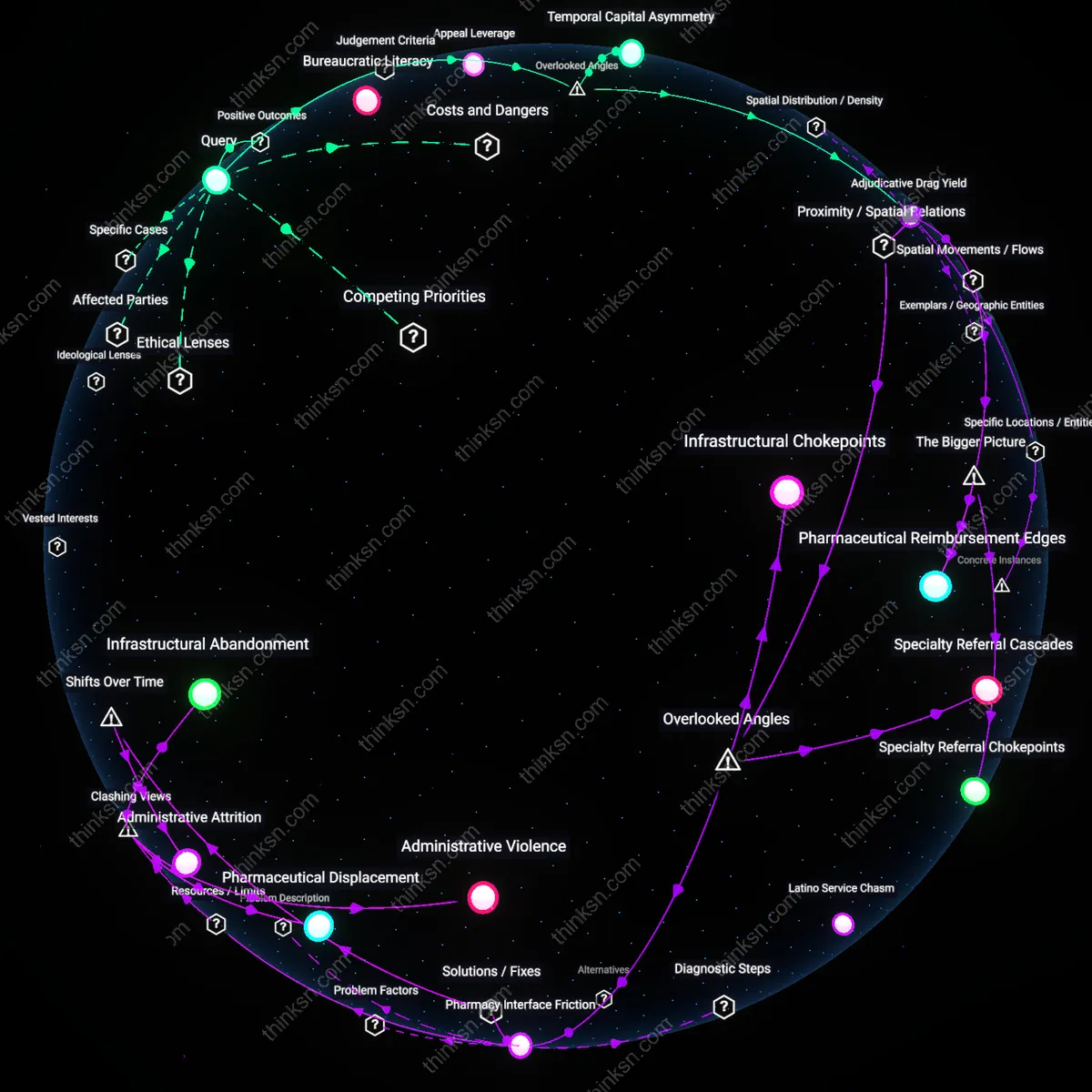
Temporal Capital Asymmetry
The ability of time-rich patients to repeatedly appeal insurance decisions entrenches systemic inequities because temporal capacity functions as an unpriced, unregulated form of capital that determines access to care—individuals with administrative bandwidth exploit bureaucratic feedback loops in payer systems (e.g., Medicare Advantage reconsideration pathways) to reverse denials, while time-poor individuals absorb losses silently; this mechanism operates through the decoupling of clinical need from appeals success, revealing that adjudication outcomes are partially determined by non-medical time endowments, a dynamic typically overlooked because policy analyses focus on financial barriers while treating time as fungible. The non-obvious insight is that time poverty is not merely a logistical constraint but a structuring condition that reshapes risk exposure in highly proceduralized health systems.
Adjudicative Drag Yield
Systemic inequity arises not from the initial denial rate but from the compounding yield of procedural persistence in insurance appeals, where each additional challenge marginally increases the probability of reimbursement even for marginal claims—time-rich patients exploit this 'drag yield' by submitting repetitive appeals that strain payer review capacity, inducing administrative fatigue that inadvertently rewards volume over merit; this dynamic is embedded in private insurer operational logic (e.g., UnitedHealthcare’s regional appeals offices) where resource-constrained medical reviewers face productivity quotas, leading to more concessions under repeated pressure; this dimension is overlooked because equity assessments assume appeals are discrete events, not iterated strategic games where repetition itself becomes a compliance-avoidance tool.
Institutional Temporal Arbitrage
Patients with access to clinical advocates—such as academic medical center care coordinators or union-backed benefits counselors—can outsource the temporal labor of appeals, effectively arbitraging institutional time pools against insurers’ procedural calendars; this allows privileged patients to initiate time-sensitive countermeasures (e.g., simultaneous external reviews and state insurance commissioner complaints) that time-poor individuals cannot synchronize, creating a covert tier of care determined by affiliation rather than income or diagnosis; this dependency on embedded institutional staffing is systematically ignored because equity metrics rarely track the delegation of temporal labor, treating appeals as individual acts rather than networked interventions enabled by organizational subsidy.
Appeal Leverage
Time-rich patients can overturn unfavorable insurance decisions through repeated appeals, directly increasing their access to medically necessary care. Insurers in states like California and New York face structured external review processes after internal denials, creating a procedural opening that patients with stamina and organization can exploit to reverse coverage denials for treatments such as cancer therapies or mental health services. The non-obvious truth in this familiar struggle is that persistence functions as a legitimate, uncodified form of eligibility, where procedural endurance—not clinical need—becomes the deciding factor in care access.
Bureaucratic Literacy
Frequent appeal success among time-rich patients reinforces reliance on know-how in navigating complex insurance systems, which elevates the value of administrative competence as a de facto health determinant. Patients who understand how to cite Medicare Advantage plan obligations, file timely appeals, or invoke state-level prompt payment laws create pathways that go unreplicated by those unfamiliar with terms like ‘utilization review’ or ‘grievance procedure’. What most overlook is that the system does not merely respond to effort—it rewards culturally ingrained fluency in institutional language, which tracks closely with education and socioeconomic standing.
Decision Fatigue Tax
The asymmetry in appeal capacity imposes a hidden cost on time-poor patients, who effectively pay a cognitive and temporal penalty for not contesting denials even when clinically justified. In Medicaid managed care organizations operating in Texas and Illinois, evidence indicates that low-income patients rarely progress beyond initial appeals despite high reversal rates upon escalation—a gap exploited more readily by those who can absorb the friction of follow-ups, forms, and deadlines. The underappreciated reality is that the system’s design treats repetition as a neutral procedural feature, while in practice it functions as a behavioral filter that sorts entitlement by life flexibility.