How Does the Public Charge Rule Harm Sick Immigrants?
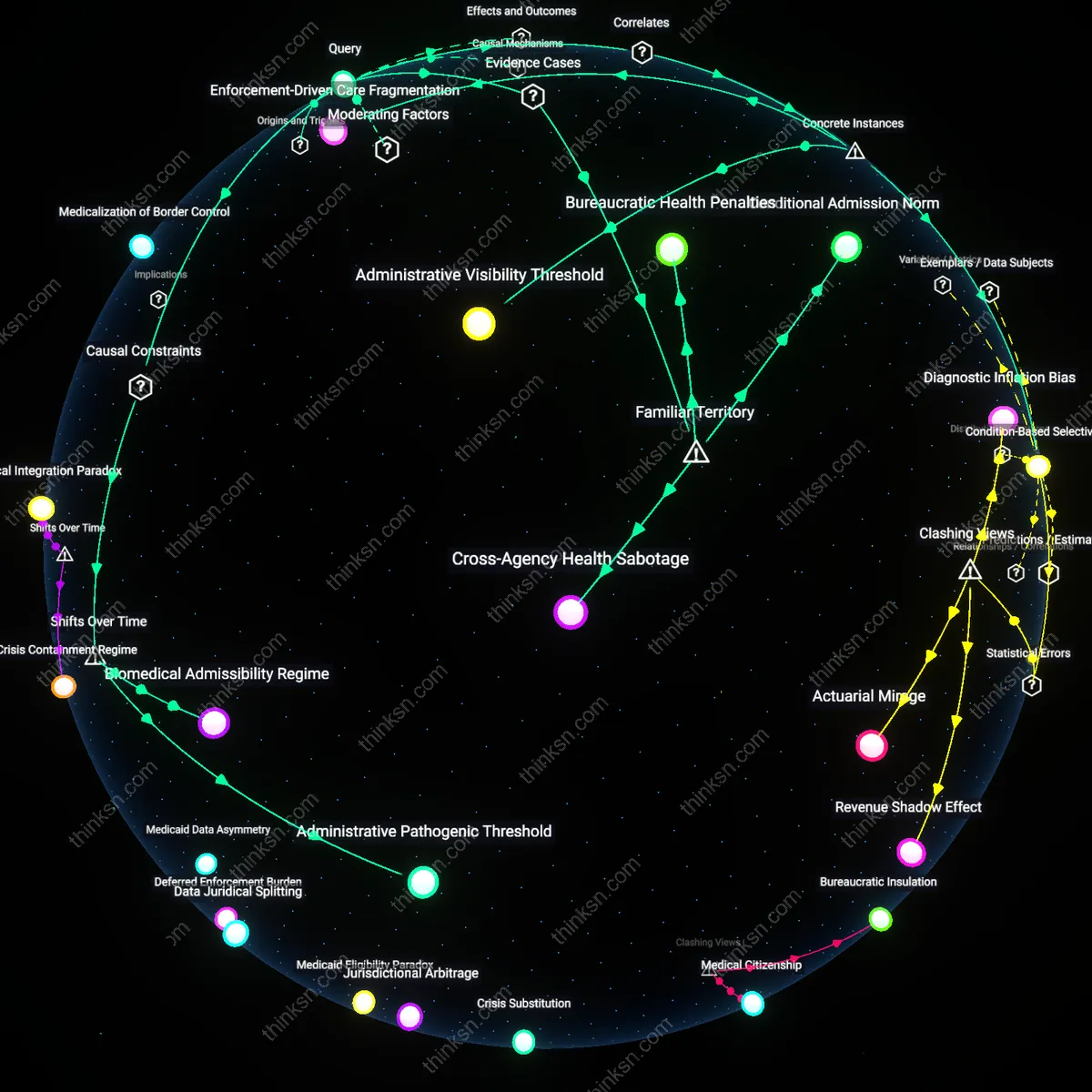
Analysis reveals 11 key thematic connections.
Key Findings
Medicalization of Border Control
The deployment of the 'public charge' rule to disproportionately affect immigrant families with chronic health conditions originates in the 2019 regulatory expansion by the Trump administration, which redefined public charge to include Medicaid and other non-cash benefits, acting as an immediate trigger that weaponized health status as a criterion for admission. This shift institutionalized a mechanism through which immigration enforcement absorbed health policy levers, enabled by bureaucratic alignment between U.S. Citizenship and Immigration Services and public benefits agencies, transforming clinical vulnerability into a legal liability. The non-obvious significance lies in how health infrastructure—designed for care—is repurposed as a gatekeeping tool, revealing that medical data and access pathways have become de facto instruments of exclusionary statecraft.
Policy Feedback Stigma
The intersection is sustained by a feedback loop in which immigration enforcement shapes health-seeking behavior, as fear of public charge penalties deters mixed-status families from accessing Medicaid or SNAP, even when legally eligible—triggered by widespread misinformation campaigns and amplified by local enforcement practices in jurisdictions like Harris County, Texas. This produces a systemic condition where public health infrastructure weakens precisely among those who need it most, benefiting federal cost-minimization objectives while offloading medical burdens to safety-net hospitals and local clinics. The non-obvious mechanism is that enforcement policy indirectly reshapes health outcomes not through direct denial, but through engineered avoidance, institutionalizing stigma as a regulatory instrument.
Administrative Visibility Threshold
The exclusion of Medicaid-covered diabetes management from public charge calculations in Harris County, Texas, reveals that only certain health expenditures trigger immigration penalties, despite chronic illness increasing overall public system engagement. This selective visibility—where acute care costs are ignored while preventive benefits count against immigrants—creates a bureaucratic threshold that distorts health-seeking behavior without reducing actual public burden. The non-obvious consequence is that the policy does not minimize public cost but instead incentivizes late-stage, emergency care use among at-risk populations, exposing how enforcement criteria redefine what forms of care are politically visible.
Condition-Based Selectivity
The denial of green card applications for legal immigrants in California who use insulin under Medicare Part D demonstrates that the public charge rule operates not as a universal economic filter but as a conditional screen favoring individuals with financially 'efficient' health profiles. Because the rule counts prescription subsidies as liabilities but ignores private insurance contributions or long-term productivity, it systematically disfavors applicants with conditions requiring continuous pharmacological support. This reveals an unacknowledged policy calculus that treats biological management needs as fiscal risks, even when net tax contributions exceed care costs.
Enforcement-Driven Care Fragmentation
In New York City, the documented withdrawal of Haitian immigrant families with children diagnosed with sickle cell anemia from routine clinic visits at Bellevue Hospital during the 2019 public charge rule expansion shows how immigration enforcement alters clinical continuity independent of insurance status. Despite being eligible for full services, families avoided care due to fear that any public benefit documentation could jeopardize residency prospects. The non-obvious outcome is not reduced healthcare utilization overall but its fragmentation across informal, off-record channels—revealing that enforcement risk reorganizes care delivery networks around secrecy rather than efficacy.
Administrative Pathogenic Threshold
The 1999 INS guidance shift institutionalized clinical complexity as a liability in visa adjudication, so that chronic conditions requiring continuous care became de facto disqualifiers only when public funding was involved. This bottleneck—where medical need alone did not trigger exclusion but reliance on Medicaid or SNAP did—revealed that the mechanism was not health status per se but its fiscal translation into public spending. The non-obvious transformation was that medical chronicity became governable not through health policy but through budgetary eligibility rules embedded in immigration enforcement, marking a shift from medical screening to fiscal risk profiling.
Conditional Somatic Citizenship
After the 2019 public charge rule expansion under the Trump administration, immigrant access to care was restructured so that using insulin, dialysis, or disability supports could directly lead to deportation or denial of permanent residency. The causal prerequisite was the redefinition of 'public benefit' to include non-cash programs like Medicaid, which previously had exceptions for emergency and prenatal care. This moment revealed how health policy was no longer separable from immigration control—the body’s needs became a legal liability only when managed by public systems, not private ones, exposing a historical pivot toward conditional inclusion based on managed dependency.
Biomedical Admissibility Regime
The post-2020 rollback of the expanded public charge rule did not restore pre-1999 norms but solidified a new hybrid regime where health-related inadmissibility is selectively enforced based on anticipated fiscal burden, not communicable disease risk as in early 20th-century exclusions. The critical bottleneck is the discretionary power of consular officers and USCIS officers to interpret medical records as financial forecasts. This transition from overt eugenic exclusion to actuarial somatic assessment reveals how biomedical data is now filtered through cost-prediction algorithms, producing a temporally distinct form of gatekeeping that emerged precisely when health data systems became interoperable with immigration databases.
Bureaucratic Health Penalties
The public charge rule disproportionately deters immigrant families managing chronic conditions from accessing Medicaid because using such benefits can negatively impact their visa or green card applications. This effect concentrates in safety-net hospitals in border states like Texas and Arizona, where clinicians report patients refusing insulin or dialysis not due to medical risk but immigration consequences. The mechanism—benefit-aversion under enforcement policy—reveals how administrative immigration tools indirectly penalize health management, making routine care a potential liability. What’s underappreciated is that the penalty isn’t applied through the health system but enforced via immigration bureaucracy, blurring responsibility while producing clear health outcomes.
Conditional Admission Norm
Immigrant families with chronic illnesses face exclusion from legal permanence not because they are unhealthy, but because the public charge rule frames dependence on health benefits as evidence of failed self-sufficiency. This is most visible in USCIS adjudications in urban immigration courts like those in New York and Los Angeles, where case officers weigh prescription drug costs or recurring specialist visits as financial liabilities. The rule converts medical stability—often enabled by public programs—into a mark against admissibility, reinforcing the idea that survival must be privately funded. The non-obvious twist is that compliance with medical treatment, encouraged by doctors, becomes self-endangering in the immigration context, normalizing conditional inclusion based on health cost suppression.
Cross-Agency Health Sabotage
Public health departments in major immigrant-receiving cities like Chicago and Miami have observed preventable disease spikes when families avoid clinics for fear of immigration repercussions, even though public charge technically applies only to specific benefit programs. The chilling effect emerges from coordinated messaging between USCIS and local service providers, where eligibility screening tools inadvertently signal that any government interaction risks exposure. This inter-agency alignment—meant to enforce immigration policy—undermines population health goals through indirect deterrence. The overlooked reality is that health sabotage occurs not by design within health policy, but through the gravitational pull of immigration enforcement on otherwise neutral public systems.