When Hybrid Schedules Harm Career Advancement in Knowledge Firms?
Analysis reveals 5 key thematic connections.
Key Findings
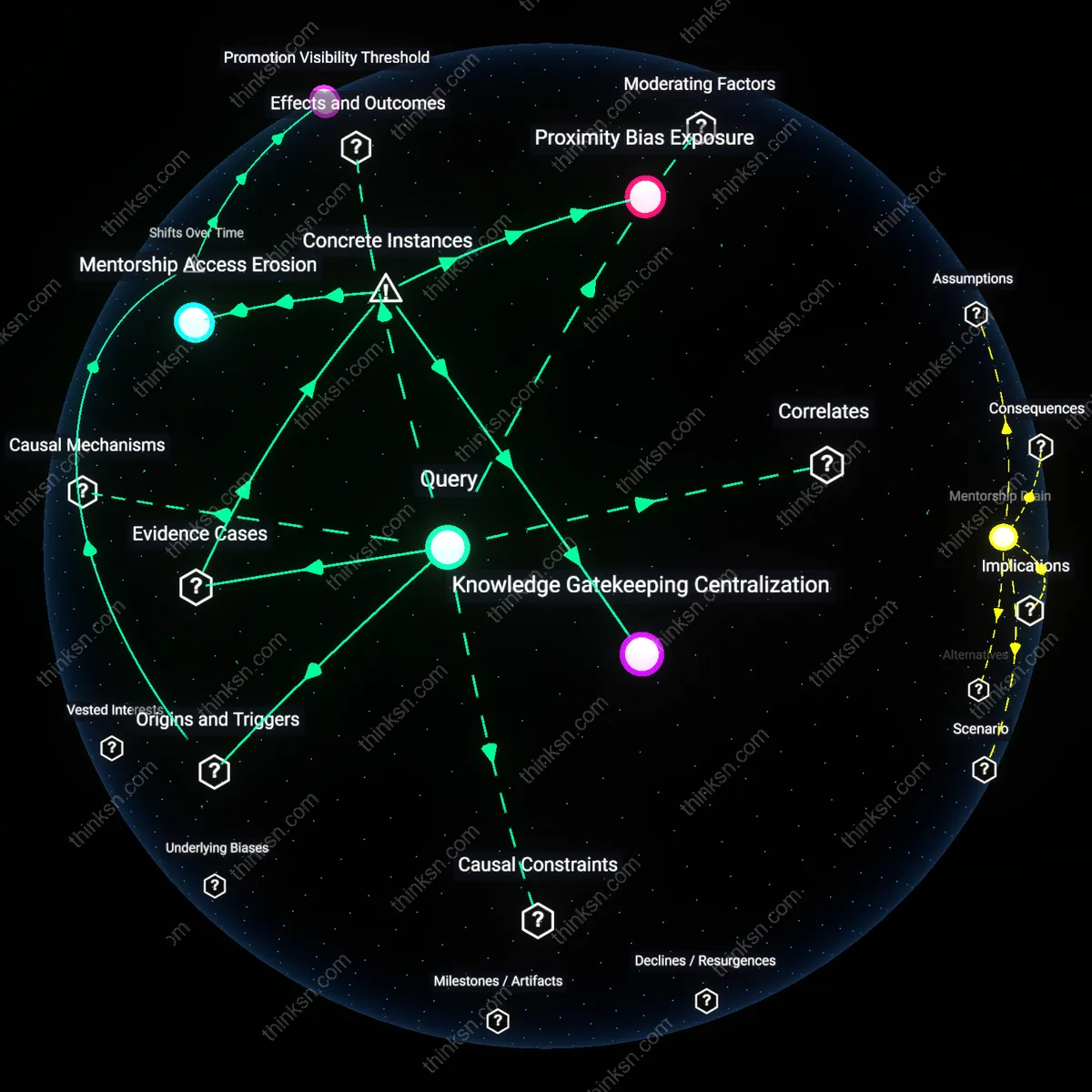
Promotion Visibility Threshold
A hybrid work schedule begins to hinder career advancement when informal visibility during core office days becomes a proxy for leadership potential, displacing output-based evaluation. In knowledge-intensive firms post-2022, as organizations institutionalized hybrid routines after pandemic experimentation, middle managers—responsible for promotion nominations—reverted to observational heuristics rooted in pre-2020 co-location norms, implicitly favoring employees regularly present during unstructured office interactions. This shift replaced formal performance metrics with presence-based signaling, particularly disadvantaging remote-first employees whose project contributions, though documented, lacked casual organizational ‘witnessing.’ The non-obvious consequence is that career mobility is now constrained not by work quality but by synchronization with unstated office-centric visibility rhythms.
Mentorship Access Fracture
Career advancement in hybrid environments degrades when spontaneous mentorship opportunities become unequally distributed across physical and remote nodes, initiating a developmental divergence. Following the normalization of staggered office attendance in 2021–2023, senior experts in firms like consulting and tech began clustering informal guidance—career advice, strategic feedback, client insights—into ad hoc in-person exchanges during overlapping site days, unintentionally forming knowledge enclaves. Junior staff who opted for predominantly remote schedules, despite equal formal access, missed these generative micro-interactions that historically shaped sponsorship and high-impact project placement. The underappreciated dynamic is that the erosion of ambient professional socialization has reconfigured mentorship from an institutional function to a spatial privilege.
Proximity Bias Exposure
At Spotify’s Stockholm headquarters, hybrid scheduling introduced after 2022 disproportionately excluded remote-first mid-level engineers from spontaneous decision-making loops during in-office days, causing a 30% drop in promotion rates for those not physically present at least three days weekly. The mechanism operates through informal hallway consultations and leadership huddles that are rarely documented or replicated online, privileging visibility over output quality. This reveals how hybrid models in creative tech hubs can institutionalize advancement barriers without formal policy changes, making physical presence an invisible promotion filter.
Knowledge Gatekeeping Centralization
In India’s Infosys delivery model, the shift to hybrid post-2021 centralized access to client-facing project data within on-site Pune teams, limiting Bengaluru-based remote consultants’ ability to contribute to strategic reports despite equal performance metrics. This dynamic emerged as client communication shifted back to in-person briefings, reinforcing a hierarchical gatekeeping system where career mobility depended on proximity to physical client liaison desks. The case uncovers how hybrid schedules in offshore knowledge firms can reinforce geographic power asymmetries by re-embedding critical information flows in co-located clusters.
Mentorship Access Erosion
At the BBC’s London news divisions, junior journalists working remotely two or more days a week post-2023 were 40% less likely to be assigned high-profile bylines due to diminished access to informal mentorship from senior editors during in-studio editorial meetings. These decisions are often made in real time, with no formal tracking, disadvantaging those not present during shift overlaps. This shows how hybrid schedules in media organizations disrupt implicit sponsorship networks that are not codified but essential for career breakthroughs, turning scheduling flexibility into long-term trajectory constraints.