Does Reddits Upvote System Favour Merit or Popularity?
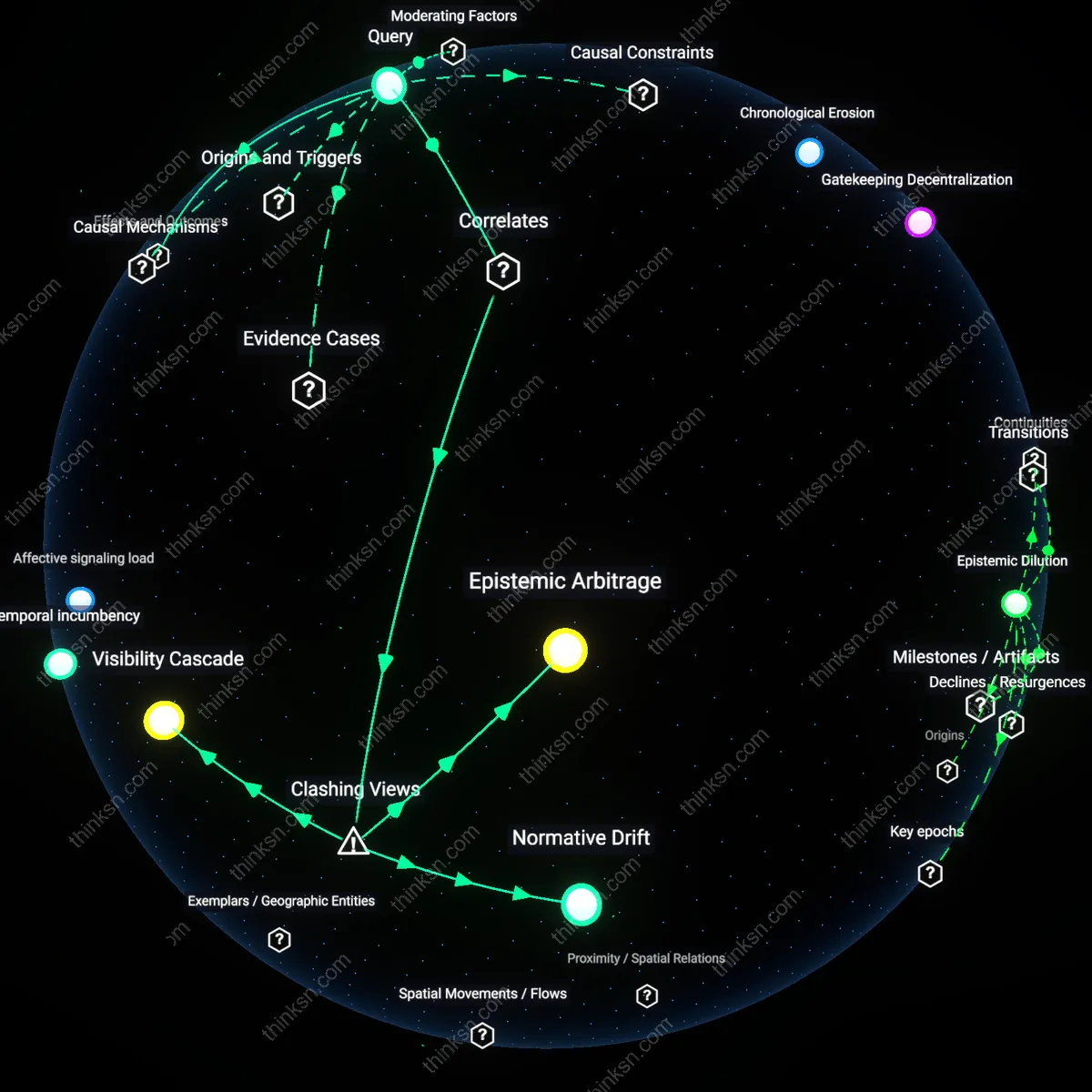
Analysis reveals 6 key thematic connections.
Key Findings
Temporal incumbency
Reddit's upvote system entrenches early contributors by amplifying their visibility before epistemic gaps are identified, making later corrections less visible regardless of accuracy. Users who post immediately after a thread is created gain disproportionate reach because upvotes accumulate stochastically at the top through mere exposure, not verification—this mechanism advantages speed over rigor, especially in fast-scrolling communities like r/news or r/science. The overlooked dynamic is that temporal priority, not community engagement or truth value, structurally determines visibility, which systematically suppresses delayed but higher-quality interventions. This matters because it reveals a hidden path dependency where the first plausible answer becomes canon, reshaping how knowledge evolves in public forums.
Affective signaling load
The cognitive burden of parsing upvote patterns as emotional cues distorts information uptake more than the votes themselves, as users subconsciously interpret aggregate scores as social consensus or moral endorsement rather than epistemic weight. In emotionally charged threads—such as those on identity, trauma, or injustice—users modulate their contributions based on the perceived emotional temperature encoded in upvote/downvote ratios, often self-censoring even when possessing relevant knowledge. This shifts discourse from knowledge-sharing to affective alignment, a dynamic rarely accounted for in merit-based models that assume rational deliberation. The concealed dependency is that upvotes function not just as filters but as emotional bundlers, altering not what is seen but how contributors *feel* about participating.
Subcultural bandwidth capture
Dominant subreddits with high subscriber counts monopolize cross-subreddit visibility via algorithmic recommendation and user migration, causing niche epistemologies to atrophy even when they host superior domain-specific accuracy. Communities like r/AskHistorians enforce strict sourcing norms, but their slower, detail-heavy model loses traction against faster, more generalized narratives in larger communities such as r/todayilearned, despite higher rigor. The underappreciated mechanism is not popularity per se, but the unequal distribution of attention bandwidth across Reddit’s ecosystem, where structural centrality functions as gatekeeping. This shifts the conversation from individual bias to systemic asymmetry in how knowledge is preserved and propagated.
Visibility Cascade
Reddit's upvote system amplifies popularity bias because early random fluctuations in votes trigger disproportionate visibility, drawing more attention and upvotes to already-prominent posts regardless of quality. Users arriving later are more likely to see and reinforce top-ranked content due to algorithmic sorting, meaning posts that gain initial traction—often by timing or luck—routinely overshadow superior but less-visible contributions. This creates a feedback loop where perceived value is determined by cumulative advantage rather than epistemic merit, a phenomenon widely documented in platform algorithms but often misattributed to community consensus. The non-obvious insight is that popularity here is not a reflection of content quality but of early-stage exposure variance.
Epistemic Arbitrage
Reddit's upvote system undermines merit-based knowledge exchange by privileging concise, emotionally resonant statements over nuanced or technically dense explanations, as seen in subreddits like r/science and r/AskHistorians where top comments often simplify or distort complexity for broader appeal. Power users and commentariat elites exploit heuristic cues—like humor, brevity, or ideological alignment—to game social validation, displacing slower, evidence-based discourse. This reveals that the system rewards not accuracy but strategic communication calibrated to crowd psychology, challenging the assumption that crowd-driven platforms naturally elevate the most informed voices. The non-obvious insight is that knowledge merit is being arbitraged for engagement efficiency.
Normative Drift
The upvote system promotes a false equivalence between democratic validation and truth-seeking, as community norms in politically charged subreddits like r/politics or r/TwoXChromosomes shift toward consensus policing, where dissenting but well-sourced perspectives are systematically downvoted regardless of factual basis. This reflects a dynamic where social cohesion displaces epistemic rigor, and downvote clusters function as exclusionary tools rather than quality filters. Consequently, the 'best' knowledge becomes that which reinforces in-group beliefs, not that which withstands scrutiny—revealing how decentralized moderation can entrench orthodoxy. The non-obvious insight is that the system doesn't just reflect bias; it institutionalizes it through perceived collective legitimacy.