Is Deplatforming Activists by App Stores Threatening Democracy?
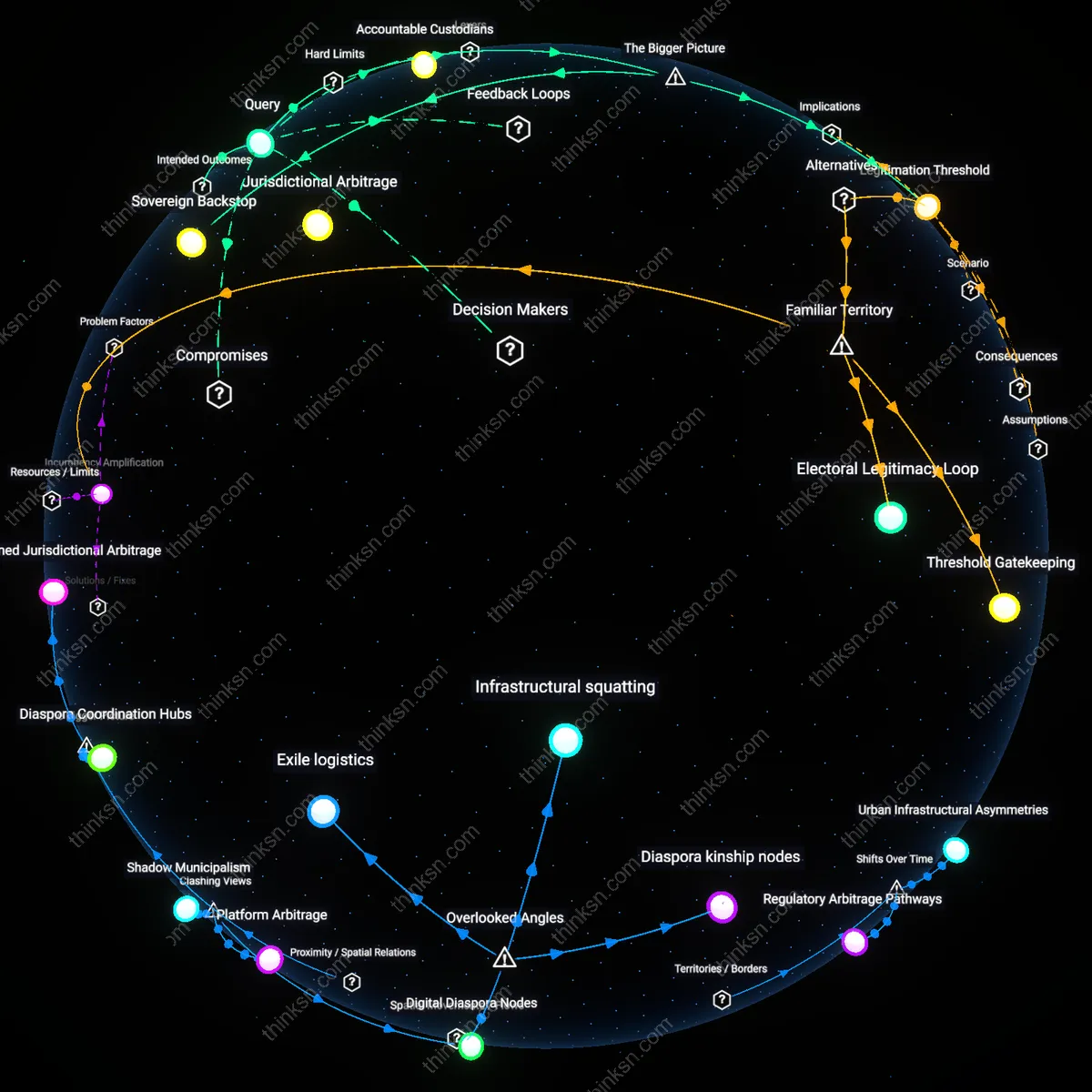
Analysis reveals 10 key thematic connections.
Key Findings
Platform Sovereignty
App stores’ removal of political activists reflects corporate assertion of sovereign-like control over digital public squares. Major firms like Apple and Google enforce privately defined community standards on their ecosystems, effectively deciding who can participate in mass digital discourse—mechanisms resembling state-based regulation but without procedural due process or democratic accountability. The non-obvious consequence is that commercial platforms now exercise jurisdictional power once reserved for polities, yet their legitimacy is derived from market position rather than civic consent.
Speech Arbitrage
Deplatforming signals a growing market in speech arbitrage where corporations balance user safety, advertiser demand, and regulatory risk to optimize platform viability. Companies like Meta or Apple act as intermediaries who calibrate expression not by civic norms but by risk-adjusted engagement metrics, suppressing content that threatens ecosystem stability or revenue. The underappreciated reality is that free expression is being priced and filtered through commercial cost-benefit logic, making dissent a function of profitability rather than principle.
Civic Friction Gap
The exclusion of activists from app stores reveals a widening civic friction gap—where fast-moving digital enforcement outpaces the slower, deliberative norms of democratic redress. When a political organizer is removed from app distribution overnight, there is no public hearing, no appeal to elected bodies, and no transparency in judgment, contrasting sharply with traditional civil liberties protections. What is rarely acknowledged is how this procedural speed gap neutralizes democratic engagement by shifting adjudication into private, technically opaque systems that operate outside civic time.
Platform Veto
Apple’s removal of the HKmap.live app during the 2019 Hong Kong protests directly substituted corporate risk assessment for democratic accountability, disabling a key coordination tool for protesters despite its non-violent utility. The mechanism—Apple’s App Store review invoking 'public safety' to delist an app used to track police movements—revealed how private platforms can unilaterally nullify civic organizing even when state actors are the source of repression. This case exposes the non-obvious reality that deplatforming can function not as content moderation but as a real-time political intervention masked as policy compliance.
Governance Arbitrage
Google’s 2020 decision to remove the U.S. far-right group Proud Boys’ app, while permitting similar militia coordination tools in Myanmar, illustrates how corporate enforcement selectively prioritizes geopolitical stability over consistent civic rights. The dynamic operates through regional legal exposure and brand risk calculus, not principle, allowing dominant powers to shape what counts as 'extremism' while permissive zones sustain parallel repression. This discrepancy reveals the underappreciated fact that platform governance often mirrors imperial policy gradients, not neutral moderation standards.
Infrastructural Partisanship
Microsoft’s termination of Parler’s Azure hosting after the January 6 Capitol riot—citing repeated policy violations—functioned less as security enforcement and more as control over digital public squares by selective infrastructure withdrawal. Unlike content takedowns, this act targeted underlying compute resources, making renewal prohibitively costly and thus foreclosing platform recovery regardless of content reform. The non-obvious insight is that cloud providers now wield a structural power akin to utility shutoffs, where access to digital existence depends on alignment with dominant corporate risk paradigms.
Asymmetric Moderation Regimes
The selective deplatforming of political activists reveals an asymmetry in enforcement shaped by geopolitical risk calculus rather than principled ethical doctrine, where platforms protect Western democratic norms while accommodating authoritarian regimes through differential policy application. This dynamic is systemically sustained by the structural incentive to prioritize market access over universal rights—a logic derived from legal doctrines like the First Amendment being non-binding abroad, and from utilitarian corporate ethics that weigh free expression against operational viability. The underappreciated consequence is the emergence of a tiered global speech order, where democratic engagement is constrained not by law but by the risk-averse pragmatism of private intermediaries balancing multiple, often conflicting, regulatory environments.
Civic Fungibility
Deplatforming signals a shift in the political economy of civic participation, where activism becomes subject to algorithmic legibility and brand safety metrics rather than democratic legitimacy, as app stores treat political expression as interchangeable content vulnerable to devaluation. This operates through monetization architectures that prioritize user retention and advertiser confidence, transforming ethical duties to democratic discourse into compliance with commercial reputation management—rooted in libertarian corporate ideologies that frame platforms as markets, not forums. The overlooked dynamic is that democratic engagement is effectively priced out when activism fails to conform to aesthetic or behavioral norms that align with platform profitability, rendering dissent structurally precarious even in the absence of overt censorship.
Infrastructural partisanship
App stores' removal of political activists reflects corporate control being exercised not through ideology but through technical compliance regimes that inadvertently favor established political actors able to meet opaque certification standards, as seen in Apple’s removal of the Hong Kong protest coordination app HKmap.live in 2019 despite its non-violent functionality. This act was framed as a violation of guidelines against illegal activity, yet the enforcement selectively targeted a tool used to avoid police crackdowns while similar crowd-monitoring tools in other regions remained untouched. The overlooked mechanism here is that platform governance now functions as de facto political arbitration through backend technical criteria—like location data use or anonymity support—that are weaponized selectively, rendering infrastructural compliance a form of quiet, non-ideological bias. This shifts the understanding of censorship from overt suppression to structural exclusion via engineering thresholds.
Jurisdictional arbitrage
The deplatforming of activists like Belarusian opposition figures using app stores to organize during the 2020–2021 protests reveals that corporate enforcement decisions often align with the geopolitical interests of the country hosting the platform’s legal headquarters or data infrastructure, rather than consistent global policy. Google and Apple removed apps like Nexta Live only after Belarusian authorities labeled them extremist, but these platforms concurrently allowed comparable tools in Western contexts under free speech rationales. The underappreciated dynamic is that app stores operate as regulatory intermediaries that outsource content legitimacy to authoritarian legal determinations when doing so minimizes market risk, effectively enabling repressive regimes to extend jurisdiction beyond their borders through private enforcement. This exposes how democratic engagement is constrained not by corporate ideology but by platform vulnerability to state legal claims in strategically important territories.