How to Care for a Family Member with BPD Without Fostering Dependency?
Analysis reveals 5 key thematic connections.
Key Findings
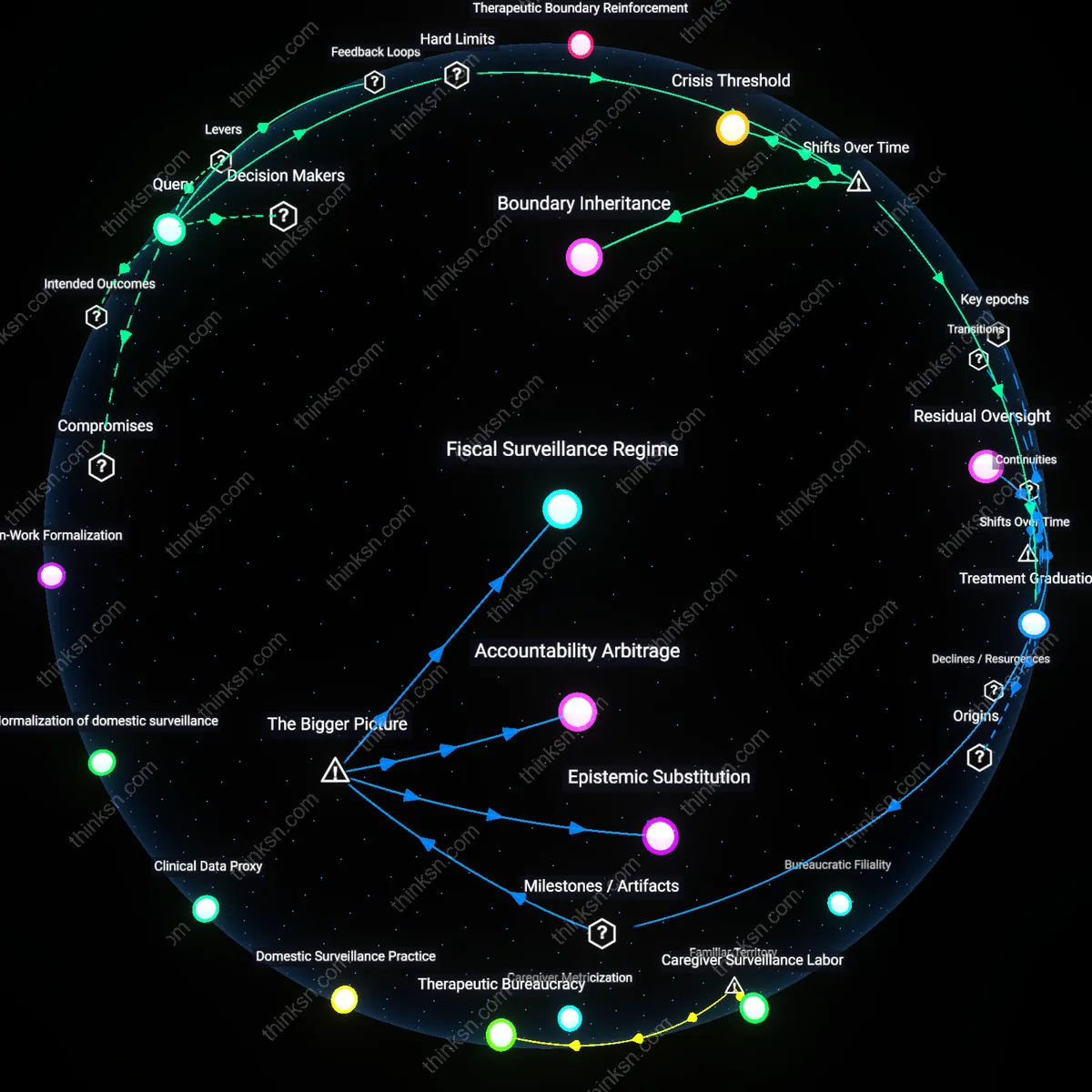
Crisis Threshold
Caregivers must enforce a non-negotiable condition that professional intervention only occurs after a clearly defined crisis threshold has been crossed, such as a suicide attempt requiring hospitalization, rather than for emotional distress alone. This boundary emerged in the 1990s with the institutionalization of psychiatric triage protocols that redefined what counted as a clinical emergency, shifting care from continuous familial management to episodic, system-triggered responses. The shift reduced caregiver burnout by offloading acute responsibility but inadvertently created a dependency cycle where families learned to withhold support until a crisis justified professional engagement. What is underappreciated is how this threshold, designed to prevent overuse of services, now structures family behavior—turning caregiver restraint into a strategic delay that defines modern crisis management in BPD households.
Treatment Graduation
Caregivers prevent dependency by adhering to time-limited treatment frameworks that require documented symptom reduction before further professional involvement is authorized, such as a six-month DBT program with exit criteria evaluated by an independent clinician. This expectation of treatment progression became codified after the 2000s expansion of evidence-based practice mandates in U.S. mental health funding, which tied reimbursement to measurable outcomes and phased disengagement. The shift turned long-term emotional support into a finite, milestone-driven process, pressuring both clinicians and families to treat therapy as a transitional phase rather than a permanent crutch. The non-obvious consequence is that caregivers now function as de facto compliance officers, monitoring their relative’s adherence not out of personal judgment but because state and insurance systems have transferred evaluative authority to them—producing a new form of regulated care.
Boundary Inheritance
Caregivers must adopt institutional boundaries—such as no-contact rules during self-harm episodes or insistence on patient-led appointment scheduling—to break intergenerational patterns of enmeshment that worsened BPD symptom expression in post-deinstitutionalization families of the late 20th century. As psychiatric hospitals downsized in the 1980s, families absorbed clinical responsibilities without training, leading to chaotic, reflexive interventions that blurred care with control. The pivot came in the 2010s when trauma-informed models explicitly framed family boundaries as therapeutic tools, not betrayals, transforming previously stigmatized detachment into clinically endorsed practice. The underappreciated insight is that today’s ‘hard limits’ are not merely personal rules but internalized fragments of collapsed public systems, reconstituted in private life to manage gaps the state no longer fills.
Therapeutic Boundary Reinforcement
Caregivers sustain intervention efficacy by codifying professional collaboration thresholds that deactivate family-enmeshed feedback loops. When clinicians and family members operate without defined roles, emotional contagion escalates crisis frequency, reinforcing a cycle where professional input becomes reactive rather than structural; establishing formal consultation intervals and decision protocols disrupts this by inserting institutional resistance into the system, making caregiver actions contingent on clinical triggers rather than symptomatic distress. This is non-obvious because families often interpret boundary-setting as emotional withdrawal, yet its systemic function is to preserve professional authority as a balancing loop against crisis normalization.
Institutional Scaffolding Gap
Caregiver dependency risks surge when community mental health infrastructures fail to provide tiered escalation pathways, forcing families into constant high-intensity intervention. Without stepped-care frameworks that shift responsibility to outpatient teams, partial hospitalization programs, or crisis respite units based on symptom severity, caregivers remain locked in a reinforcing loop where each crisis demands total personal immersion, eroding their autonomy and overloading informal support systems. The underappreciated reality is that individual coping strategies cannot compensate for absent institutional circuit breakers—dependency emerges structurally when no external container exists to receive acute psychological strain.