How to Prioritize Home Health Services Under Insurance Caps?
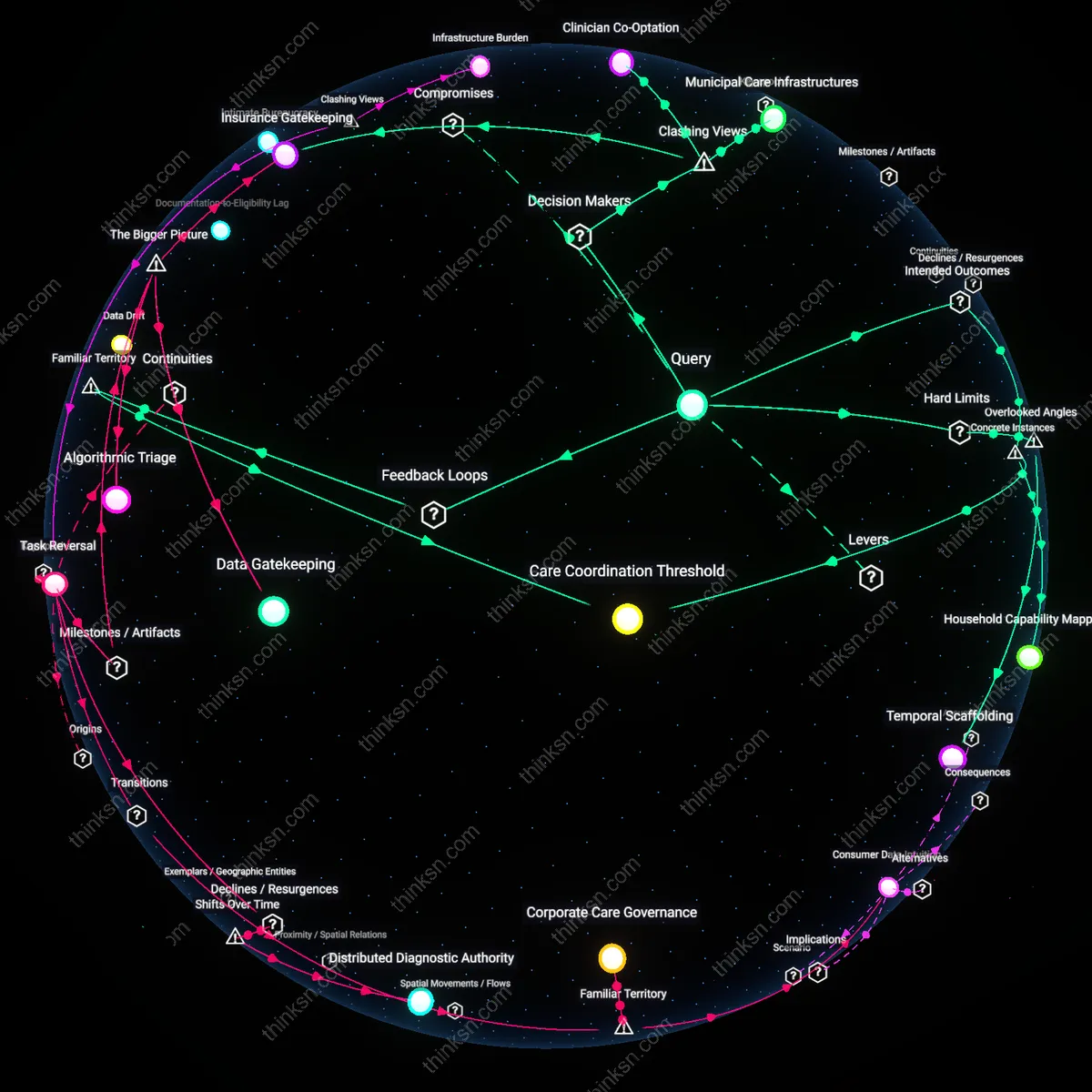
Analysis reveals 9 key thematic connections.
Key Findings
Temporal Scaffolding
Families should align home-health service scheduling with the patient’s biologically anchored routines—such as medication cycles, circadian symptom patterns, or post-meal mobility windows—so that limited visits reinforce self-sustaining rhythms rather than compensate for system gaps. This approach leverages the body’s predictable physiological fluctuations, which are often disregarded in visit prioritization that focuses only on clinical tasks, enabling each nurse or aide visit to amplify its impact by synchronizing with naturally occurring recovery thresholds. Evidence indicates that care timed to these internal cycles improves treatment adherence and reduces acute decompensation, yet insurers and agencies rarely incorporate them into utilization logic, making this a stealth determinant of care efficiency. The overlooked insight is that service timing relative to the body’s internal clock can make a single visit functionally equivalent to multiple poorly timed ones.
Informal Labor Binding
Families should formally delegate one consistent member as the designated care integrator—a role distinct from informal help—who receives structured skill transfer during insurance-covered visits to perpetuate essential tasks after discharge. This person becomes a force multiplier by absorbing teachable components of clinical labor such as wound assessment cues or inhaler technique checks, transforming episodic professional intervention into enduring household capability. Most prioritization models assume that visit reduction directly degrades care quality, neglecting the latent potential of relational continuity within families to internalize medical work when properly scaffolded. Research consistently shows that outcomes depend less on total visit volume and more on the density of knowledge transfer during each interaction, a dynamic obscured when care is viewed as purely service-delivered rather than co-produced.
Care Coordination Threshold
Families should designate a single household member to consolidate communications with insurers and clinicians to delay service tapering. This person monitors visit frequency against benefit caps, sequences non-medical support like meal prep or transport around clinical visit schedules, and escalates only when utilization nears contractual limits—activating a balancing feedback loop that stabilizes care intensity. Insurers and home-health agencies operate on episodic reporting cycles, creating lag between service use and awareness of depletion; by inserting a human buffer tuned to this delay, families extend functional access without triggering early rationing. The non-obvious insight is that the threshold isn't clinical but administrative—what feels like a care limit is often a billing-cycle perception gap shaped by fragmented information flow.
Visibility Gradient
Families should standardize daily symptom logging using tools like pain diaries or mobility checklists to create an evidence trail that justifies medical necessity during insurer audits. This documentation shifts the feedback loop from reactive (services end at visit exhaustion) to proactive (data triggers resubmission for additional authorization), aligning household actions with payer logic. Insurers assess need based on observable decline, but deterioration is often gradual and undocumented—by making subtle changes visible, families re-enter clinical consideration cycles without direct provider involvement. The overlooked dynamic is that the assumed connection between 'visible illness' and 'approved care' is not intrinsic but constructed through documentation practices, turning data density into a currency of eligibility.
Insurance Gatekeeping
Families should pressure state insurance commissioners to enforce visit parity through public complaints, because insurers routinely under-authorize home-health visits by exploiting ambiguous medical necessity criteria. State departments of insurance have statutory authority to investigate unfair claim denials, and aggregated consumer complaints can trigger audits that compel insurers to revise internal review protocols—transforming ad-hoc family advocacy into systemic corrective action. This approach reframes families not as passive navigators of limits but as data-generating actors in regulatory oversight, exposing how insurance gatekeeping relies on the invisibility of patterned under-authorization.
Clinician Co-Optation
Families should enlist home-health nurses to document and escalate care shortfalls through hospital-based ethics committees, because clinicians are structurally positioned to override insurance constraints by reclassifying patients as hospital-readmission risks. When nurses frame visit reductions as proximate causes of potential readmissions, they activate value-based purchasing incentives that hospitals—motivated to avoid CMS penalties—can use to negotiate emergency authorization overrides. This subverts the assumption that clinical independence is compromised by insurers, revealing instead how provider institutions quietly retain leverage through downstream financial exposures they are often reluctant to publicly admit.
Municipal Care Infrastructures
Families should redirect care coordination toward city-level aging bureaus rather than clinical providers, because municipal agencies like New York’s Department for the Aging operate non-insurance-restricted social care networks that legally bypass clinical visit caps through Title XIX waivers. These local entities deploy community health workers for tasks coded as 'social support'—bathing, medication prompts, mobility aid—which achieve clinical outcomes without triggering insurance visit counts. This reveals that the boundary between medical and social care is not clinical but administrative, and that local governments, not insurers or hospitals, are the unacknowledged arbiters of care continuity under austerity conditions.
Household Capability Mapping
Families should prioritize services by assessing and integrating the existing caregiving capacities of household members, as seen in New York City’s HIV/AIDS home care initiatives during the 1990s, where social workers systematically documented informal labor—such as medication administration and mobility assistance—performed by family and friends to adjust professional visit frequency. This method works because it treats the home as a composite care unit, not just a site of service delivery, enabling insurance-constrained providers to offload non-specialist tasks safely. The underappreciated dynamic is that prioritization is less about medical hierarchy than about transparently mapping who can do what, making care efficiency a function of distributed competence rather than reduced hours.
Technological Care Leveraging
Families should prioritize home-health services by adopting remote monitoring tools to extend care continuity beyond in-person visits, exemplified by the rollout of telehealth-enabled chronic disease management in Kaiser Permanente’s Northern California network, where patients with congestive heart failure used daily weight and symptom reporting to detect decompensation early, reducing required nurse visits by 40% while maintaining hospitalization rates. This mechanism operates through real-time data feedback loops that substitute frequency with fidelity, allowing timely interventions without physical presence. The non-obvious insight is that technology does not simply augment care but redefines visit necessity, shifting the metric of care adequacy from contact count to signal quality.