When Refusing Assisted Living Endangers Safety: Who Decides?
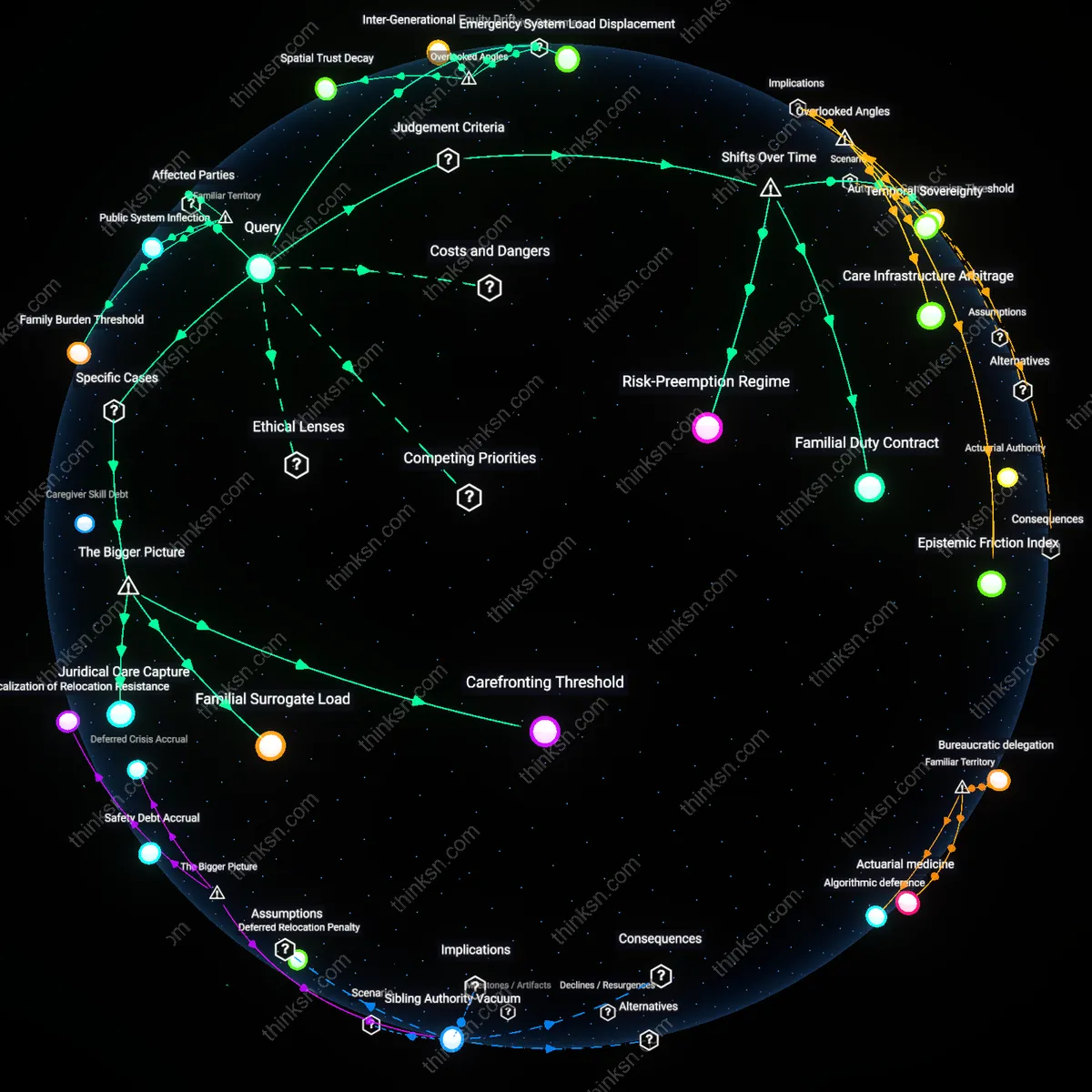
Analysis reveals 12 key thematic connections.
Key Findings
Family Burden Threshold
A parent’s refusal of assisted-living becomes a safety risk requiring override when their care exceeds the physical and emotional capacity of immediate family caregivers. This shift transforms familial love into unsustainable labor, typically observed when adult children experience burnout, marital strain, or health deterioration while managing parental needs at home. The family unit, often presumed to be the natural guardian of elder welfare, becomes a site of cumulative harm—where continued autonomy for the parent directly compromises the well-being of those nearest to them. What is underappreciated in public discourse is that the decision threshold is rarely about the parent’s acute medical crisis, but about the quiet collapse of family resilience that precedes it.
Clinical Risk Escalation
A parent’s refusal of assisted-living should be overridden when objective clinical indicators—such as repeated falls, medication mismanagement, or untreated cognitive decline—demonstrate a pattern of preventable harm that exceeds safety thresholds established by geriatric care protocols. This determination is made by licensed medical professionals, typically in coordination with hospital discharge planners or home health assessors, who document functional impairments that correlate with high risk of injury or death. The underappreciated reality is that clinical judgment, not emotional urgency or family preference, institutionalizes the shift from autonomy to intervention—turning subjective worry into codified risk that justifies legal or medical override.
Public System Inflection
The decision to override a parent’s autonomy emerges when their care needs overflow private resources and begin straining publicly funded systems, such as emergency medical services, Medicaid-funded home care, or public guardianship programs. When repeated 911 calls, ER visits, or social worker interventions become routine, the state transitions from bystander to stakeholder—not out of familial concern, but fiscal and systemic necessity. The overlooked dynamic is that public systems do not act solely on medical risk or family plea, but on the economic and operational burden of sustained crisis response, transforming individual choice into collective liability.
Autonomy-Compromise Threshold
A parent's refusal of assisted-living becomes a safety risk warranting override when observable cognitive decline impairs judgment to the point of demonstrable harm, a decision increasingly institutionalized in geriatric care protocols since the 1990s; clinicians, guided by frameworks like the MacArthur Competence Assessment Tool, now play a central mediating role, assessing mental capacity formally—what was once treated as a private family matter is now subject to standardized medical scrutiny, revealing how biomedicalization has shifted elder decision-making authority from kin to credentialized experts.
Familial Duty Contract
The decision to override a parent’s autonomy should default to adult children when residing in proximity, because after the postwar suburban boom in the U.S., geographic dispersion of families transformed co-residence into a moral obligation rather than norm, embedding a new expectation that children bear physical and financial responsibility—this reversal from institutional to kin-based accountability emerged precisely as public eldercare infrastructure stagnated, making the unspoken bargain of familial stewardship the de facto risk-assessment mechanism in middle-class America.
Risk-Preemption Regime
A parent’s refusal of assisted-living is overridden when liability exposure to municipal agencies outweighs individual liberty, a threshold increasingly triggered since the 2010s by automated elder-abuse reporting systems in Medicaid-participating states; here, adult protective services operate through predictive risk modeling that treats isolation and noncompliance as algorithmic flags, shifting the decision from clinical or familial domains to bureaucratic actuarial logic—revealing how digital governance has produced a new standard where danger is defined less by present harm than by probabilistic deviation from care norms.
Spatial Trust Decay
A parent's refusal of assisted-living becomes a safety risk that warrants overriding autonomy when prolonged isolation erodes the high-frequency observational monitoring traditionally provided by nearby kin, thereby degrading informal surveillance networks before formal interventions activate. In suburban or rural U.S. communities where adult children live more than 30 miles from aging parents, the density of unplanned visits drops below levels needed to detect early cognitive or mobility declines, creating a blind spot that neither telehealth nor monthly check-ins can reliably fill; this is rarely accounted for in clinical risk assessments, which assume proximity or routine contact. The overlooked dynamic is that geographic distance doesn't just complicate care logistics—it systematically weakens the epistemic foundation of familial oversight, allowing preventable crises to emerge undetected. Most analyses treat distance as a logistical inconvenience, not a cognitive erosion mechanism in caregiving systems.
Inter-Generational Equity Drift
A parent’s refusal of assisted-living poses a safety risk that justifies override when the cost of maintaining their autonomy begins to compromise the primary caregiver’s long-term financial or psychological viability, particularly when that caregiver is a working-age daughter balancing elder care with child-rearing. In middle-income urban families, especially among Black and Latina women who disproportionately shoulder unpaid care labor, sustained resistance to assisted-living can trigger cascading job instability, reduced retirement savings, and higher rates of clinical anxiety—risks that public health systems rarely track as external costs of autonomy preservation. The hidden dependency is that inter-generational equity—the balance between protecting elder dignity and preserving younger caregivers’ life trajectories—is not formally recognized in guardianship evaluations, though its collapse destabilizes family resilience more reliably than medical incidents. This reframes 'safety' as a multi-life construct, not just an individual condition.
Emergency System Load Displacement
A parent's refusal of assisted-living warrants override when their home environment generates recurrent 911 dispatches that exceed the surge capacity of rural emergency medical services, diverting paramedics from community-wide crises; this occurs disproportionately in aging Appalachia counties where volunteer EMS squads respond to the same patients for falls or medication errors multiple times per month. Because these calls are logged as 'low severity' individually, their cumulative strain on already-underfunded departments goes unmeasured in public health metrics, masking a systemic burden shift from private homes to public safety infrastructure. The overlooked angle is that autonomy exercised in isolation can function as a stealth privatization of risk, offloading care failures onto under-resourced municipal systems—a dynamic absent from bioethical frameworks centered on individual rights but critical to community-wide emergency prepared grinding.
Carefronting Threshold
A parent’s refusal of assisted-living becomes a safety override trigger when documented incidents of functional decline—such as repeated hospitalizations from falls or medication mismanagement—result in measurable harm that exceeds community-based intervention capacities, as seen in urban home-care deserts like Chicago’s South Side, where under-resourced public health infrastructure amplifies individual risk into systemic liability; this mechanism reveals how geographic disparities in care access recalibrate the threshold for justifiable autonomy override not on medical criteria alone, but on the capacity of local systems to absorb risk, a factor rarely acknowledged in bioethics frameworks that presume uniform care availability.
Familial Surrogate Load
When adult children assume dual roles as primary caregivers and decision-makers, as frequently observed in culturally tight-knit communities such as Korean-American families in Los Angeles, their accumulated physical and cognitive burden from managing unroutinized crises—like nighttime wandering or sudden incapacitation—can erode their own health to the point that the parent's autonomy directly imperils a second life, creating a moral economy wherein the system relies on familial sacrifice as a de facto risk buffer; this exposes how informal care networks, when structurally expected but institutionally unsupported, become the hidden fulcrum on which autonomy override decisions pivot, not due to clinical deterioration alone, but to the collapse of familial endurance.
Juridical Care Capture
In jurisdictions with court-backed protective custody statutes, such as guardianship proceedings in New York State, a parent’s refusal of assisted-living is overridden not through clinical consensus but through legal rituals that convert ambiguous risk into adjudicated incapacity, where the decisive trigger is less the parent’s condition than the procedural competence of petitioners—often adult children or social workers—within a strained court system incentivized to close cases efficiently; this reveals how bureaucratic rationality, rather than medical necessity or relational ethics, becomes the dominant mechanism for resolving autonomy conflicts, turning family crises into administrative timelines governed by courtroom calendars and not care continua.