Smart Thermostats: When Convenience Crosses into Behavioral Profiling?
Analysis reveals 6 key thematic connections.
Key Findings
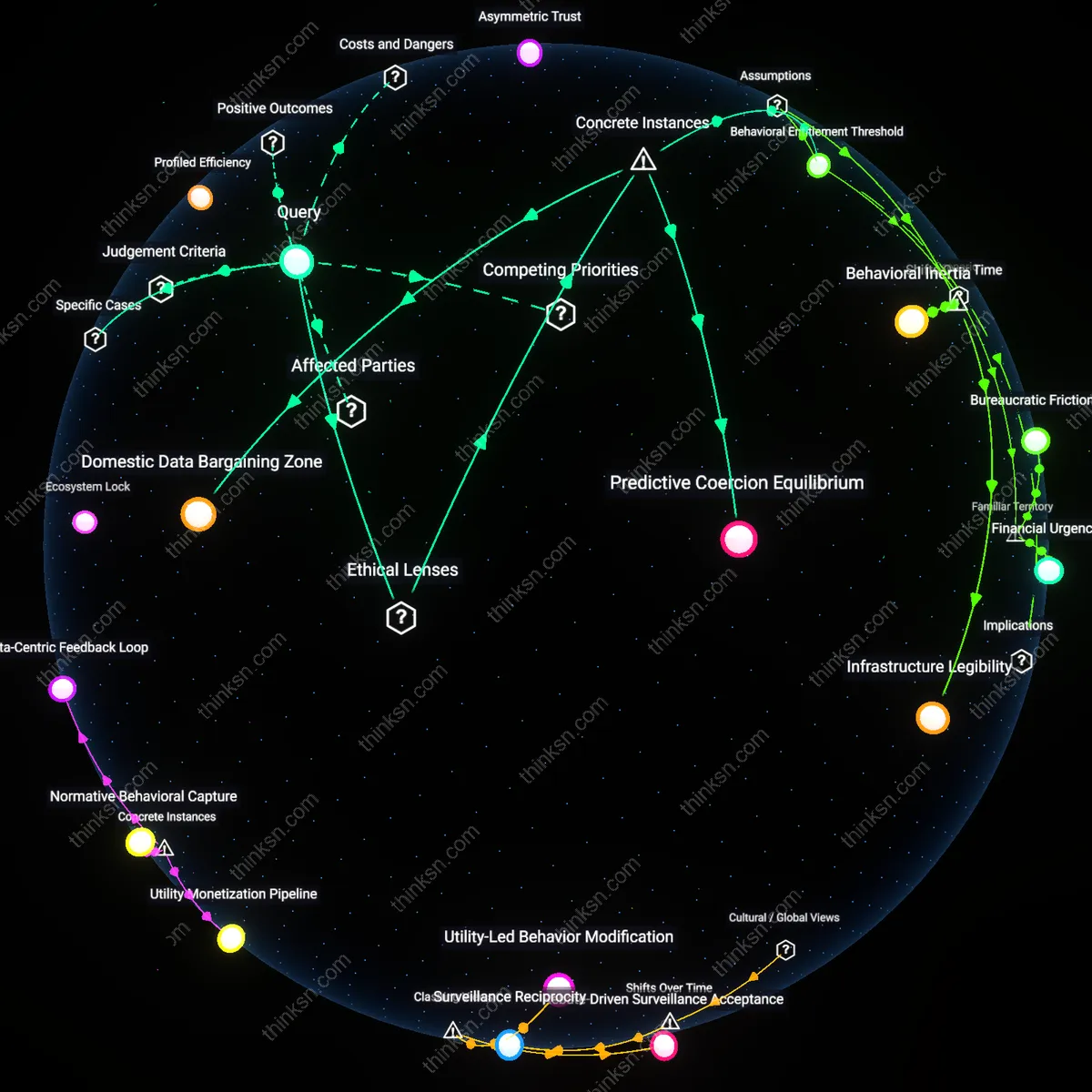
Behavioral Entitlement Threshold
The convenience of smart-home energy savings outweighs ethical concerns when municipal utility programs, such as those implemented in Boulder, Colorado’s ClimateSmart initiative, mandate thermostat data collection as a condition for receiving public rebates, thereby establishing a public-private mechanism where citizens tacitly consent to behavioral monitoring in exchange for verified efficiency gains—this reveals that legitimacy is conferred not through individual autonomy but through institutional framing of surveillance as civic duty, a shift rarely acknowledged in privacy discourses.
Predictive Coercion Equilibrium
In the Dutch social housing sector, where smart thermostats linked to welfare-supported housing leases automatically adjust temperatures based on occupancy patterns, the tipping point occurs when non-compliance with energy-saving behaviors triggers infrastructural penalties—this integration of algorithmic enforcement into public tenancy agreements demonstrates how consequential control, not data collection per se, becomes the ethical red line, exposing that behavioral profiling becomes tolerable only when it operates as a feedback loop of enforceable social contract rather than corporate observation.
Domestic Data Bargaining Zone
The rollout of Google Nest Renew in partnership with Pacific Gas & Electric in Northern California illustrates the threshold being crossed when users are offered direct monetary credits in exchange for permitting utility-controlled load shedding during peak hours, embedding behavioral profiling within a transparent quid pro quo—this case uncovers that ethical resistance diminishes not with stronger privacy safeguards but with the emergence of a visible, reversible exchange structure, where domestic energy behavior becomes a negotiable commodity rather than an invisible extractive target.
Profiled Efficiency
Energy savings from smart thermostats like Nest outweigh ethical concerns only when user behavior is systemically coerced into predictability by utility providers, as seen in Pacific Gas & Electric’s demand-response programs where thermostat adjustments are mandated during peak loads; the convenience emerges not from user autonomy but from enforced alignment with grid needs, revealing that the trade-off is less about personal profiling and more about institutionalized behavior modulation under the guise of efficiency.
Invasive Normalization
The convenience of energy savings never outweighs ethical concerns because companies like Ecobee monetize granular occupancy patterns through affiliate marketing partnerships with home service platforms, transforming thermostat data into cross-sold leads for HVAC contractors; this reframes behavioral profiling not as a hidden cost but as the primary business model, challenging the notion that energy efficiency is the core product being traded.
Asymmetric Trust
Convenience outweighs ethics only in post-disaster rebuilding contexts, such as Puerto Rico after Hurricane Maria, where residents adopt smart thermostats distributed through FEMA-aided housing recovery programs despite data risks, because immediate thermal reliability trumps abstract privacy fears; this inversion shows that the decision calculus shifts not due to improved transparency or fairness, but from vulnerability-induced dependency on aid-linked technology.