Tech Titans vs Users: The CCAAs Soft Enforcement Conundrum?
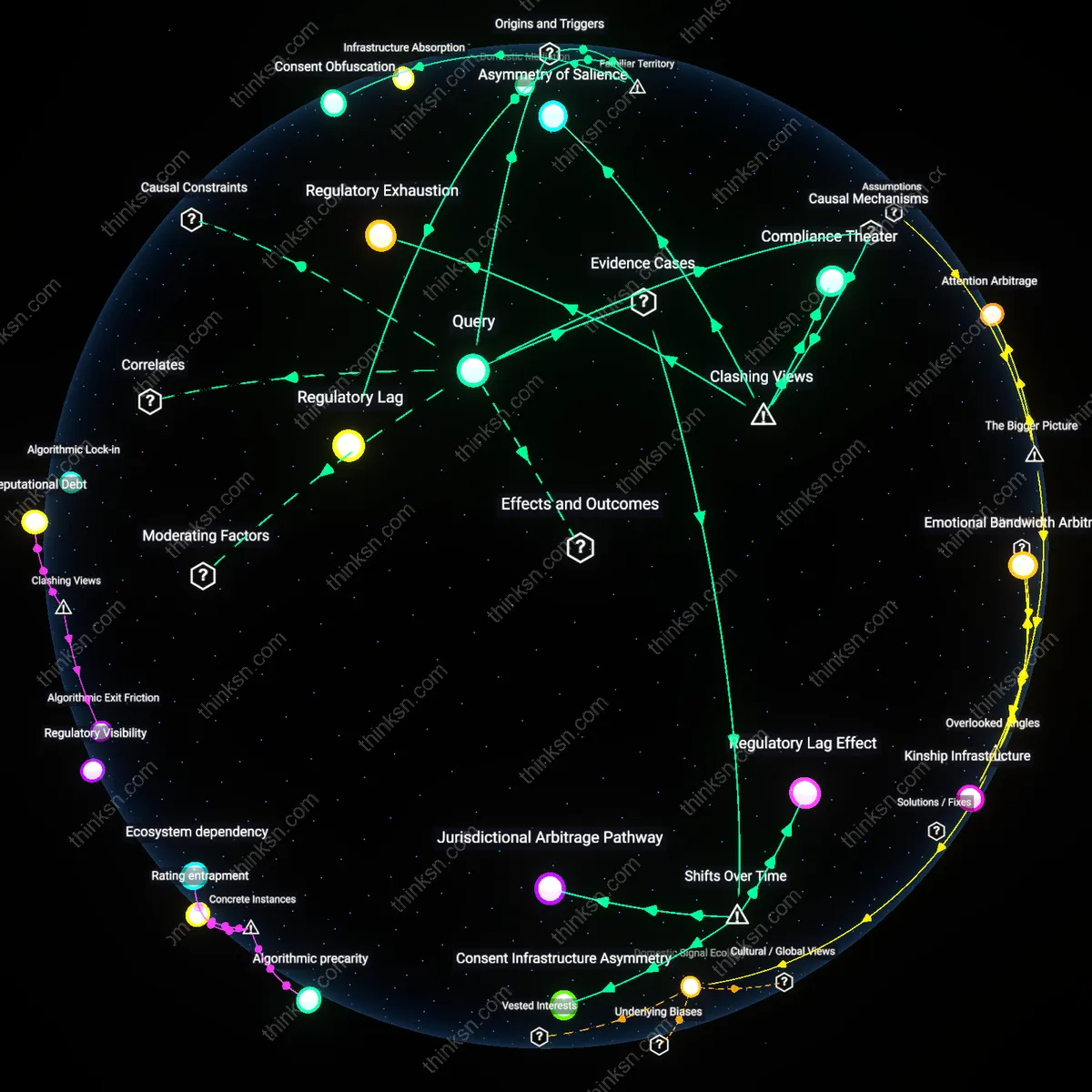
Analysis reveals 9 key thematic connections.
Key Findings
Regulatory Lag
Weak enforcement of the CCAA stems from technological innovation outpacing legislative updates, leaving gaps in oversight. Legislative bodies rely on precedent-driven processes that cannot rapidly adapt to the speed at which tech firms deploy new location-tracking capabilities, allowing companies like Google and Meta to normalize data collection before rules are codified. This reveals that the power imbalance is structurally embedded in temporal misalignment—the state operates on a slow, deliberative clock, while platform capitalism advances in real time, making enforcement reactive rather than preventive. The underappreciated reality is that the law’s stability, often seen as a virtue, becomes a vulnerability in digital markets.
Consent Obfuscation
The CCAA’s limited enforcement reveals that user consent mechanisms are designed to simulate autonomy without delivering it. Tech firms embed location permissions in lengthy, jargon-filled terms of service—interfaces users must accept to access essential services—making refusal functionally costly. This dynamic leverages behavioral inertia and information asymmetry, where consumers assume they have control but lack usable knowledge or alternatives. What’s rarely acknowledged is that the illusion of informed consent, not its absence, is the system’s intended outcome, reinforcing corporate power through normalized surrender.
Infrastructural Dependence
Ordinary consumers cannot realistically avoid location-based services because these are woven into critical routines like navigation, employment verification, and social coordination. Companies like Apple and Uber have positioned their platforms as utilities, making opting out socially and economically prohibitive, while simultaneously lobbying against strict CCAA enforcement through industry coalitions. The imbalance emerges not from consumer ignorance alone but from systemic lock-in, where everyday functionality depends on surveillance-inflected infrastructure. The overlooked insight is that power resides less in overt coercion and more in the quiet necessity of participation.
Regulatory Exhaustion
The limited enforcement of the CCAA does not stem from corporate evasion but from administrative saturation, where oversight bodies are structurally overwhelmed by the volume and velocity of data practices they are meant to monitor. Enforcement agencies like the FTC or state attorneys general face finite investigative bandwidth and rely on complaint-driven models, meaning violations by firms like Google or Uber accumulate faster than they can be processed—this is not weakness but overload. The non-obvious insight is that underenforcement is not a sign of captured regulators or regulatory capture, but of a system so inundated that even willing enforcers cannot act at scale, revealing how the sheer operational tempo of large tech firms functions as a form of de facto immunity.
Asymmetry of Salience
The CCAA’s weak enforcement reveals not institutional failure but a divergence in priority systems, where consumer location privacy is functionally deprioritized in daily life despite legal recognition. Most users continue to engage with location-based services from companies like Apple or Uber even when informed of data collection, treating access and convenience as non-negotiable—this habitual acquiescence signals to enforcers that privacy violations are low-stakes politically, even when legally actionable. The dissonance lies in rejecting the assumption that underenforcement reflects only corporate dominance; instead, it exposes how collective consumer behavior legitimizes lax enforcement by rendering privacy claims episodic rather than urgent.
Compliance Theater
Limited enforcement of the CCAA persists because major tech platforms fulfill the appearance of compliance through granular permissions and pop-up interfaces, creating a procedural shield that absorbs regulatory scrutiny without altering underlying data extraction. Firms like Facebook or Snapchat deploy design architectures that technically satisfy CCAA notice requirements, allowing regulators to close cases on 'user consent' grounds, even when choice is illusory due to interface coercion. This challenges the intuitive view that enforcement gaps reflect regulatory absence—it instead reveals how performative adherence simulates accountability, transforming legal obligations into ceremonial routines that protect power by mimicking redress.
Regulatory Lag Effect
The limited enforcement of the CCAA after 2018 reveals that regulatory frameworks evolved too slowly to keep pace with the rapid expansion of location-based ad targeting by firms like Google and Facebook, allowing these companies to normalize data extraction before legal oversight could adapt. The Federal Trade Commission’s reactive posture—exemplified by the 2019 $5 billion penalty against Facebook that did not alter underlying data practices—demonstrates how enforcement rituals replaced structural correction, enabling tech firms to treat fines as operational costs. This shift from anticipatory governance to retrospective sanctioning, solidified in the post-Snowden era, reveals how the timing mismatch between legislative cycles and technological deployment entrenches corporate control. The underappreciated consequence is that the delay itself becomes a tactical advantage, not merely a systemic flaw.
Consent Infrastructure Asymmetry
The weakening of CCAA enforcement after the 2016 shift toward opt-in geolocation tracking standards reveals how design-level changes in user interfaces—such as Apple’s and Google’s default settings—systematically disadvantaged consumer agency despite apparent transparency gains. As Android and iOS platforms introduced granular permissions during OS updates, the complexity and frequency of prompts led to decision fatigue, which firms exploited by timing data requests during moments of high user engagement. This transition from invisible tracking to ritualized consent, beginning in earnest around 2018, reframed user choice as performative compliance rather than meaningful control. The non-obvious outcome is that the very mechanisms meant to empower consumers became tools for legitimizing data extraction.
Jurisdictional Arbitrage Pathway
The failure to enforce the CCAA against multi-state location tracking by firms like Clearview AI after 2020 reveals how decentralized enforcement authority enabled tech firms to exploit gaps between federal inaction and fragmented state-level responses. Unlike traditional consumer protection regimes anchored in territorial regulation, geolocation platforms operated through federated data systems that routed user data through permissive jurisdictions like Texas or Delaware before re-entering regulated markets. This post-2018 fragmentation phase, marked by California’s CCPA diverging from weaker frameworks in other states, allowed companies to centralize surveillance practices while localizing compliance. The overlooked dynamic is that enforcement decentralization didn’t merely weaken regulation—it was re-engineered into a scalable evasion infrastructure.