Why FTC Fines for Deceptive Ads Fall Short of Consumer Justice?
Analysis reveals 11 key thematic connections.
Key Findings
Regulatory Deterrence Calibration
FTC fines are deliberately small to maintain prosecutorial flexibility and avoid setting precedents that could limit future enforcement leverage against repeat offenders. By imposing moderate penalties, the FTC preserves its capacity to negotiate consent decrees and avoid protracted litigation, which would otherwise strain its limited administrative resources and weaken systemic deterrence across the broader market. This approach reflects a calculated trade-off where individual consumer redress is subordinated to long-term institutional strategy, revealing that the FTC acts less as a consumer restitution body and more as a calibrated market regulator. The non-obvious insight is that low fines are not a failure of enforcement but a feature of strategic constraint management.
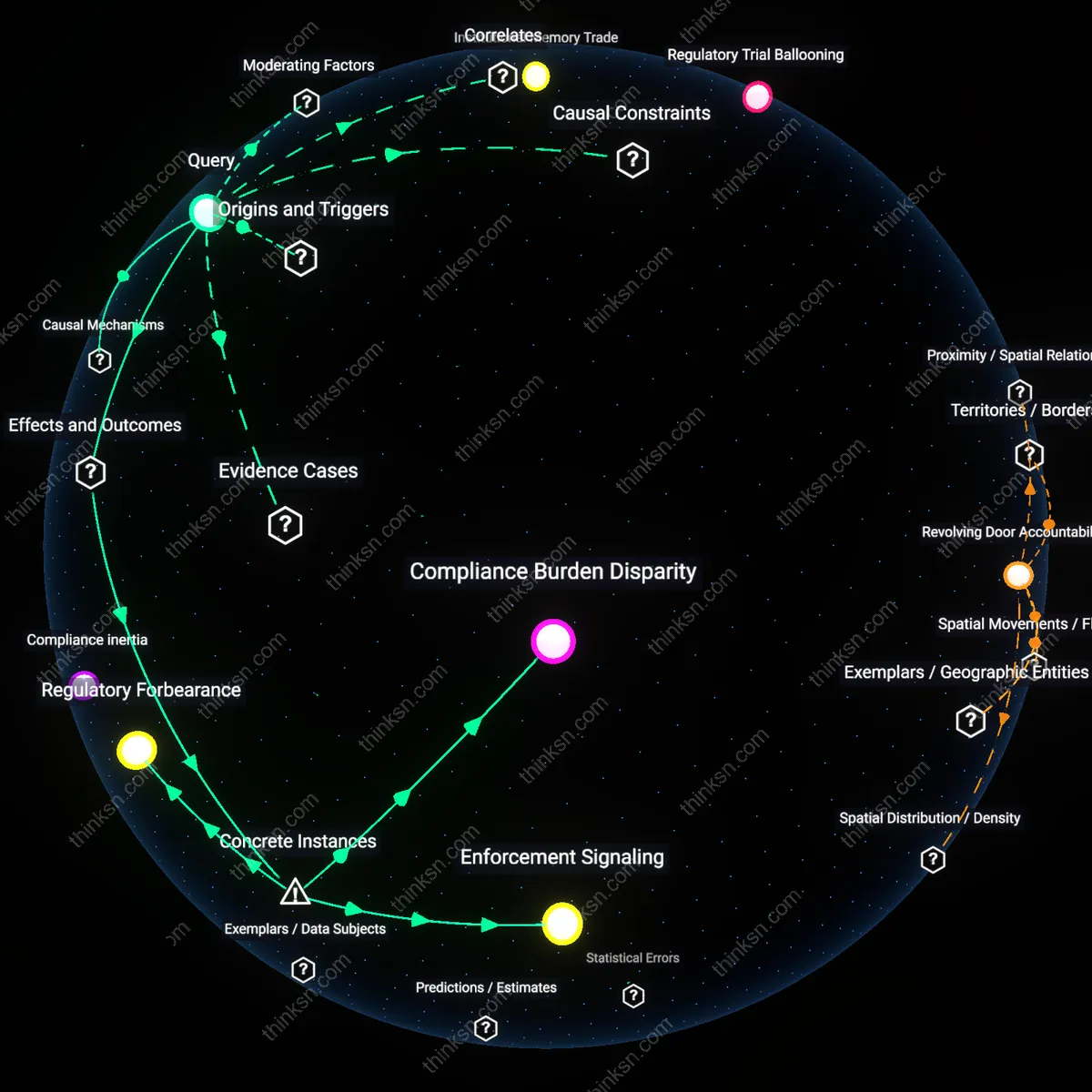
Enforcement Signaling Economy
Small fines function as cost-justified signals to investors and competitors rather than punishments, where the primary audience for FTC actions is the capital market, not deceived consumers. By levying predictable, non-excessive penalties, the FTC enables firms to model compliance costs and reassure shareholders that regulatory risk is manageable, thus stabilizing market expectations. This reframes enforcement not as consumer protection but as a tool for regulatory predictability, where the fine's communicative value supersedes its redistributive potential. The dissonant finding is that the FTC’s success is measured by market normalization, not consumer restitution—exposing a hidden audience in regulatory theater.
Budget Constraints
FTC enforcement actions impose small fines because Congress allocates limited funding to the agency, restricting its legal capacity to pursue large-scale restitution. The FTC relies on congressional appropriations that fall short of the investigative and litigation resources needed to track dispersed consumer harm or establish complex damages models, especially across digital platforms with vast user bases. This creates a gap between statutory authority and operational reach, where even proven violations yield minimal penalties due to cost-benefit calculations in case selection—something rarely acknowledged in public debates that assume enforcement power reflects political will alone.
Legal Liability Thresholds
FTC enforcement results in fines rather than redress because federal consumer protection statutes authorize injunctive relief and civil penalties but do not provide a private right of action or automatic restitution framework enforceable by the agency. Courts require the FTC to prove actual consumer injury with specificity before ordering relief, and judges often cap penalties based on statutory maximums per violation, not total harm. This structural constraint—embedded in the Federal Trade Commission Act’s remedial design—explains why penalties appear trivial relative to corporate revenues, a detail obscured in public discourse that frames fines as moral judgments rather than legal calculations.
Administrative Backlog
FTC enforcement actions yield small fines because the agency prioritizes speed and precedent over restitution in its case docket, opting for consent decrees with minimal admissions of guilt to conserve scarce legal resources. Facing years-long delays in federal court and administrative proceedings, the FTC resolves most cases through negotiated settlements that avoid costly trials, trading full redress for guaranteed injunctive relief. This tradeoff—visible in the Commission’s annual performance reports but absent from media narratives—reveals how procedural efficiency, not just deterrence, shapes the scale of penalties, undermining expectations of consumer compensation.
Budget-Zone Tradeoff
FTC enforcement yields small fines because appropriations constrain the number of consumer-redress-focused legal teams, forcing the agency to prioritize cases with broad jurisdictional novelty over distributed harms. The DOJ-controlled antitrust and civil divisions receive larger enforcement budgets, leaving the FTC to ration legal capacity across deceptive advertising dockets, which skews remediation toward symbolic penalties. This bottleneck reveals how inter-agency budget allocation, not legal authority or corporate resistance, governs redress scale—an overlooked steering mechanism in enforcement outcomes.
Evidence Fungibility Threshold
FTC cannot deliver meaningful consumer redress because courts require individualized proof of material deception, but advertising victims are often statistically numerous and geographically diffuse, making verification of harm more expensive than potential restitution. This creates a paradox where class-wide deception is too thinly spread to justify claims, rendering redress economically nonviable even when wrongdoing is proven. The dynamic exposes how evidentiary rules—rarely questioned in policy debates—act as a stealth filter that nullifies remedial intent at scale.
Remediation Narrative Gap
FTC fines stay minimal because redress mechanisms depend on media amplification to validate agency impact, yet deceptive advertising cases rarely generate public visibility compared to data breaches or monopolistic behavior, undermining political incentives for costly restitution campaigns. Without narrative salience, Congress and internal reviewers reward case closure over consumer reimbursement, directing resources to high-profile domains. This reveals how perception infrastructure—an unacknowledged dependency in enforcement gravity—determines remedial investment more than harm magnitude.
Institutional Capacity Lag
The FTC began prioritizing deterrence over restitution in the 1980s due to systemic underfunding and judicial constraints, shifting enforcement toward injunctive relief and symbolic fines. This transition emerged when courts increasingly rejected broad consumer redress orders in cases like *FTC v. Amy Travel* (1983), which limited the agency’s ability to manage complex disgorgement schemes. As the volume of deceptive advertising exploded with direct marketing and later digital platforms, the FTC lacked sufficient staff and technological infrastructure to identify, calculate, and distribute meaningful compensation—particularly in cases involving transnational operations or diffuse harm, such as in *LabMD* or *Everalbum*. This underappreciated shift from redress-as-core-mission to redress-as-logistical-afterthought reveals how regulatory ambition is shaped not just by legal authority, but by operational feasibility eroded over decades.
Judicial Risk Aversion
After the 1994 *Kmart v. FTC* decision and subsequent circuit court rulings, courts began treating large-scale monetary redress as an equitable remedy requiring precise accounting, effectively constraining FTC disgorgement powers unless consumer harm was individually traceable. This legal turning point, solidified in the early 2000s, forced the FTC to settle for smaller, stipulated penalties that could be swiftly enforced, as seen in cases like *Purity Knight* (2007) and *Vemma* (2015), where proposed redress was gutted through litigation risk. The non-obvious consequence of this judicial shift is that the FTC now often settles for nominal fines not due to lack of will, but because full redress would require evidentiary burdens comparable to civil litigation—transforming the enforcement model from compensatory justice to calibrated deterrence calibrated against judicial hostility.
Asymmetric Enforcement Trajectory
From the early 2000s onward, the FTC increasingly outsourced consumer redress to state attorneys general and private class actions, allowing it to focus on precedent-setting injunctive orders while accepting minimal fines in exchange for broader behavioral bans—evident in cases like *LendingTree* (2006) and *Weight Watchers/KidzJet* (2022). This strategic retreat from restitution emerged when the agency recognized that federal mechanisms for mass redress were too slow and politically visible, whereas fines served as low-friction enforcement markers. The underappreciated pivot here is that the FTC’s apparent leniency in fines reflects not weakness, but a deliberate shift toward leveraging its rulemaking and consent decree authority as the primary vehicle of market shaping, leaving compensatory justice to decentralized actors better positioned for claims processing.