Is a Lateral Move Worth Losing Long-Term Career Advancement?
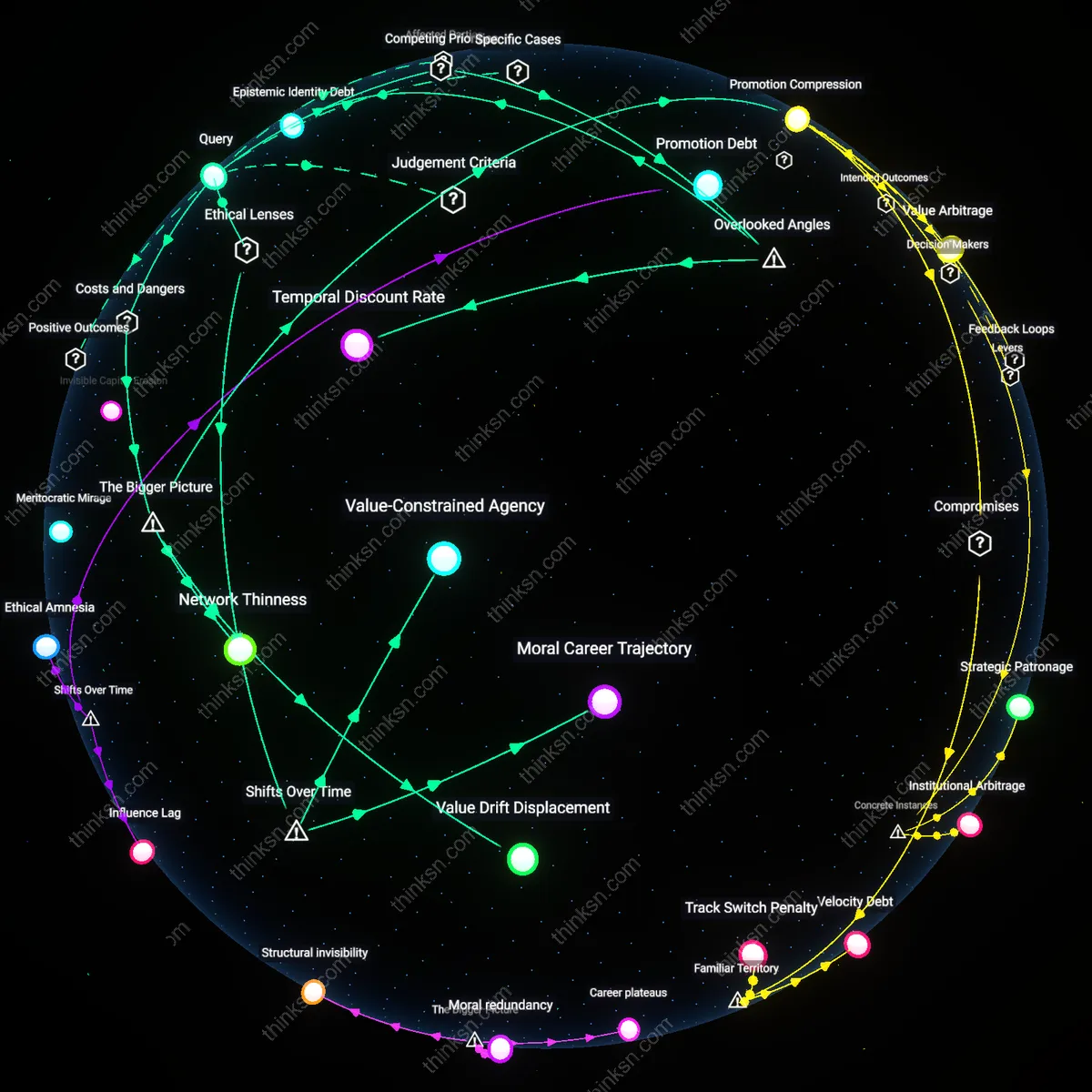
Analysis reveals 8 key thematic connections.
Key Findings
Promotion Compression
A lateral move to align with personal values risks triggering promotion compression by disrupting the expected tempo and hierarchy of advancement within corporate pipelines. In large bureaucratic organizations—such as multinational consultancies or federal agencies—promotion is often cohort- and timeline-gated, where delays or non-linear moves signal diminished leadership potential to algorithmic HR systems and senior evaluators alike. This creates a structural penalty not immediately visible at the time of transfer, as the employee becomes systemically deprioritized for high-visibility succession tracks, even if performance remains strong. What’s underappreciated is that value alignment becomes a career tax when organizational inertia equates trajectory with merit, regardless of actual output.
Value Drift Displacement
Prioritizing personal values through a lateral shift unintentionally fuels value drift displacement by offloading moral or ethical labor onto less empowered peers within the same organizational ecosystem. When an individual exits a high-impact but misaligned role to join a mission-congruent team, they often leave behind a vacuum that gets filled by someone more willing to compromise—accelerating cultural erosion in precisely the domains where integrity was most needed. This dynamic is amplified in industries like tech or finance, where project ownership is siloed and accountability diffused; the systemic consequence is not just individual stagnation but the metastasizing of instrumental rationality across critical nodes. The overlooked mechanism is that withdrawal for ethical reasons can function as a perverse subsidy to norm decay.
Network Thinness
Switching laterally for values alignment risks inducing network thinness by detaching the individual from dense webs of instrumental relationships concentrated in core business units—such as product development in Silicon Valley firms or trading desks in investment banks. These networks operate as hidden promotion infrastructure, where informal mentorship, deal access, and reputation accrual occur through proximity and repeated interaction. A values-driven move to peripheral or ESG-adjacent roles often relocates the employee to structural holes with low tie strength, reducing their visibility during pivotal board-level succession planning. The non-obvious systemic cost is that ethical positioning, when geographically isolated, becomes cognitively separable from executive power—rendering values both preserved and powerless.
Temporal Discount Rate
Lateral moves aligned with personal values often succeed in reducing psychological erosion that silently compounds over time, altering an individual’s implicit temporal discount rate—where long-term career advancement is devalued not by loss of opportunity but by sustained mental fatigue. High-stress misaligned roles degrade future-oriented thinking, making individuals more likely to abandon advancement trajectories anyway; choosing alignment preemptively stabilizes cognitive resource allocation. This dimension is rarely considered because career models assume rational actors with stable time preferences, ignoring how job context reshapes decision-making time horizons through neurocognitive wear.
Relational Mobility Ceiling
Shifting laterally to match personal values can unexpectedly constrain access to high-mobility professional networks that depend on perceived ambition consistency, thereby lowering an individual’s relational mobility ceiling—the unspoken threshold beyond which peers and mentors no longer vouch for or include them in advancement-critical loops. These networks operate on implicit trust in trajectory continuity, and a values-justified detour is often interpreted as reduced commitment, even when performance remains high. This effect is overlooked because most analyses treat networks as neutral conduits, not value-laden systems that penalize moral recalibration as social drift.
Epistemic Identity Debt
Accepting a lateral move for values alignment risks accumulating epistemic identity debt—where the professional self becomes cognitively fragmented because daily work no longer reinforces the expertise narrative recognized by influential peers, leading to diminished credibility in strategic conversations. This occurs when one’s role fails to validate the knowledge identity expected in advancement pathways, eroding informal influence even when formal performance is intact. It is typically ignored because career models focus on output metrics, not the identity-level coherence required to be seen as a legitimate future leader.
Value-Constrained Agency
Accepting a lateral move to align with personal values reflects a shift from utility-driven career rationality to ethics-laden autonomy, as seen in post-WWII professionalization where liberal individualism began challenging Weberian bureaucratic neutrality; this transition reveals that professionals now treat career decisions as moral commitments rather than mere positional climbs, embedding Kantian deontology into labor mobility. The non-obvious dimension is that this agency is not freely exercised but constrained by institutional tolerance for ethical deviation—visible in sectors like tech and finance since the 2010s, where ‘ethics resignations’ signal a new normative boundary between self-integrity and organizational loyalty.
Moral Career Trajectory
The risk to long-term advancement from a values-aligned lateral move has diminished since the rise of stakeholder capitalism in the 1990s, because ESG frameworks and corporate social responsibility have institutionalized ethical consistency as a leadership credential; executives who pivot laterally for integrity now gain reputational capital that functions as a developmental proxy for promotion, particularly in regulated industries post-Enron. What is underappreciated is that this creates a new career logic—moral continuity over linear ascent—where deviation from personal values becomes a mark of unfitness, not just personal compromise.