Sue for Overtime or Stay Silent? The Salaried Employees Dilemma
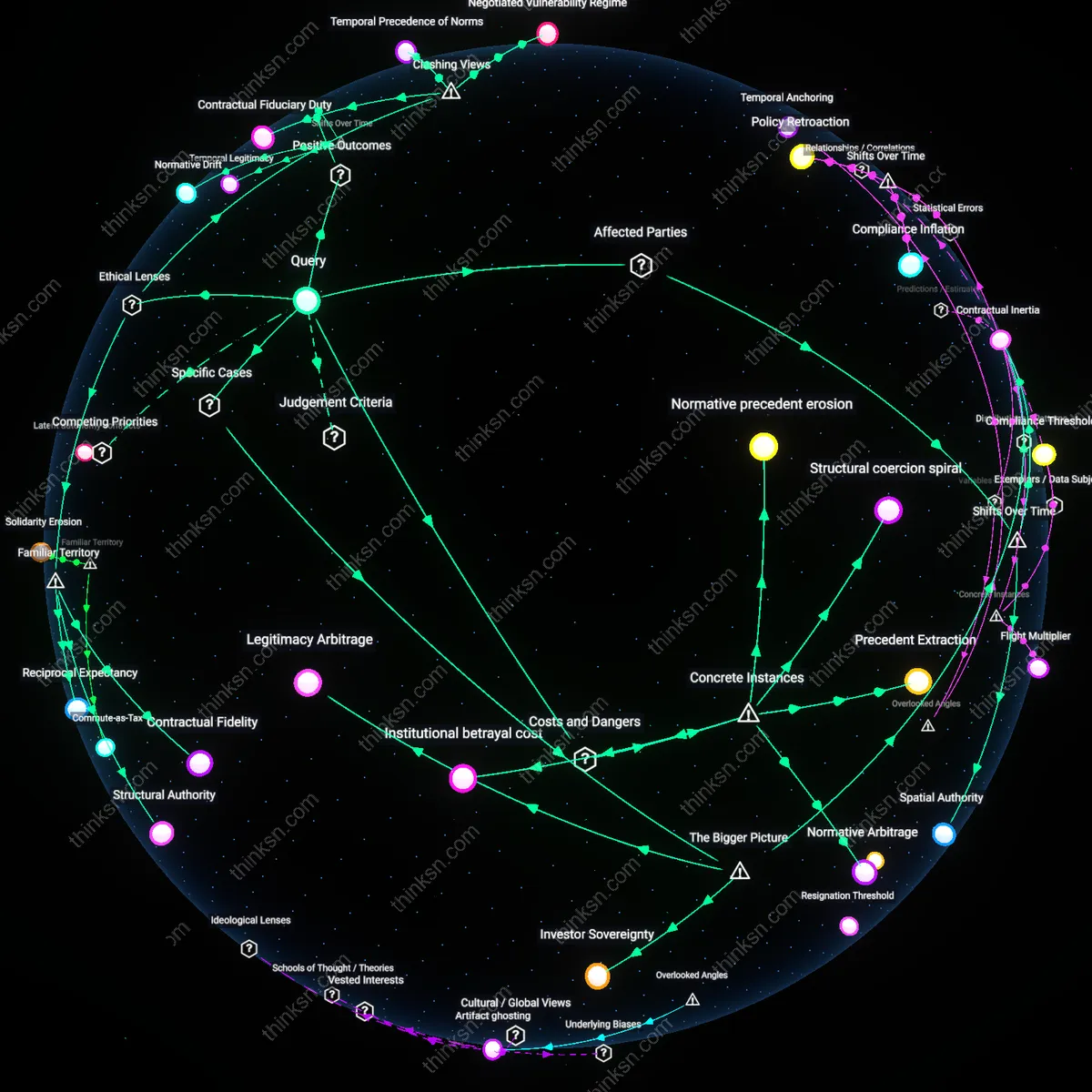
Analysis reveals 9 key thematic connections.
Key Findings
Retaliation Entrenchment
Pursuing unpaid overtime litigation after exhausting a biased internal process risks career-ending retaliation, as seen in the 2013 case of Regina Saulo vs. Walmart, where a salaried assistant manager was constructively discharged following her formal complaint over off-the-clock work demands. Despite documenting overtime discrepancies and following internal protocols, Saulo faced immediate isolation, schedule manipulation, and false performance accusations—tactics that research consistently shows are used to delegitimize claims before legal escalation. This reveals how the very act of contesting unpaid labor can activate informal managerial sanctions that are difficult to prove but devastating to livelihood, embedding organizational resistance into personal consequence.
Procedural Exhaustion Trap
Mandatory internal dispute resolution mechanisms can function as legal shields rather than remedial tools, as demonstrated by the 2016 settlement in Carrillo v. Chipotle Mexican Grill, where plaintiffs showed the company’s internal review system for wage claims was systematically underfunded and staffed with non-legal personnel trained to discourage escalation. Employees who followed protocol were recorded as having ‘resolved’ disputes informally, weakening their standing in federal court under the Fair Labor Standards Act. This dynamic transforms procedural compliance into evidentiary prejudice, privileging the appearance of due process over its substance.
Status-Based Legal Disparity
Salaried employees classified as ‘exempt’ under the Fair Labor Standards Act—even when performing non-managerial duties—are frequently denied standing to claim overtime, as illustrated by the 2018 Ninth Circuit ruling in Harris v. HomeTeam Securities, where security supervisors were reclassified as non-exempt only after years of litigation despite logging over 55-hour weeks. The court found the employer had manipulated job descriptions to fit exemption categories, but the initial legal barrier discouraged individual suits due to high evidentiary burdens. This exposes how classification systems weaponize legal formalism, converting job titles into shields against compensation regardless of actual work performed.
Judicial Asymmetry
A salaried employee should sue their employer for unpaid overtime only if they can secure legal standing that bypasses internal grievance mechanisms, because courts in the United States increasingly serve as default arbiters when administrative processes are structurally skewed by employer control over appeals. Federal labor protections under the Fair Labor Standards Act (FLSA) allow employees to file collective actions, but the effectiveness of such claims depends on overcoming procedural defenses like forced arbitration clauses and employer-classified exemptions—mechanisms that reflect a systemic imbalance where judicial access is preserved in theory but constrained in practice by resource and information disparities. This reveals the underappreciated reality that the legal system does not neutralize workplace power imbalances but reproduces them through differential access to litigation infrastructure, with corporations leveraging standardized employment contracts to pre-emptively isolate disputes from public adjudication.
Compliance Theater
A salaried employee should evaluate litigation as a necessary disruption when internal dispute resolution processes function primarily as symbolic compliance tools rather than pathways to restitution, a dynamic enabled by federal enforcement reliance on employer self-auditing and reactive investigations by the Wage and Hour Division. These internal systems often satisfy legal appearance requirements without producing material corrections, especially in sectors like tech and finance where salaried roles are routinely misclassified under “administrative” or “executive” exemptions to avoid overtime mandates. The non-obvious consequence is that employees who sue do not merely seek back pay but expose a broader regulatory dependency on perfunctory institutional rituals, wherein oversight bodies are under-resourced to detect violations without whistleblower-initiated lawsuits, thus making individual litigation a de facto enforcement mechanism within a chronically underfunded public compliance regime.
Temporal Precarity
A salaried employee should weigh the timing of legal action against the escalating personal cost of delayed income recovery, because the longer an employee remains within a biased internal process, the more they accumulate opportunity costs in foregone wages and diminished employability due to workplace alienation. This tradeoff is structurally enforced by the absence of interim remedies—such as wage continuation or neutral third-party review—during internal appeals, which are often designed to prolong resolution beyond the employee’s financial or emotional endurance. The overlooked dynamic is how employers in knowledge-based industries exploit the temporal architecture of dispute resolution to induce self-withdrawal, rendering legal action not just a challenge to wage theft but a race against an invisible countdown fueled by personal economic fragility embedded in the fixed-cost reality of salaried work.
Procedural Subordination
A salaried employee should evaluate suing their employer for unpaid overtime by recognizing that the internal dispute resolution process functions not as a neutral arbitrator but as a mechanism of procedural subordination that reproduces employer dominance. Introduced in the late 20th-century corporate governance reforms, mandatory arbitration clauses and internal grievance systems were restructured to prioritize organizational stability over individual redress, embedding legal deference to managerial authority—an evolution from earlier labor protections rooted in New Deal-era due process norms. This shift, crystallized in the 1998 Supreme Court decision in Gilmer v. Interstate/Johnson Lane Corp., normalized the privatization of labor disputes, making internal processes structurally blind to power asymmetry and thus rendering individual litigation a rupture rather than a remedy. The non-obvious insight is that the bias in dispute resolution is not a flaw but a design feature evolved to absorb dissent without altering hierarchy.
Temporal Displacement
A salaried employee should consider litigation as a means of challenging how the definition of 'exempt' status has shifted since the 1985 Fair Labor Standards Act (FLSA) amendments, which reclassified broad categories of salaried workers—especially in managerial and administrative roles—as exempt from overtime protections regardless of actual job duties. This reclassification, accelerated by the 2004 FLSA regulatory overhaul under the Bush administration, progressively disentangled salary form from labor content, enabling employers to avoid overtime obligations by reclassifying positions rather than compensating hours worked. The non-obvious insight is that the employee’s current dispute is not merely about unpaid wages but about a decades-long erosion of the temporal boundary between work and compensation, where labor extraction expands precisely through the abolition of measurable thresholds. Thus, suing becomes a claim against the temporal displacement of work itself.
Ethical Retrofitting
A salaried employee should evaluate litigation as an act of ethical retrofitting—invoking deontological labor rights under Kantian fairness that were central to the mid-20th-century labor compact, but now function as subversive claims within a neoliberal employment regime where residual legal duties conflict with normalized managerial discretion. Since the 1970s, fiduciary duty to shareholders has progressively displaced ethical obligations to employees, reframing overtime not as a moral entitlement but as a cost variable; courts, however, still uphold FLSA as a floor of minimal justice, creating a disjuncture that employees can weaponize. The non-obvious insight is that pursuing unpaid overtime today is not merely a legal action but a reinsertion of moral personhood into a system designed to reduce employees to contractual functions—thereby exposing how past ethical frameworks persist as disruptive potentials within current doctrine.