TikTok Mood Swings: Mixed Evidence and Mental Health Implications?
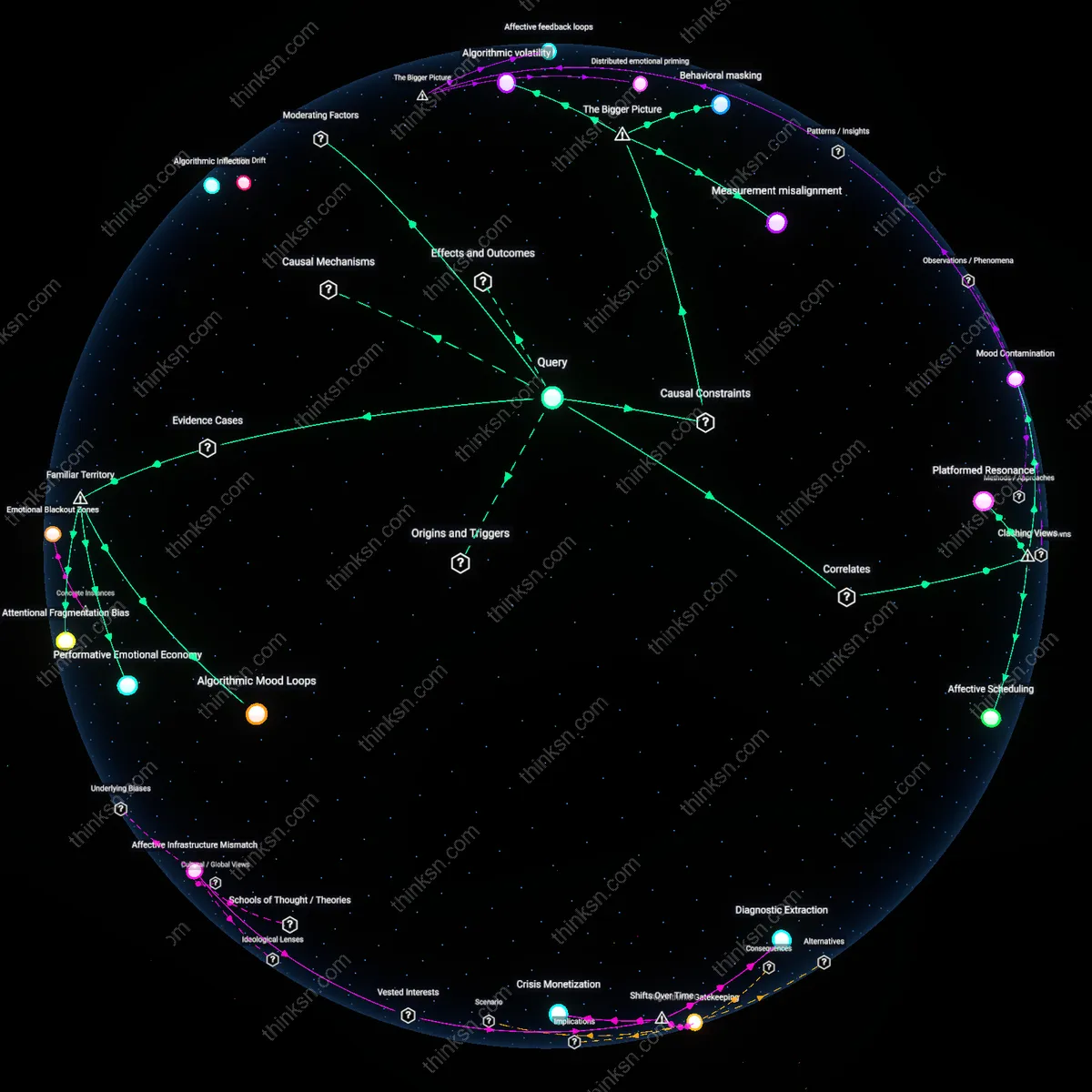
Analysis reveals 12 key thematic connections.
Key Findings
Algorithmic Inflection
TikTok’s shift from chronologically ordered content to behaviorally optimized recommendation systems after 2018 intensified mood volatility by prioritizing emotionally salient stimuli, which destabilized user affect in ways that vary by engagement pattern. The mechanism—attentional feedback loops generated by real-time behavioral tracking—means mood effects are not inherent to the platform but emerge from the timing, frequency, and affective charge of content sequences shaped by backend AI. This produces inconsistent findings in mood studies because early research assumed content type (e.g., humorous vs. distressing) was the primary driver, overlooking how the temporal structure of exposure—shaped by a post-2018 algorithmic overhaul—modulates emotional outcomes. The historical pivot from time-based to engagement-maximizing delivery systems reveals that what appears as inconsistent evidence is actually phase-dependent variation in platform architecture.
Era of Contingent Coping
The inconsistency in TikTok's mood effects since 2020 stems from users increasingly deploying the app as an on-demand affect regulation tool, shifting from passive consumption to active emotional self-management amid rising mental health distress during the pandemic. Young users, in particular, curate dual-use strategies—simultaneously seeking relief through niche communities (e.g., ADHD or anxiety support) while being exposed to triggering content—creating divergent mood trajectories that depend on individual regulatory capacity and digital literacy. This development renders aggregate mood studies misleading, as TikTok no longer functions uniformly as a mood disruptor or enhancer but as a context-sensitive coping interface whose impact hinges on how users navigate affective trade-offs in real time. The transition to crisis-era digital coping reveals that mood outcomes are not fixed but pivot on the user’s role as a strategic emotional technician.
Modality Drift
The evidential inconsistency in TikTok’s mood effects emerged after 2022 as the platform's dominant content form shifted from short-form performance videos to immersive, high-sensory 'moodscapes'—ambient loops, whispered audio, and rhythmic visuals—designed less for engagement than for autonomic regulation. This modality shift, driven by creator experimentation and user demand for calming content, activates parasympathetic nervous system responses that can elevate mood in controlled doses but induce dissociation or flattening with prolonged exposure, producing contradictory findings in studies that treat all video types as functionally equivalent. Unlike earlier eras where mood impact was tied to social comparison or narrative content, current effects are increasingly mediated by neurophysiological entrainment to audiovisual patterns, rendering past models of digital mood influence obsolete. The rise of sensory-first design reveals that TikTok’s mental health implications are no longer primarily social but perceptual in origin.
Mood Contamination
TikTok algorithms amplify mood-congruent content regardless of valence, meaning users in low moods are systematically fed more negative or distressing content, creating a feedback loop that mimics causation between platform use and worsening mood, when the observed correlation arises from real-time personalization to affective states. This mechanism operates through TikTok's engagement-driven recommendation engine, which detects micro-behaviors like dwell time and rewatch frequency—biomarkers of emotional arousal—and intensifies content alignment accordingly, often deepening the user's existing mood state. The non-obvious implication is that mood changes attributed to TikTok may not stem from raw usage duration or content type, but from algorithmic responses to mood-indicative user behavior, effectively contaminating emotional trajectories with engine-reflected feedback.
Affective Scheduling
Users experiencing emotional distress deliberately seek TikTok as a self-administered affective intervention, scheduling platform use during low-mood episodes to stimulate arousal or validation, which inflates statistical associations between TikTok use and mood decline without implying platform-induced harm. This self-regulatory behavior operates through voluntary timing mechanisms in which users deploy TikTok as an emotional tool during pre-existing downswings, often tracking recovery phases as well, which introduces reverse causality into observational data—a pattern especially prevalent among adolescent and young adult demographics using the app for identity-framed emotional mirroring. The dissonant finding here—that higher usage correlates with mood dips not because TikTok causes them, but because users deploy it precisely during them—undermines assumptions of passive victimization and highlights strategic engagement patterns masked by aggregate metrics.
Platformed Resonance
Short-term mood fluctuations linked to TikTok use are less about the platform’s content or design than about users’ social synchronization with microculture rhythms—shared emotional pulses in comment threads, duet chains, or viral challenges—that generate transient but intense collective affect states which dissipate as trends exhaust, making mood effects contextually bound rather than individually attributable. This dynamic operates through densely networked participation loops unique to TikTok’s socially embedded algorithm, where emotional valence spreads virally not through personalization alone, but through co-creative acts like stitching or sound reuse that bind mood to communal expression. The underappreciated insight is that mood changes reflect not exposure, but resonance with ephemerally dominant group affects—revealing that TikTok’s mental health impact is not located in isolated usage but in temporal alignment with emotionally charged cultural currents.
Algorithmic volatility
TikTok’s recommendation system prevents consistent mood effects by continuously adapting content based on real-time engagement signals rather than user well-being. This creates unpredictable emotional outcomes, as the same user may encounter mood-elevating or distressing content within minutes due to shifts in inferred engagement preferences, with no stable feedback loop for emotional regulation. The non-obvious insight is that personalization mechanisms—driven by platform growth metrics—actively destabilize emotional consistency, making sustained mental health benefits structurally unviable under current incentive models.
Behavioral masking
Users’ self-reported mood changes mask deeper affective adaptations that undermine mental health gains, as short-term emotional spikes from TikTok use often reflect conditioned responses to variable reward schedules rather than authentic mood improvement. These responses are reinforced by interaction patterns optimized for retention, not psychological resilience, causing subjective well-being measures to conflate habituation with benefit. This reveals how platform-mediated affect is misinterpreted within individual cognition, producing a systemic blind spot in both research and personal evaluation of digital well-being.
Measurement misalignment
Empirical studies fail to capture TikTok’s mood effects because they rely on standardized timelines and survey tools that do not align with the app’s hyper-accelerated affective cycles, which operate on timescales of seconds rather than hours or days. Standard mood assessments assume emotional persistence, but TikTok’s micro-content triggers transient, subclinical shifts that dissipate before measurement thresholds are met, rendering them statistically invisible. The critical underappreciated factor is that existing mental health research infrastructure is temporally mismatched to the kinetics of platform-mediated emotion, producing structural null findings.
Algorithmic Mood Loops
TikTok’s recommendation algorithm intensifies short-term emotional responses by rapidly serving content that mirrors a user’s immediate affective state, such as showing distressing videos after a user lingers on one sign of sadness. This feedback loop is most visible in teenagers scrolling late at night, where the system’s speed and affective sensitivity override conscious intent, making mood shifts feel involuntary. The non-obvious implication is that the platform doesn’t just reflect mood—it becomes a real-time emotional regulator, which users increasingly rely on without recognizing its destabilizing effects.
Performative Emotional Economy
Influencers and casual creators alike on TikTok routinely exaggerate or fabricate emotional states—like faking breakdowns or staging ‘healing journeys’—to gain engagement, creating a distorted emotional marketplace most evident in therapy-themed content from figures like ‘Trauma Tok’ coaches. This environment trains users to associate mental health progress with visible, shareable emotional displays rather than internal regulation, warping their expectations of what mood improvement feels like. The underappreciated effect is that users begin to measure their psychological state not by stability, but by how ‘post-worthy’ their emotions feel.
Attentional Fragmentation Bias
Users seeking mental health relief through TikTok often consume dozens of micro-tips—breathing techniques, grounding hacks, or affirmations—in a single session, as seen in the proliferation of ‘5-second anxiety fixes’ among college students during exam periods. Because the platform rewards brevity and immediate payoff, the interventions are stripped of context and continuity, leading to spotty adherence and unreliable results. The overlooked consequence is that the very design meant to deliver accessible mental health support systematically undermines the consistency required for actual psychological benefit.