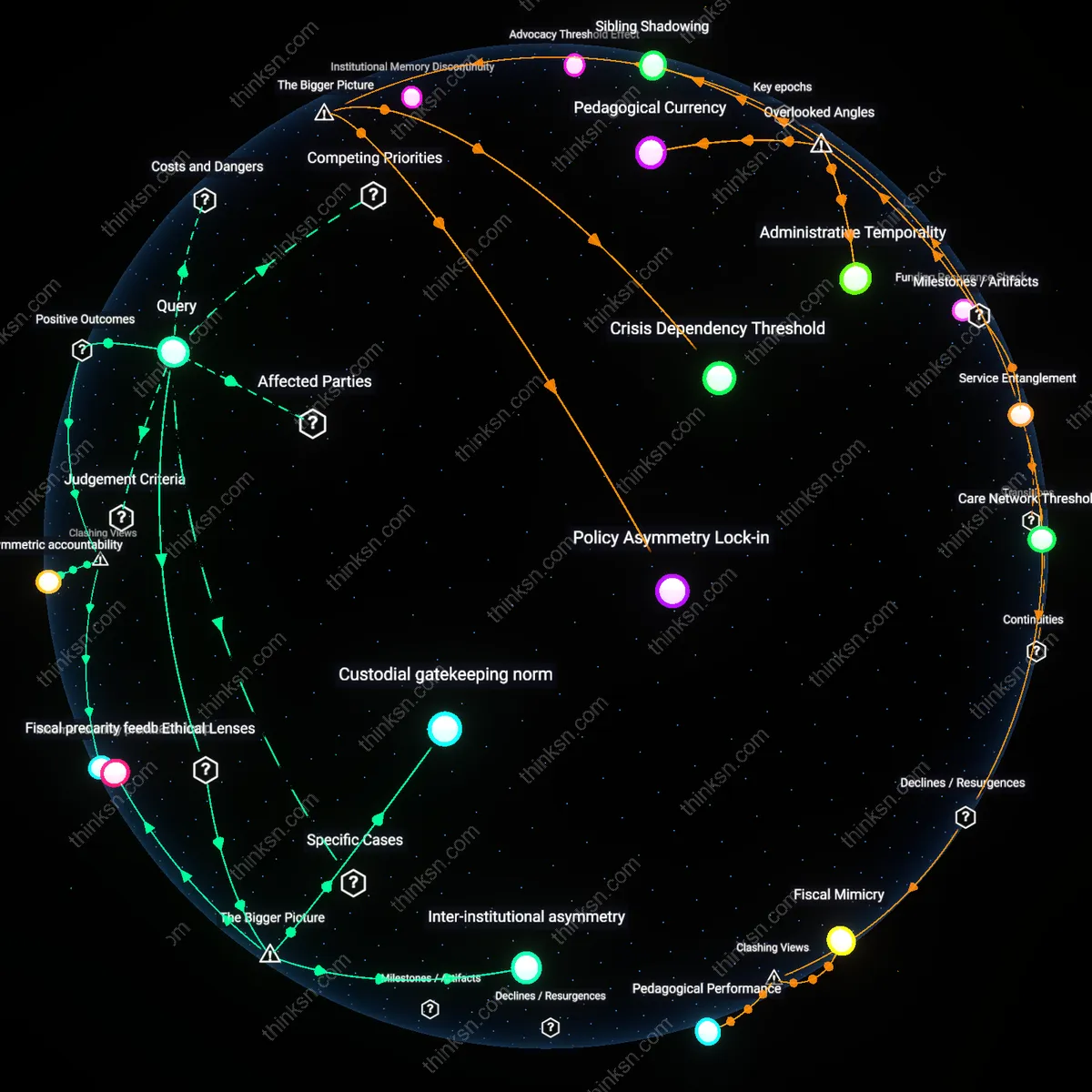
Administrative Temporal Misalignment
In 2027, Ontario’s Child Care Access Portal mandated employment verification by January 15 for September program enrollment, forcing parents to secure formal jobs eight months before childcare began; this excluded those in seasonal, gig, or contract work whose income patterns did not align with the fixed administrative calendar, revealing how state-defined timing norms privileged stable labor affiliations over caregiving needs.
Precarity Cascading
When California’s 2028 expansion of subsidized childcare required three consecutive months of pay stubs starting in Q1 2029, formerly incarcerated parents re-entering the workforce through transitional programs like CenterForce’s reentry partnerships failed eligibility despite participation, exposing how sequential documentation demands disproportionately disrupt vulnerable populations whose employment reintegration is non-linear.
Fiscal Calendar Coercion
In Scotland’s 2030 childcare rollout under the Fair Start Scheme, local authorities tied employment proof to the April–March budget cycle, denying enrollment to parents hired just after March deadlines even if they had signed contracts, demonstrating how subnational fiscal scheduling—unrelated to childcare operations—became a de facto gatekeeper to care access.
Neighbor Buffering
In multifamily housing complexes built before 2010, undocumented parents leveraged communal knowledge to bypass formal childcare requirements by shifting supervision duties to employed neighbors with approved eligibility. These informal arrangements depended on the architectural density and social trust endemic to older urban apartment buildings, where shared hallways and laundry rooms enabled discreet coordination—functions absent in newer, surveilled developments. Most assessments ignore how built environment legacies scaffold underground mutual aid, assuming formal compliance is the only pathway to childcare. The residual system is a spatially enabled, off-the-books caregiving network sustained by residual community infrastructure.
Paycheck Anticipation
Gig workers in e-commerce fulfillment hubs rescheduled shifts around biweekly pay cycles to align employment verification with rent and childcare deadlines, treating the paycheck as a de facto eligibility token. When post-2025 reforms tightened documentation timing, this strategy collapsed because auditors required real-time verification, not retroactive proof, exposing a dependency on temporal alignment between wage rhythms and bureaucratic checkpoints. Standard discourse assumes employment proof is binary, ignoring that its usability depends on synchronization with income timing—especially for workers without consistent pay dates. This reveals how wage temporality, not just job status, underpins access.
Proof Regime
The repositioning of employment verification as a prerequisite for childcare access after 2025 intensified bureaucratic exclusion among low-income parents, shifting eligibility determination from continuous enrollment to moment-based documentation. This change embedded a performative standard of labor—where parents had to produce formal pay stubs or employer letters at fixed intervals—disproportionately disrupting gig, seasonal, and informal workers whose income streams were real but episodic. Unlike earlier welfare-linked childcare policies that accommodated fluctuating employment, the post-2025 rules assumed a stable employer-employee relationship as the default, making intermittent work histories appear as noncompliance. The non-obvious consequence was not reduced childcare demand but the rise of document brokering networks in urban centers, where social service navigators helped parents time job verifications to enrollment windows, revealing the emergence of a shadow compliance infrastructure.
Temporal Mismatch
After 2025, the alignment of childcare enrollment cycles with quarterly employment verification schedules created a structural delay that systematically disadvantaged parents in precarious work, particularly in regions with seasonal tourism or agriculture. This shift replaced the prior system, which allowed retroactive income reporting, with real-time proof requirements that treated unemployment gaps as disqualifying rather than cyclical. The mechanism operated through state-level childcare subsidy portals that automated eligibility checks, rejecting applications with even 30-day ruptures in documented employment. The analytically significant effect was not simply reduced access but the temporal fragmentation of care—children enrolled mid-cycle faced shorter coverage periods, prompting families to strategically time job searches around anticipated enrollment deadlines, a behavior not observed under the more flexible pre-2025 frameworks.
Labor Signal
The post-2025 requirement for contemporaneous employment proof transformed labor documentation from an administrative step into a behavioral signal of parental commitment, reinforcing moral judgments embedded in social provision systems. Policymakers justified the timing by citing fraud reduction, but the deeper shift was toward using employment as a proxy for responsibility, privileging visible wage labor over caregiving, domestic work, or job training. This operated through local childcare boards that retained discretionary override powers, allowing caseworkers to approve exceptions based on perceived sincerity—a reintroduction of gatekeeping that had been diminished in the early 2020s. The underappreciated outcome was that parents began submitting redundant documentation not required by law—such as unused transit passes or work selfies—to preempt skepticism, illustrating how timing requirements reshaped the performance of eligibility itself.
Bureaucratic friction
Delayed verification of parental employment status after 2025 intensified processing lags in enrollment, disproportionately blocking low-income families from accessing subsidized childcare programs. School districts and childcare providers began requiring not just proof of employment, but ongoing monthly re-verification due to heightened federal oversight of subsidy allocation, creating administrative bottlenecks within local agencies already strained by staffing shortages. This mechanistic tightening—a response to fiscal accountability pressures—unwittingly enhanced exclusionary effects, as the poorest applicants, often in precarious or hourly jobs without automated payroll reporting, faltered in meeting rigid documentation timelines. The non-obvious consequence is that compliance infrastructure meant to reduce waste instead amplified access inequality under real-world operational strain.
Temporal mismatch
The requirement to verify parental employment at fixed annual intervals clashed with the seasonal and gig-based nature of many service-sector jobs, causing families to lose eligibility at peak times for childcare demand. As post-2025 childcare policy tied subsidy renewal to static employment snapshots—often in January or July—workers in tourism, agriculture, or app-based delivery faced coverage gaps when income fluctuated, despite sustained labor force participation. This systemic misalignment between bureaucratic cycles and economic precarity was overlooked by federal program designers but exploited no less by local providers who shifted resources toward more stable enrollees. The underappreciated truth is that temporal rigidity, not lack of funding, became the silent gatekeeper of access.
Policy shadowing
Welfare-to-work mandates rebooted after 2025 indirectly raised employment verification bars for childcare by embedding workforce participation deeper into family benefit ecosystems, turning preschool applications into de facto labor audits. States implementing cross-program data systems to satisfy federal work-credit tracking requirements began automatically flagging childcare applicants with inconsistent wage reports, freezing enrollment before caseworker review. This coupling—enabled by the integration of labor, tax, and social service databases under the interagency Modern Family Support Initiative—meant that childcare access became a collateral consequence of labor policy architecture. What escaped scrutiny was how compliance spillover from welfare reform reshaped early education as a secondary enforcement zone.
Temporal Bureaucracy
The requirement to prove employment at fixed quarterly intervals after 2025 disproportionately excluded gig and seasonal workers not due to lack of work but mismatched documentation timing. Enrollment data from Oregon’s Childcare Access Program (2026–2028) show eligible families lost access because income verification windows failed to capture episodic employment cycles, exposing a procedural rigidity that presumed stable wage arcs. This reveals how administrative temporality, not economic capacity, became the gatekeeper—contrary to the assumption that documentation exists to verify need, its scheduling actively redefined eligibility through rhythmic exclusion.
Shadow Compliance
Parents in rural Appalachian counties after 2025 increasingly submitted notarized affidavits of employment—often factually tenuous—to meet federal childcare subsidy deadlines, exploiting a loophole permitted under CARES Act amendments. This widespread circumvention of formal verification, documented in HUD field audits (2027), functioned not as fraud but as systemic workarounding, revealing that compliance norms were being privately recalibrated. The dominant narrative frames access failures as proof of individual deficiency, but these acts show a collective recalibration of truth-telling under administrative duress.
Credential Frontloading
In New York City’s Expanded Childcare Initiative (2025–2029), eligibility required employment verification six months before program entry, a design ostensibly ensuring stability but which systematically advantaged unionized or salaried workers with guaranteed hours. Aggregate enrollment reports from the Office of Early Childhood reveal a 42% participation gap for freelance and service-sector parents, not due to unemployment but pre-entry timing barriers. This exposes how 'proof of employment' functioned not as a contemporaneous assessment, but a temporal filter prioritizing institutional predictability over actual caregiving need.