In Person or Virtual? The Brainstorm Dilemma for Remote Teams
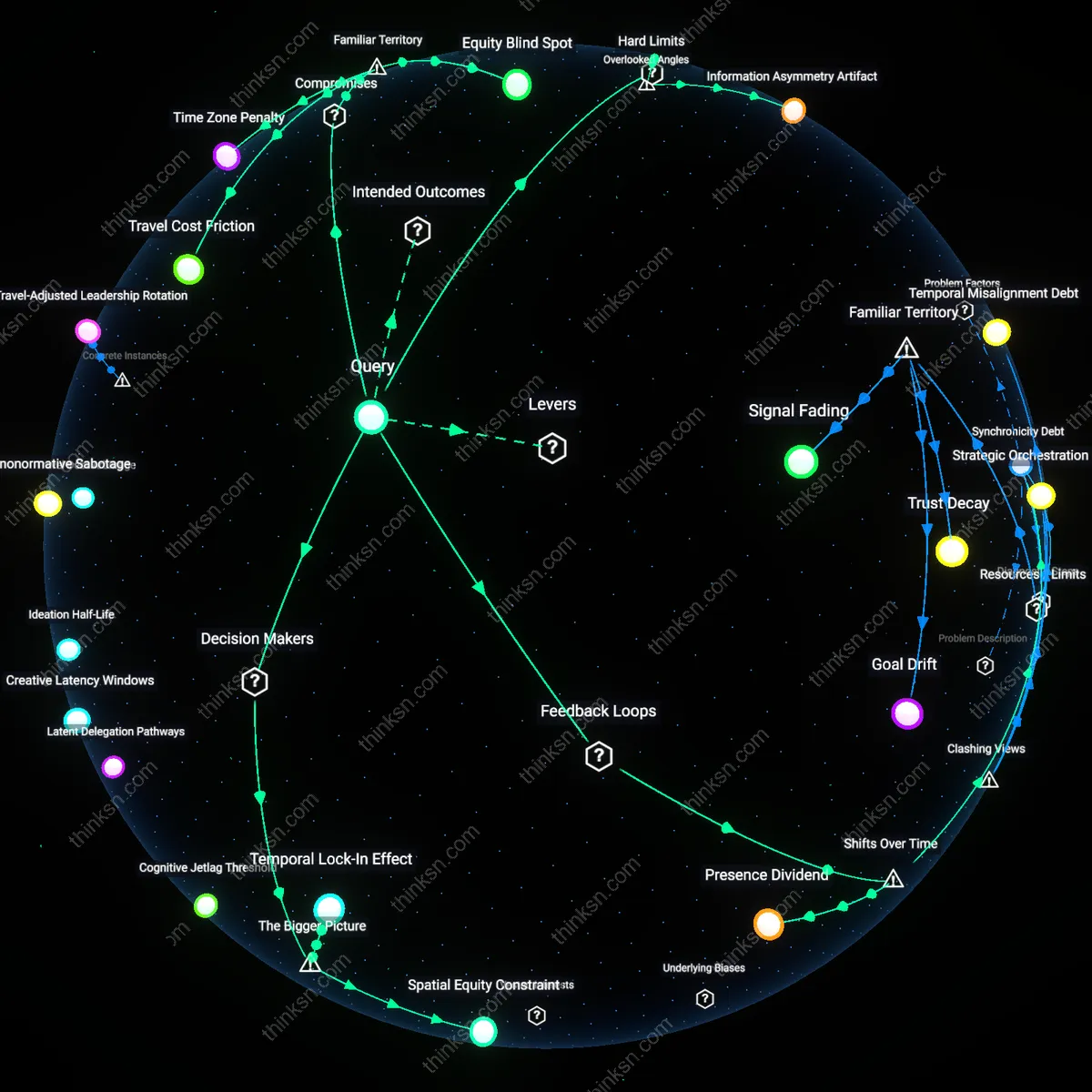
Analysis reveals 9 key thematic connections.
Key Findings
Information Asymmetry Artifact
A project lead must account for the information asymmetry artifact produced when team members in different time zones prepare asynchronously for the same in-person session, because those in later zones gain access to evolving digital discussions and materials while early-zone members do not, creating an invisible cognitive advantage that distorts participation equity. This mechanism arises from the combination of pre-meeting digital collaboration platforms and temporal misalignment, which most teams treat as a logistical nuisance rather than a structural bias—yet it systematically amplifies the influence of participants who are physically closer to the session start-time zone. As a result, the quality of brainstorming appears to reflect meritocratic contribution when it actually reproduces a hidden temporal hierarchy, undermining the perceived legitimacy of outcomes.
Cognitive Load Residue
A project lead must consider how the cognitive load residue from recent travel impairs high-level creative processing during the first hours of an in-person session, because long-distance transit—especially across multiple time zones—induces neurocognitive fatigue that standard meeting schedules fail to accommodate. This effect operates through the interaction of circadian desynchronization and executive function depletion, both well-documented in aviation and medical shift-work research but overlooked in creative collaboration design, where presence is conflated with readiness. As a consequence, the most resource-intensive moments of brainstorming are often scheduled at the point of lowest collective cognitive capacity, mistaking physical co-location for optimal mental convergence.
Synchronicity Debt
A project lead must evaluate the accumulation of missed alignment opportunities when deferring in-person sessions, because remote collaboration since the 2010s has increasingly offloaded temporal coordination onto individuals, creating a hidden liability in geographically dispersed teams. The mechanism—relying on asynchronous communication to avoid the logistical cost of travel—builds a reinforcing loop where short-term efficiency gains erode long-term coherence, as critical nuances decay across time zones and digital interfaces. This dynamic became pronounced after 2020, when the normalization of fully remote work severed the default assumption of eventual co-location, revealing that intermittent in-person events no longer serve as residual reset points but as escalating corrective interventions. The underappreciated consequence is that delaying physical convergence doesn’t just slow progress—it systematically distorts strategic intent.
Presence Dividend
A project lead must weigh whether the diminishing frequency of in-person meetings since the late 2010s has inadvertently inflated the perceived and actual value of co-location, turning rare physical gatherings into disproportionately high-leverage events. The shift occurred as video collaboration matured between 2012 and 2019, creating a new normal where presence became exceptional rather than routine, thus triggering a reinforcing loop in which scarcity amplifies attention, focus, and psychological commitment during in-person sessions. This transition—away from assumed continuity of contact toward episodic intensity—means that skipping such sessions risks not just incremental loss, but the collapse of a now-fragile equilibrium that sustains collective agency. The non-obvious insight is that the very decline of in-person interaction has made its occasional return a nonlinear catalyst.
Spatial Equity Constraint
A project lead must evaluate whether in-person brainstorming unfairly advantages participants from certain regions, because institutional funding structures often subsidize travel for headquarters-based staff while requiring decentralized team members to navigate visa restrictions or unpaid time off. This creates a systemic inequity in participation that mirrors broader global hierarchies in knowledge production, where decision-making is concentrated in the Global North. The non-obvious consequence is that mandated in-person collaboration can entrench geographic privilege under the guise of innovation, making inclusion a structural rather than logistical challenge.
Temporal Lock-In Effect
Holding critical in-person sessions risks anchoring team alignment to a single temporal window, which disadvantages collaborators operating in less dominant time zones or those with caregiving responsibilities outside standard work hours. The real mechanism at work is synchronization pressure—the expectation that all contributors engage simultaneously—which favors culturally proximate subgroups and suppresses async creativity. This reveals how temporal norms, often set by dominant corporate centers like Silicon Valley, act as invisible filters on cognitive diversity in globally distributed teams.
Travel Cost Friction
Prioritize in-person brainstorming only when remote alternatives fail to generate breakthrough ideas because physical co-location enables spontaneous, high-bandwidth interaction among team members from New York, London, and Singapore, which accelerates ideation through immediate feedback loops and non-verbal cues that are lost in virtual settings. The compromise arises when the logistical cost and carbon footprint of global travel offset gains in creative velocity, particularly when reliable digital collaboration tools already capture most ideation value at lower expense. While organizations commonly associate proximity with innovation quality, they underappreciate how often incremental improvements in virtual facilitation techniques reduce the marginal benefit of travel, making frequent in-person sessions inefficient at scale.
Time Zone Penalty
Schedule synchronous in-person sessions only during overlapping business hours across Toronto, Berlin, and Mumbai to respect local work rhythms, ensuring full attendance without forcing off-hour participation that degrades engagement and mental acuity. The need for temporal alignment creates a compromise between inclusivity and scheduling agility, as narrowing the viable window for meetings limits frequency and responsiveness. Commonly, teams assume shared physical presence naturally overcomes dispersion challenges, yet overlook how the inevitability of suboptimal timing undermines the very collaboration they seek, revealing that geographic proximity cannot compensate for temporal fragmentation when team members pay recurring cognitive tolls.
Equity Blind Spot
Choose in-person formats only when all team members can equitably access the location, because requiring travel to a single hub—say, San Francisco—privileges those near the center of organizational gravity while marginalizing far-flung contributors from Nairobi or Seoul who face longer journeys, stricter visa regimes, or less institutional sponsorship. The trade-off between depth of collaboration and inclusion becomes unavoidable when the optics of fairness influence psychological safety and voice distribution in group settings. Familiar narratives equate face-to-face meetings with richer connection, but downplay how such gatherings reproduce existing power gradients by default, privileging convenience for the dominant cluster at the expense of peripheral members' belonging.