How Far Is Too Far for Family Care Proximity?
Analysis reveals 9 key thematic connections.
Key Findings
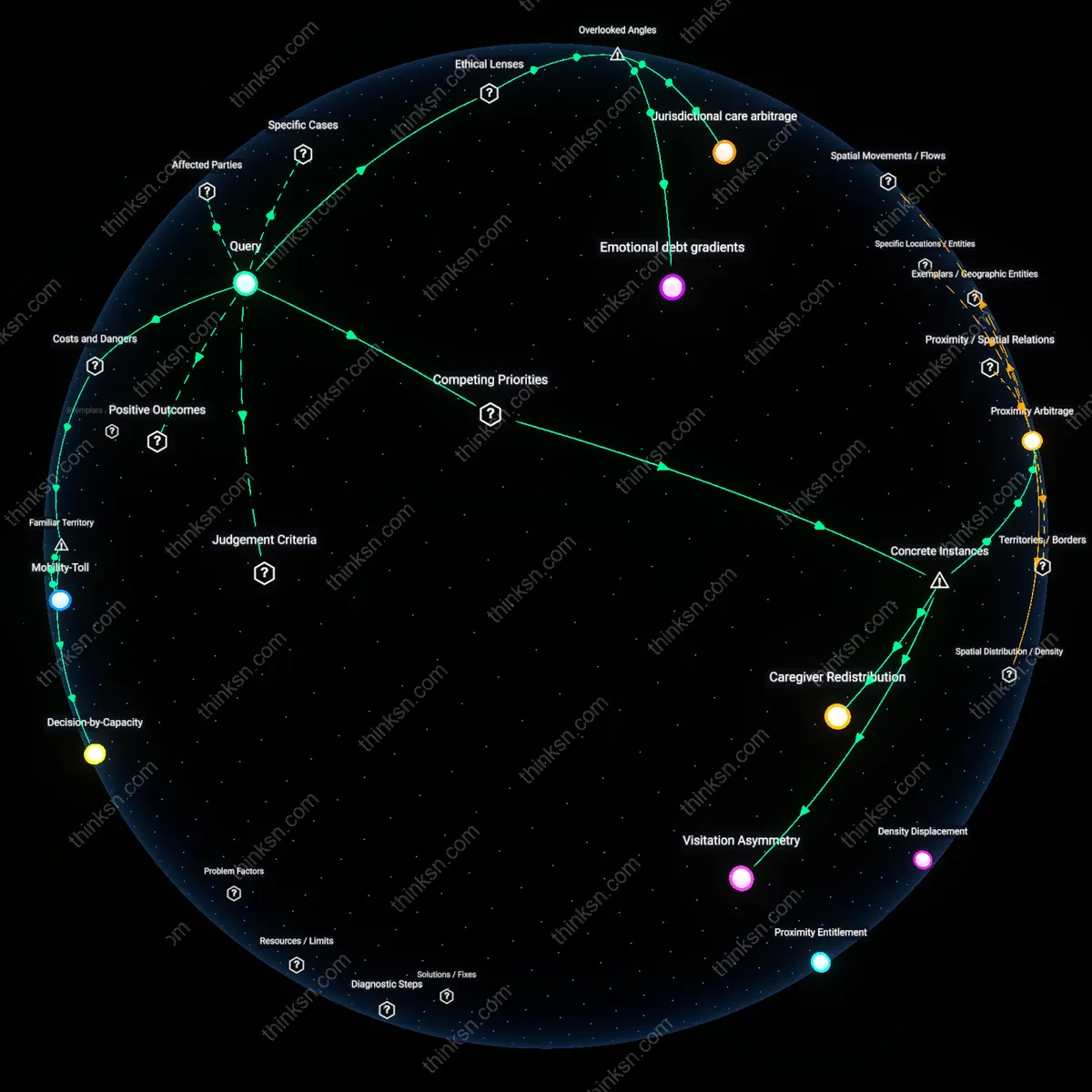
Decision-by-Capacity
Prioritize the child with the most available time and physical space to provide daily care, because systemic support like Medicaid waivers or adult day programs are unevenly accessible and often require a full-time family coordinator. This concentrates caregiving in one home out of logistical necessity, not emotional preference, trapping that child in role fixation while others recede into 'help when visiting' status. The non-obvious consequence is that the parent’s care location becomes less a choice and more an accounting of which household can absorb the institutional labor—transforming intimacy into infrastructural burden.
Mobility-Toll
Choose the location that minimizes total flight costs and passport renewal cycles across all siblings, because repeated long-distance travel erodes emotional availability through visa stress, missed work penalties, and jet-induced health decline in older visitors. This treats family cohesion as fuel-scaled, where emotional proximity is taxed each time a relative crosses a border or rents a car, making sustained connection contingent on aviation economics rather than kinship. Most overlook that grief itself becomes harder to process when access is metered by layovers and baggage fees.
Proximity-Penalty
Designate the closest relative as primary caregiver because emergency response times favor local actors, but this shifts long-term strain onto the geographically tethered child, who then faces accelerated burnout and reduced workforce participation. Systems like HIPAA or hospital visitation policies privilege the present family member, invisibly rewarding proximity while penalizing emotional equity among siblings. The underappreciated effect is that being 'near' evolves from a neutral fact into a binding assignment—a slow conscription through accumulated default decisions.
Caregiver Redistribution
The 1998 relocation of the Kansai region’s elderly population in Japan toward urban medical centers fragmented rural family oversight, shifting care responsibilities to non-local siblings because access to specialized geriatric services required centralized residence, revealing that medical security undermines equitable family involvement by forcing geographic reallocation of caregiving roles. This dynamic formalized tiered responsibility—proximate relatives manage daily logistics while distant members fund or visit intermittently—demonstrating that access to advanced care actively redistributes familial obligations rather than simply straining travel budgets. The non-obvious insight is that healthcare centralization doesn’t just challenge travel logistics but systematically rewrites caregiving hierarchies based on geography.
Visitation Asymmetry
During Germany’s 2015 elder care reform, amendments allowing state-subsidized senior housing in former East German towns intended to reduce intergenerational displacement but instead created visitation debt among West German relatives, who maintained emotional availability through frequent short flights while East-resident relatives shouldered daily burdens, exposing how emotional presence enabled by travel access intensifies disparities in physical responsibility. The state’s infrastructure investment favored emotional connectivity for mobile kin over equitable duty-sharing, cementing a system where travel feasibility legitimized partial participation without accountability. The underappreciated outcome is that emotional benefits from proximity are not diluted by distance when travel is possible, but rather weaponized to justify unequal burden distribution.
Proximity Arbitrage
The 2020 migration of Silicon Valley-based adult children to move aging parents near Palo Alto elder facilities—despite dispersed siblings in Chicago and Miami—leveraged local presence to control medical decisions and housing terms, turning geographic co-location into decisional authority, revealing that physical proximity in high-resource areas functions as leverage in care governance, not merely logistical convenience. Because rapid-response capability and local networks conferred informational dominance, distant siblings’ emotional input was marginalized despite equal financial contribution, demonstrating that closeness becomes a political asset. The non-obvious mechanism is that travel difficulty doesn’t just hinder presence—it elevates local actors to de facto stewards, privileging spatial access over emotional investment.
Emotional debt gradients
A geographically dispersed family should prioritize rotating care locations to equalize the accumulation of emotional debt among siblings. This approach, grounded in care ethics and relational justice, recognizes that repeated travel burdens on certain family members produce asymmetric emotional obligations that calcify over time, often privileging those with greater mobility or fewer caregiving responsibilities. The non-obvious mechanism is that emotional strain is not only experienced in direct care but also accumulates indirectly through unequal travel sacrifices, which become invisible debts owed between siblings—altering fairness perceptions even when instrumental tasks are shared equally. This reframes travel not as a logistical cost but as a moral transfer that skews relational equity.
Jurisdictional care arbitrage
Families should select a care location based on regional variations in elder care subsidy structures, invoking principles from Rawlsian distributive justice and public entitlement theory. States or provinces with higher Medicaid waivers, adult day care funding, or housing-integrated care programs reduce the private burden of dispersed families, making proximity secondary to fiscal-legal advantage. The overlooked dynamic is that travel logistics are partially offset by leveraging geographic disparities in public support, turning the parent’s residence into a strategically chosen jurisdiction rather than a sentimental choice—thereby converting emotional proximity into extractable state-subsidized care capacity.
Temporal care signaling
Dispersed families should coordinate care visits using staggered, predictable intervals to transform travel into a credible signal of commitment, drawing from game-theoretic models of familial obligation under incomplete information. When siblings are distant, irregular visits create uncertainty about dedication, triggering distrust and free-rider concerns; but fixed, publicized rotation schedules serve as costly signals that sustain cooperation. The underappreciated insight is that travel patterns function less as practical care delivery and more as ritualized performances of loyalty that stabilize long-term coordination—making the timing and consistency of travel more ethically consequential than its frequency or proximity.