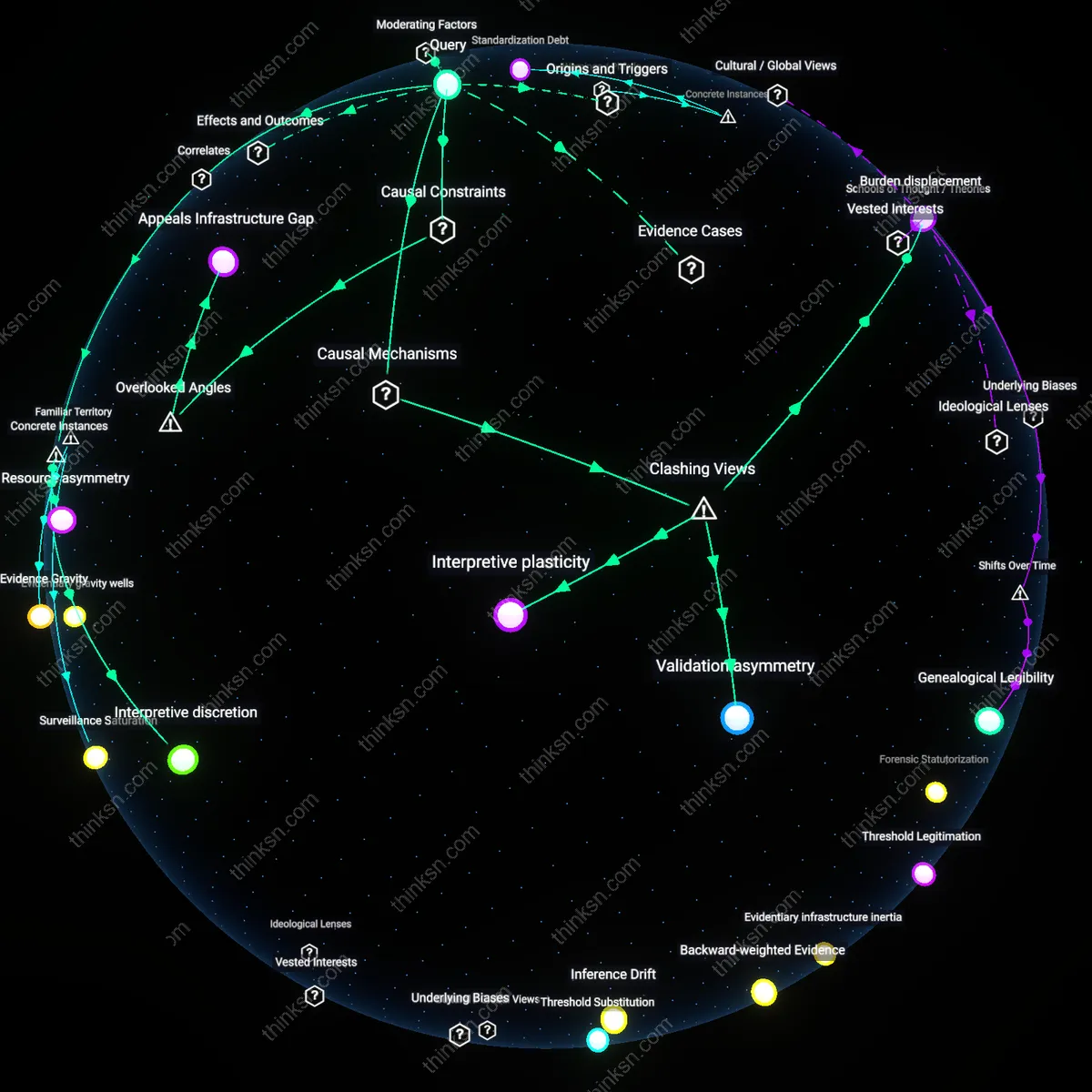
Forensic Statutorization
The shift to probabilistic DNA reporting in the early 2000s originated in U.S. state crime labs, particularly in Virginia and California, where statistical models like the Combined Probability of Inclusion (CPI) were first formally encoded into forensic protocols following the 1998 National Research Council guidelines; this institutionalization transformed how DNA matches were communicated—not as certainties but as likelihoods—embedding quantitative thresholds into legal evaluation and cementing earlier policing practices that disproportionately collected urban, minority DNA into seemingly neutral statistical frameworks. The procedural legitimacy granted by statistical formalism allowed historical sampling biases to persist as embedded structural assumptions in match probability calculations, making past policing patterns statistically inertial rather than correctable. This reveals how technical standardization in forensic science can convert sociopolitical asymmetries into epistemic defaults under the guise of objectivity.
Threshold Legitimation
Probabilistic DNA reporting gained judicial acceptance in the mid-2000s through admissibility rulings like *People v. Pacheco* (2010) in California, where courts began treating statistical thresholds (e.g., a profile match likelihood of 1 in 10 billion) as proxies for evidentiary certainty, thereby shifting the burden of contesting DNA evidence to defense experts who lacked access to laboratory data and population databases. This legal reliance on threshold values—produced by crime labs historically shaped by urban drug policing—converted past surveillance patterns into normative benchmarks for probative weight, effectively freezing into law the demographic skews of earlier DNA database composition. The underappreciated dynamic here is that legal systems began using statistical thresholds not as context-dependent measures but as self-validating markers of truth, enabling institutional memory without critical recalibration.
Database Path Dependency
Beginning in the late 1990s, federal funding through the FBI’s CODIS program incentivized local police departments to submit arrestee DNA, disproportionately from drug and violent crime arrests concentrated in marginalized urban communities, and when probabilistic reporting emerged in the 2000s, the resulting match statistics were calibrated against these racially skewed reference populations, making matches appear stronger for individuals from overpoliced groups due to reduced genetic diversity in the sample baseline. Because statistical models assumed population homogeneity based on these biased databases, the same genotype could yield different match probabilities depending on the defendant’s demographic profile, silently encoding past policing into the metric itself. This demonstrates how infrastructural inertia in forensic databases turns historical surveillance asymmetries into algorithmic priors that persist independently of individual intent.
Backward-weighted Evidence
Probabilistic DNA reporting amplified historical disparities by retroactively certifying older, racially skewed conviction data as statistically reliable, thereby converting past arrest patterns into forensic baselines. Crime labs in cities like Houston and Los Angeles began using conviction databases from the 1980s and 1990s—periods of intensive, race-targeted policing—as reference populations for calculating random match probabilities, which gave the statistical appearance of neutrality to evidence rooted in discriminatory practice. This mechanism made policing bias computationally invisible, not by hiding it, but by positioning it as the foundation of objectivity, a move that courts rarely questioned due to the perceived technical authority of probabilistic models.
Inference Drift
The shift to probabilistic reporting allowed judicial interpretation of DNA evidence to drift from evidentiary thresholds to narrative plausibility, privileging investigatory continuity over evidentiary rupture. In cases like People v. Pizarro (2003), appellate courts upheld convictions based on extremely low-template DNA matches by emphasizing investigative momentum—the idea that once a suspect is in the system, subsequent probabilistic hits confirm guilt—rather than demanding independent corroboration. This redefined evidentiary weight not as a function of biological certainty but of procedural path dependency, privileging the persistence of suspicion over forensic clarity, an analytical shift that escaped scrutiny because it masqueraded as statistical sophistication.
Threshold Substitution
Courts began treating the precision of probabilistic formats as a proxy for evidentiary sufficiency, replacing qualitative assessments of investigative origin with quantitative displays of statistical extremity. When jurisdictions like the New York State Police adopted STR profiling with 13-locus reporting in the early 2000s, judges increasingly admitted DNA matches with minimal inquiry into chain-of-custody lapses or sample contamination, citing the billion-to-one statistics as self-validating. This displaced the need to scrutinize how a suspect’s DNA entered the system—often through prior stops or arrests without conviction—converting procedural vulnerabilities into rhetorical strengths through the spectacle of numerical exactitude, a substitution that reconfigured due process expectations around presentation rather than provenance.
Backward-weighted Interpretation
The adoption of probabilistic genotyping software like STRmix in New Zealand courts after 2010 retroactively altered evidentiary weight given to DNA mixtures collected during earlier, high-volume policing campaigns in Auckland, where Maori and Pacific Islanders were over-sampled; because the new probabilistic models could extract likelihood ratios from degraded or complex mixtures that older binary methods dismissed, old samples from marginalized communities gained new evidentiary value—disproportionately affecting individuals first contacted under aggressive 1990s gang-intervention sweeps. This created a feedback loop where past over-policing supplied the raw material for present-day forensic advantage, not because contamination or bias exists in the software itself, but because the interpretation of older biological data is now asymmetrically revived where surveillance was already concentrated—revealing a non-obvious path by which technical advancements in analysis deepen historical inequities in legal outcomes without any new data collection.
Threshold Arbitrage
In the 2008 Houston DNA lab scandal, the discovery of systemic errors in manual mixture interpretation led the Texas Forensic Science Commission to mandate probabilistic reporting by 2015, which redefined the threshold for statistical significance in DNA matches; this shift allowed prosecutors in Harris County to reintroduce previously inconclusive rape kit results with precise likelihood ratios, especially from cases involving low-income complainants where samples had degraded due to storage neglect. By substituting a stochastic threshold for a categorical one, the state arbitrated which evidentiary failures would be forgiven—technical ones via new math, but not procedural ones like delayed testing—thereby privileging statistical sophistication over due process timeliness, an asymmetry that remains hidden unless one traces how a forensic 'correction' selectively amnestied certain lapses while reinforcing others rooted in resource disparity.
Data Legacy Asymmetry
After the UK’s Forensic Science Service adopted DNA likelihood ratio reporting in 2004, the London Metropolitan Police began re-analyzing cold case samples from the 1993 Stephen Lawrence murder investigation, where initial tests excluded suspects due to low-template DNA—a decision later reversed probabilistically to support retrial convictions in 2012; this pivot redefined the probative value of old forensic neglect as new statistical certainty, but only for high-profile cases with sustained political pressure, while hundreds of similar low-template samples from routine stop-and-search operations in Birmingham or Manchester remained unprocessed. The recalibration of DNA evidence did not apply uniformly across cases, revealing that the shift to probabilistic reporting did not neutralize past patterns but instead amplified them through selective reactivation—where visibility, not evidentiary merit, determined whether historical data would be revived under new standards.
Evidentiary inertia
The shift to probabilistic DNA reporting in the 2000s locked in earlier policing biases by retroactively validating conviction-era DNA matches through statistical reinterpretation, embedding past investigative assumptions into current forensic standards. Crime labs and appellate courts began reprocessing pre-2000 DNA profiles using new probabilistic genotyping software like TrueAllele, which assigned high-likelihood ratios to degraded or mixed samples previously deemed inconclusive—yet these re-analyses relied on population databases and threshold settings shaped by prior arrest patterns, especially from over-policed urban neighborhoods. This created a feedback loop where old investigative behaviors, such as targeting repeat offenders in specific zip codes, became statistically codified in allele frequency baselines, making it more likely that future matches would again implicate demographically similar individuals. The non-obvious consequence is that statistical 'advancement' did not correct past skew but instead fossilized it into algorithmic normality, giving older, behaviorally derived patterns the authority of contemporary science.
Threshold drift
The adoption of probabilistic DNA reporting redefined the legal threshold for 'sufficient' evidence not through legislative or judicial decree, but through incremental calibration shifts in forensic laboratory practice during the mid-2000s. As labs transitioned from binary (match/no match) interpretations to continuous likelihood ratios, they established arbitrary analytical thresholds—such as 200X odds—for presenting results in court, thresholds that were initially internal quality controls but quickly became de facto standards of proof without judicial scrutiny. Because these thresholds were derived from pre-existing conviction rates and lab error margins from the 1990s—a period marked by high clearance goals and forensic confirmation bias—they carried forward an implicit tolerance for circumstantial certainty that favored prosecutorial use. The non-obvious effect is that what appears to be a technical, neutral standardization in forensic science was in fact a temporal transfer of performance-driven policing norms into the epistemic foundation of evidence evaluation.
Probabilistic precedent
Courts began treating statistically generated likelihood ratios from probabilistic genotyping systems as self-validating evidence, thereby displacing earlier demands for transparency and methodological critique that had governed DNA admissibility in the 1990s. Following the 2008 National Research Council report and subsequent FBI endorsements, judges increasingly accepted complex algorithms as inherently more reliable than human interpretation, even when defense experts could not access source code or validation data, a shift crystallized in rulings like *People v. Collins* (2016). This doctrinal shift privileged computational output over procedural accountability, allowing decades-old DNA samples—often collected under broad or suspect authority in the 1980s and 1990s—to be re-entered into evidence with renewed scientific gravitas. The underappreciated outcome is that procedural trust in black-boxed algorithms has retroactively legitimized the collection and retention practices of an earlier punitive era, transforming historically contested data into contemporary proof through computational endorsement.
Evidence Inflation
The shift to probabilistic DNA reporting amplified the perceived reliability of forensic matches by converting ambiguous biological traces into statistical certainties, which courts began to treat as definitive proof. This transformation was driven by crime laboratories adopting likelihood ratio frameworks that assigned numerical weight to DNA profiles, disproportionately influencing jury perception despite the lack of standardized error margins. As a result, cases from the pre-probabilistic era—where DNA was reported in binary, inclusionary terms—now appear forensically weaker, not because they were scientifically invalid, but because their presentation lacks the numerical authority now expected. The non-obvious consequence is that older evidence is effectively downgraded in legal memory, not through critical re-evaluation, but through rhetorical obsolescence in the courtroom.
Method Trivia
Probabilistic DNA reporting reframed forensic validity around statistical sophistication, making the method itself more memorable than the evidentiary context it served. Investigators, prosecutors, and judges began associating evidentiary strength with the presence of complex algorithms like STRmix or TrueAllele, even when simpler exclusion results from earlier decades were more conclusive. This created a cognitive hierarchy where the appearance of computational rigor signals reliability, causing courts to treat older DNA analysis methods as primitive even when they followed rigorous standards. The underappreciated effect is that the public equates forensic legitimacy with technical opacity, turning methodological fashion into a filter for legal credibility.
Forensic Obsolescence
The institutional adoption of probabilistic interpretation systems rendered pre-2000s DNA evidence technically incompatible with current reporting standards, forcing archives of biological samples and profiles into a state of latent irrelevance. Unlike physical evidence, which degrades predictably, DNA data became obsolete not through decay but through procedural succession—older profiles were not reanalyzed at scale, leaving convictions or exonerations stranded in outdated formats. This lifecycle mirrors planned obsolescence in consumer technology, where backward incompatibility is not accidental but systemic, privileging new interpretations over prior conclusions. The overlooked reality is that legal outcomes now depend not just on the biology, but on which statistical regime was in power when the evidence was reported.
Evidentiary infrastructure inertia
The adoption of probabilistic genotyping software like TrueAllele in the mid-2000s entrenched historical arrest patterns into forensic interpretation by automating the statistical weighting of DNA mixtures through algorithms trained on reference datasets dominated by urban, high-arrest populations. This mechanism embedded disproportionate representation of marginalized communities into the baseline assumptions of what constitutes a 'probable' genetic match, transforming policing disparities into technical artifacts within the software’s likelihood ratios—effectively making past surveillance intensity a hidden variable in current evidentiary weight. Most analyses overlook that the software’s probabilistic outputs are not neutral calculations but sociotechnical reconstructions shaped by where and on whom DNA was historically collected, thus rendering the algorithm itself a repository of uneven state attention.
Threshold migration effect
As courts began accepting probabilistic genotyping results in the 2010s, the thresholds for 'sufficient' DNA contribution—once based on subjective peak height assessments—were replaced by dynamic statistical filters set within software, which silently adjusted evidentiary significance based on population frequency databases calibrated to arrestee DNA banks like CODIS. Because these databases overrepresent individuals from overpoliced neighborhoods, the statistical models effectively lower the threshold for implicating people from those groups, making partial or degraded DNA appear more probative for certain demographic profiles. This calibration drift—a technical adjustment with forensic consequences—is an unnoticed mechanism by which historical policing becomes statistically amplified in the present, reframing bias not as contamination but as calculation.