How Far Should Family Go for Political Unity?
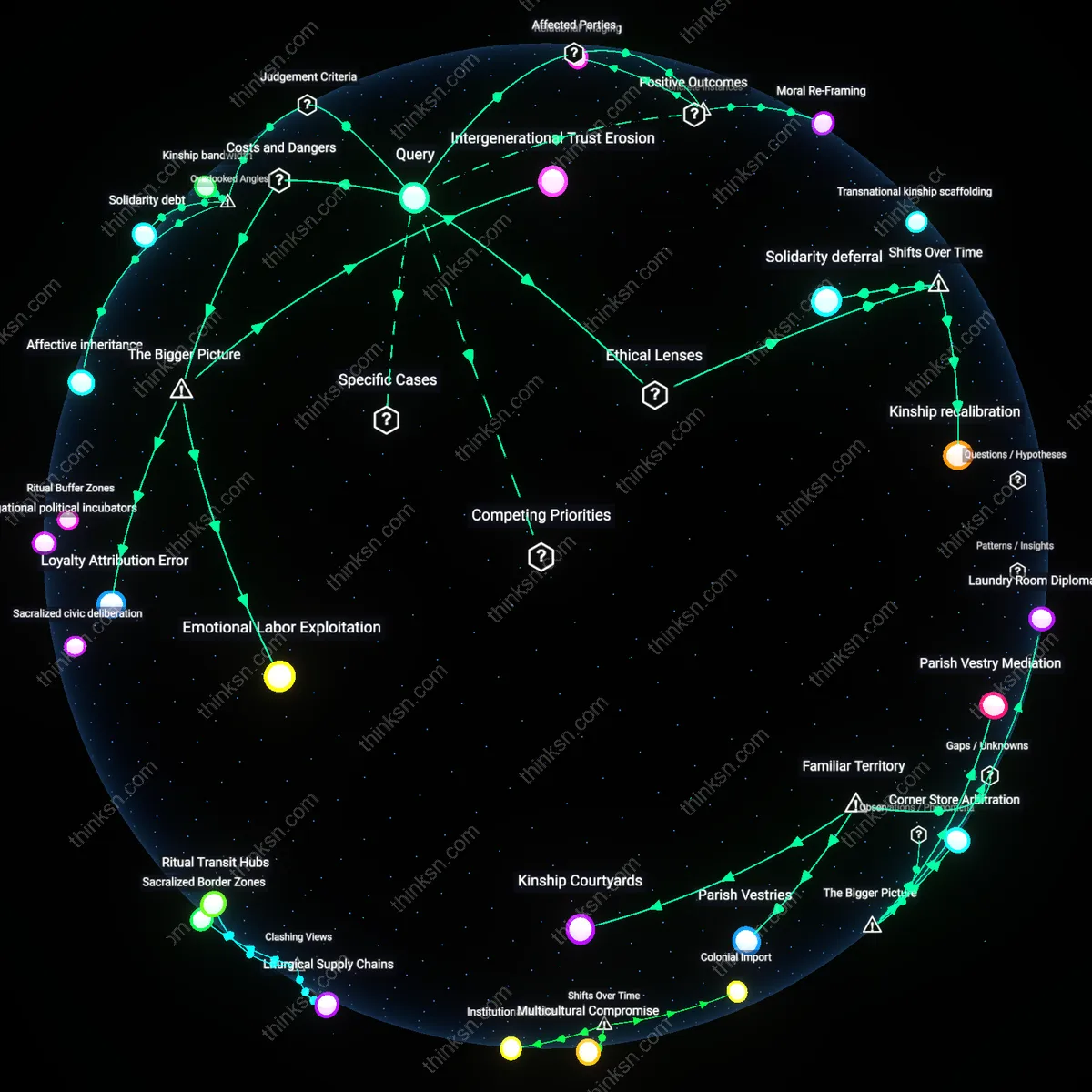
Analysis reveals 11 key thematic connections.
Key Findings
Relational Triaging
One should prioritize maintaining minimum viable communication channels with extended family while designating certain topics as temporarily off-limits to preserve both solidarity and cohesion, as seen in the responses of South African anti-apartheid activists’ families during the 1980s. Activist spouses within black township households often restricted political discussion during family gatherings to avoid drawing state surveillance through kin networks, thereby shielding relatives while sustaining resistance efforts—this created a deliberate practice of relational triaging, where selective disclosure functioned as a survival mechanism. What is non-obvious is that silence was not capitulation but a strategic calibration of risk across familial and political domains, revealing that cohesion can be preserved through structured omission rather than full transparency.
Moral Re-Framing
One should recast the partner’s activism in terms of shared familial values—such as justice, protection, or faith—to align political action with the moral language of estranged relatives, as demonstrated by relatives of Argentine human rights activists during the post-dictatorship reckoning in the early 1980s. When members of the Mothers of the Plaza de Mayo were ostracized by conservative Catholic in-laws who saw their protests as divisive, some spouses countered by framing the search for disappeared children as a sacred family duty, rooted in Catholic doctrines of dignity and mourning—thus transforming activism into a spiritually legible kinship obligation. The non-obvious insight is that ideological conflict within families can be bridged not by compromise but by semantic redeployment, where political acts are reinterpreted through preexisting affective frameworks to regain relational legitimacy.
Institutional Buffering
One should channel family tensions through third-party institutions that neutralize personal blame while accommodating both activism and kinship, as occurred in Swedish social democratic households during the 1970s labor movements where union halls and municipal mediation councils hosted 'family dialogues' on conflicting political commitments. When a partner's involvement in anti-Vietnam War strikes provoked rifts with pro-NATO extended kin, local labor councils facilitated structured meetings that externalized conflict from the domestic sphere, allowing grievances to be processed in civic rather than familial space. The overlooked mechanism here is that institutional buffering depersonalizes political rifts—by shifting discourse to a recognized public forum, families avoid rupture without requiring private agreement, revealing how collective infrastructure can absorb intergenerational ideological strain.
Affective inheritance
Prioritize the emotional templates children absorb from intergenerational conflict over immediate alliance choices, because these unspoken patterns—how disagreement is modeled between kin and partners—become the blueprint for future political and familial behavior; this dynamic is structurally significant in middle-class suburban US families where holiday gatherings serve as ritualized emotional rehearsals, yet is rarely acknowledged because it operates beneath declared values, revealing that long-term cohesion is shaped not by who wins the argument but by how the argument lives in silence.
Solidarity debt
Compensate for a partner's activist alienation by redirecting resources—time, care, attention—to marginalized members within the extended family who are also structurally disempowered but lack visible political language, such as disabled uncles or undereducated aunts in post-industrial Rust Belt communities; doing so redistributes the moral burden of solidarity and prevents activism from replicating the very hierarchies it opposes, a mechanism overlooked because political loyalty is typically assessed through public affiliation rather than private care labor.
Kinship bandwidth
Limit the frequency and emotional scope of family-political negotiations to match the cognitive and affective processing capacity of the least resilient elder in rural evangelical networks, where sustained ideological confrontation triggers psychological withdrawal rather than engagement; this technical constraint—akin to data throughput in communication systems—determines whether dialogue persists or collapses into permanent silence, a factor ignored in favor of content-based strategies despite being the actual gatekeeper of relational continuity.
Intergenerational Trust Erosion
Prioritize repairing familial fractures over rigid political alignment because unresolved ideological rifts calcify into permanent relational disintegration, particularly when older kin interpret activism as moral betrayal. In extended families where respect for hierarchy and tradition mediates cohesion—such as in post-colonial Caribbean or Southern U.S. contexts—public activism that challenges state or religious norms triggers defensive withdrawals of emotional and material support, especially from elders who equate dissent with ingratitude. This dynamic is amplified by the unspoken expectation that younger members will uphold familial reputation, so when a partner’s activism becomes visible, it activates intergenerational enforcement mechanisms like shunning or disinheritance, which are not merely symbolic but reconfigure long-term care and kin-based survival networks. The non-obvious consequence is that political expression, even when ethically grounded, can destabilize the informal social safety nets that marginalized families rely on more heavily than state services.
Emotional Labor Exploitation
Refuse to absorb the burden of maintaining harmony through emotional suppression, as this quietly transfers the cost of political risk onto the non-activist partner and especially any woman or femme-identifying mediator in the family system. In transnational families disrupted by migration or economic stratification—such as Mexican-American households navigating mixed immigration statuses—the expectation to soothe tensions after a partner's arrest or public protest often defaults to daughters or daughters-in-law, who are culturally mandated to preserve unity without challenging power structures. This reproduces a hidden economy of uncompensated emotional labor that sustains familial functionality at the expense of individual mental health and political agency, effectively depoliticizing the domestic sphere by gendered fiat. The underappreciated danger is that the family, idealized as a refuge, becomes a site of ideological containment where dissent is managed not through debate but through affective guilt and coercive caretaking roles.
Loyalty Attribution Error
Actively reframe the narrative of 'alienation' as a systemic misattribution that blames activists for ruptures caused by structural anxieties over race, class, or state surveillance, particularly in communities historically targeted by political repression. For instance, in Palestinian diaspora families in Europe or the U.S., elders may condemn activism not due to apathy but from traumatic memory of state violence following visible dissent, leading them to interpret any public stance as reckless endangerment of kin. The real fracture isn’t ideological but epistemic—activist partners operate from a rights-based framework while elders operate from a survival-heuristic shaped by past persecution, and the family conflict becomes a proxy for unresolved historical trauma. The non-obvious insight is that the demand for political moderation is less about solidarity and more about intergenerational transmission of risk aversion in response to systemic persecution, misread as personal disloyalty.
Kinship recalibration
One should prioritize familial cohesion by negotiating political expression through private mediation, not public confrontation, because the post-civil rights expansion of individual rights discourse transformed kinship from a hierarchy of duty into a network of negotiated belonging. Mid-20th-century legal victories in family law and civil liberties elevated personal autonomy over collective tradition, making political activism a legitimate individual claim but destabilizing intergenerational authority in extended families, particularly in racially or ethnically stratified communities. This shift reveals that what appears as a moral conflict today—activism versus family unity—was structurally uncommon before the 1970s, when state recognition of personal identity rights began to fracture filial obligations, leaving mediation the primary mechanism to sustain kinship across ideological divides.
Solidarity deferral
One should temporarily subordinate political solidarity to familial cohesion when engaging with older relatives socialized in Cold War–era ideological containment, because the securitization of dissent during the 1950s entrenched a cultural script equating political extremism with familial betrayal. This historical conditioning, especially strong in immigrant or national-minority families with experiences of state repression, means that activism risks being interpreted not as civic engagement but as existential disloyalty, a perception that persists despite the decline of actual state surveillance. The underappreciated reality is that contemporary activism often reactivates unhealed historical trauma rather than confronting present opposition, making timing and context essential to avoid reproducing past fractures.