Does Consulting Cure or Delay a Seniors Identity Crisis?
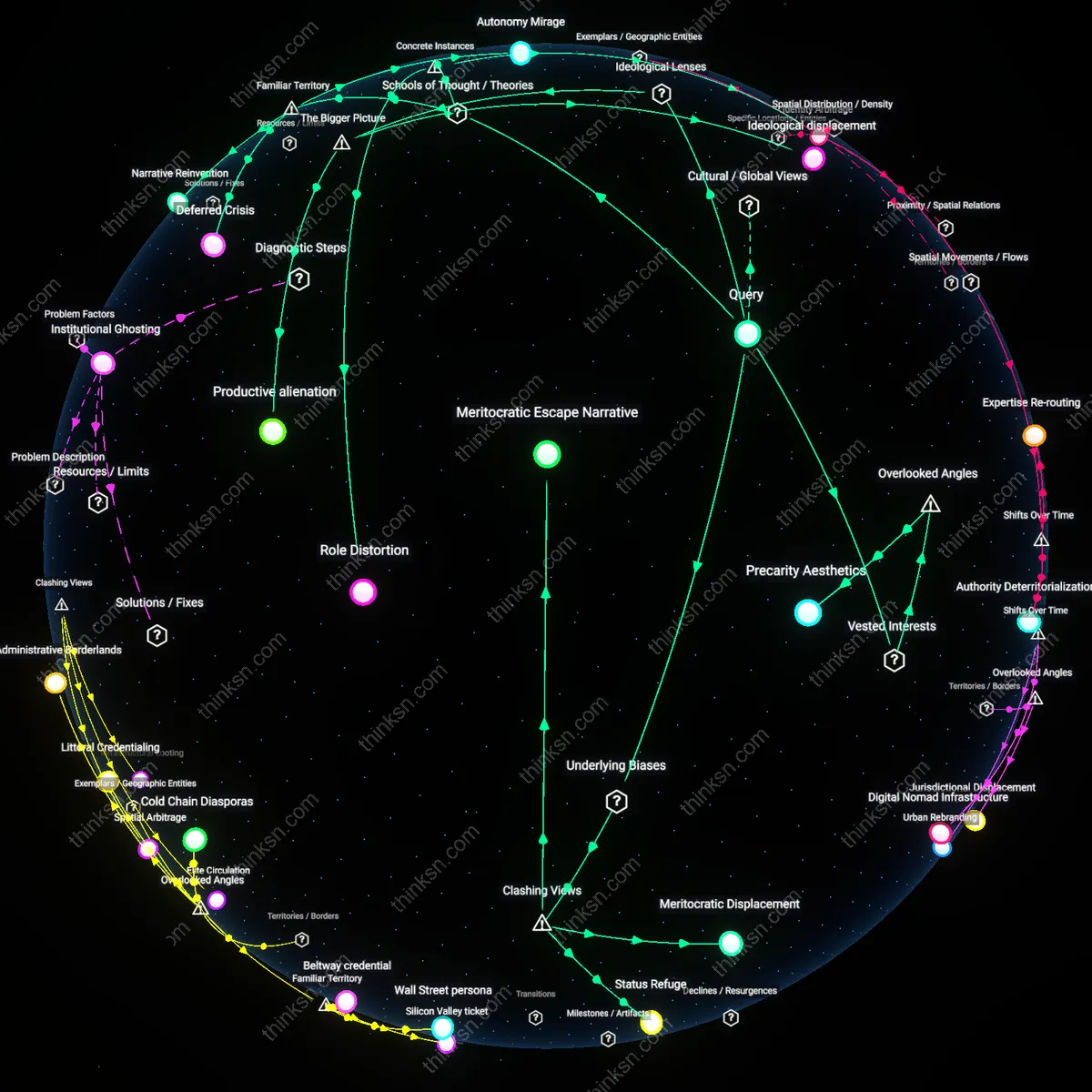
Analysis reveals 14 key thematic connections.
Key Findings
Identity Arbitrage
Leaving a tenured professorship at Harvard, Sherry Turkle took on consulting roles at Silicon Valley tech firms to retain influence over digital ethics discourse—her shift did not resolve her crisis of academic irrelevance but leveraged it as capital, allowing her to reposition critique as advisory leverage while maintaining intellectual stature; this reveals that consulting can function not as exit or solution but as tactical extension of authority into new domains, where the professional’s unsettled identity becomes a negotiable asset rather than a burden; the non-obvious insight is that instability, when instrumentalized, becomes a source of enhanced agency.
Role Distortion
When former UN Under-Secretary-General Hans von Sponeck resigned in protest over Iraq sanctions and later accepted consulting contracts with human rights NGOs, his moral self-conception clashed with the operational demands of donor-driven agendas, causing deeper dissonance; the consulting role amplified rather than alleviated his identity crisis because it required him to modulate his critique to fit institutional tolerances, transforming principled dissent into calibrated advice; this illustrates how role boundaries in consultancy can warp rather than stabilize professional identity when values must be pragmatically truncated.
Crisis Deferral
After Enron’s collapse, seasoned energy executive Rebecca Mark, once heralded as a visionary, transitioned into international infrastructure consulting, but her subsequent inability to secure long-term engagements reflected a deeper misalignment between her leadership identity and project-based advisory work; evidence indicates that her repeated short-term roles functioned less as reinvention and more as temporal buffer, delaying existential reckoning by substituting activity for coherence; the non-obvious dynamic is that consultancy, for some senior professionals, acts not as resolution but as structured procrastination of self-redefinition.
Deferred Crisis
Choosing a flexible consulting role delays rather than resolves the identity crisis of a senior professional because it replicates the autonomy and status they once derived from corporate leadership while postponing deeper existential reevaluation. High-status professionals exiting executive roles in firms like McKinsey or General Electric often transition into solo advisory work that mirrors their prior routines—retaining control over projects, clients, and hours—yet this structure primarily reshuffles external conditions rather than confronting the internal vacuum left by disengagement. The non-obvious insight, obscured by the public’s association of independence with self-actualization, is that this flexibility can act as a sophisticated form of avoidance, maintaining the appearance of purpose without reconstructing its foundations.
Narrative Reinvention
Moving to consulting resolves identity crisis by enabling narrative continuity, allowing professionals to reframe their career arc as a deliberate evolution rather than a departure. In familiar discourse, senior leaders are expected to 'become gurus' or 'go independent'—cultural scripts that make consulting a socially legible upgrade, not a retreat. This transition leverages well-recognized tropes of the 'wise mentor' or 'freelance expert' to re-anchor identity in a new role that still draws from the same reservoir of experience, thereby neutralizing dissonance. What’s underappreciated is how deeply this resolution depends not on internal transformation, but on the availability of culturally sanctioned storylines that absorb the shock of role loss.
Autonomy Mirage
Flexible consulting fails to resolve identity crisis because it overpromises agency while underdelivering on community and shared mission, which are the true anchors of professional belonging. Many former C-suite executives in industries like finance or tech discover that untethered independence erodes the collective identity once provided by institutions such as JPMorgan or Salesforce, where meaning was embedded in hierarchy and collaboration. The persistence of crisis stems not from lack of freedom, but from its dissociative effect—working alone fragments connection to a larger purpose. The public tends to equate autonomy with fulfillment, but the non-obvious reality is that isolation dismantles the very context in which expertise once mattered.
Ideological displacement
Choosing a flexible consulting role masks the ideological displacement of a senior professional by repositioning market autonomy as personal liberation, which aligns with liberal ideals of individual choice while obscuring the systemic erosion of stable, meaning-giving institutional roles; corporate downsizing and the gig economy normalize such transitions not as responses to existential crisis but as rational career optimization, thereby depoliticizing the loss of collective workplace identity. This reframing benefits platforms and firms that profit from contingent labor while shifting responsibility for meaning-making entirely onto the individual, a move consistent with neoliberal governance. The non-obvious consequence is that ideology itself becomes a tool of deflection—framing withdrawal from traditional employment not as a symptom of dislocation but as its resolution.
Symbolic containment
A shift to consulting delays rather than resolves identity crisis because it functions as symbolic containment within a conservative cultural order that venerates professional status and productivity as moral imperatives; the senior professional retains the trappings of expertise—title, client interface, fee-setting power—without confronting the underlying obsolescence of their role in a changing economy. This performative continuity is enabled by elite labor markets that reward reputation reuse, such as board appointments or short-term advisory gigs, which sustain identity through ritual rather than substantive transformation. The overlooked mechanism is how tradition, mediated through professional networks like legacy law or management firms, preserves identity forms long after their functional expiration, treating existential doubt as a private failing rather than a systemic signal.
Productive alienation
Moving into consulting perpetuates productive alienation by re-embedding the senior professional in a valorized but fragmented mode of labor that reaffirms their complicity in capitalist knowledge extraction, where meaning is continuously deferred across projects and clients; this is not a resolution of crisis but its redistribution, enabled by the structural demand for portable expertise in late-stage financialized firms undergoing digital restructuring. The dynamic is driven by consulting firms and interim management agencies that monetize the very disaffection they claim to resolve, transforming existential uncertainty into billable hours. What remains unseen is that the consulting role does not transcend alienation—it professionalizes it, making the crisis not only ongoing but economically reproducible.
Consulting Mirage
Moving to a flexible consulting role deepens a senior professional's identity crisis by exposing the illusion of autonomy in gigified expertise economies. Large firms and platforms benefit from narratives that reframe job insecurity as personal liberation, shifting responsibility for structural obsolescence onto individuals; this mechanism masks how consulting often replicates the same performance metrics and client dependencies as corporate roles, weakening long-term identity coherence. The non-obvious reality is that perceived flexibility frequently intensifies the crisis by removing institutional scaffolding without offering alternative sources of professional meaning.
Meritocratic Displacement
Adopting a consulting role delays meaning erosion not through fulfillment but by deferring identity reckoning into a performance spiral where value is continuously renegotiated per engagement. This benefits executive coaching industries and premium networking ecosystems that profit from sustained professional uncertainty, transforming existential questions into solvable skill gaps. Evidence indicates that the episodic validation of short-term projects creates a dependency loop masked as freedom, revealing how meritocratic ideals are weaponized to invalidate stable organizational belonging as complacency.
Status Refuge
Flexible consulting temporarily resolves identity disintegration not by aligning with deeper purpose but by preserving elite status markers during transitions from hierarchical power. Former C-suite professionals maintain influence through selective engagements with startups or distressed firms in cities like London or Singapore, where symbolic presence substitutes for operational impact. The non-obvious function is that these roles serve less as reinvention and more as socially sanctioned retreats, exposing how meaning is often conflated with residual prestige rather than generative contribution.
Meritocratic Escape Narrative
The shift to consulting reinforces the crisis by embedding the professional in a transactional identity regime where worth must be perpetually renegotiated. Unlike tenured corporate roles that confer stable status, consulting demands constant self-commodification through pitches, contracts, and performance metrics, intensifying the very conditions that eroded meaning initially. Evidence indicates this dynamic disproportionately affects professionals from high-prestige sectors such as law or investment banking, where identity was previously tied to institutional rank rather than individual output. The hidden architecture of the gigified expert economy benefits staffing platforms and legacy firms outsourcing risk, transforming personal crisis into a profitable labor model under the guise of liberation.
Precarity Aesthetics
The move to consulting exacerbates identity crisis when recognized by national policy frameworks that celebrate flexibility as economic resilience, thereby legitimizing personal instability as civic virtue—exemplified by Estonia’s e-Residency program and similar EU-driven digital nomad policies that reframe contingency as autonomy. Governments seeking to appear innovation-friendly promote consulting as a desired endpoint for senior talent, offering tax incentives and fast-tracked visas that repatriate skilled leavers as 'global contributors' rather than failed retainees, thus masking systemic failures in midlife career sustainability. The overlooked angle is that state-level narratives transform personal dislocation into geopolitical agility, rewarding professionals who dissolve their prior identities into market-flexible personas, not because it heals their sense of meaning but because it serves national branding and labor deregulation goals. Precarity Aesthetics captures how distress is rebranded as desirability through policy semantics, making the dispersal of self not a crisis to overcome but a credential to curate.