Scholarship Risk: Undocumented Status vs. Education Gain?
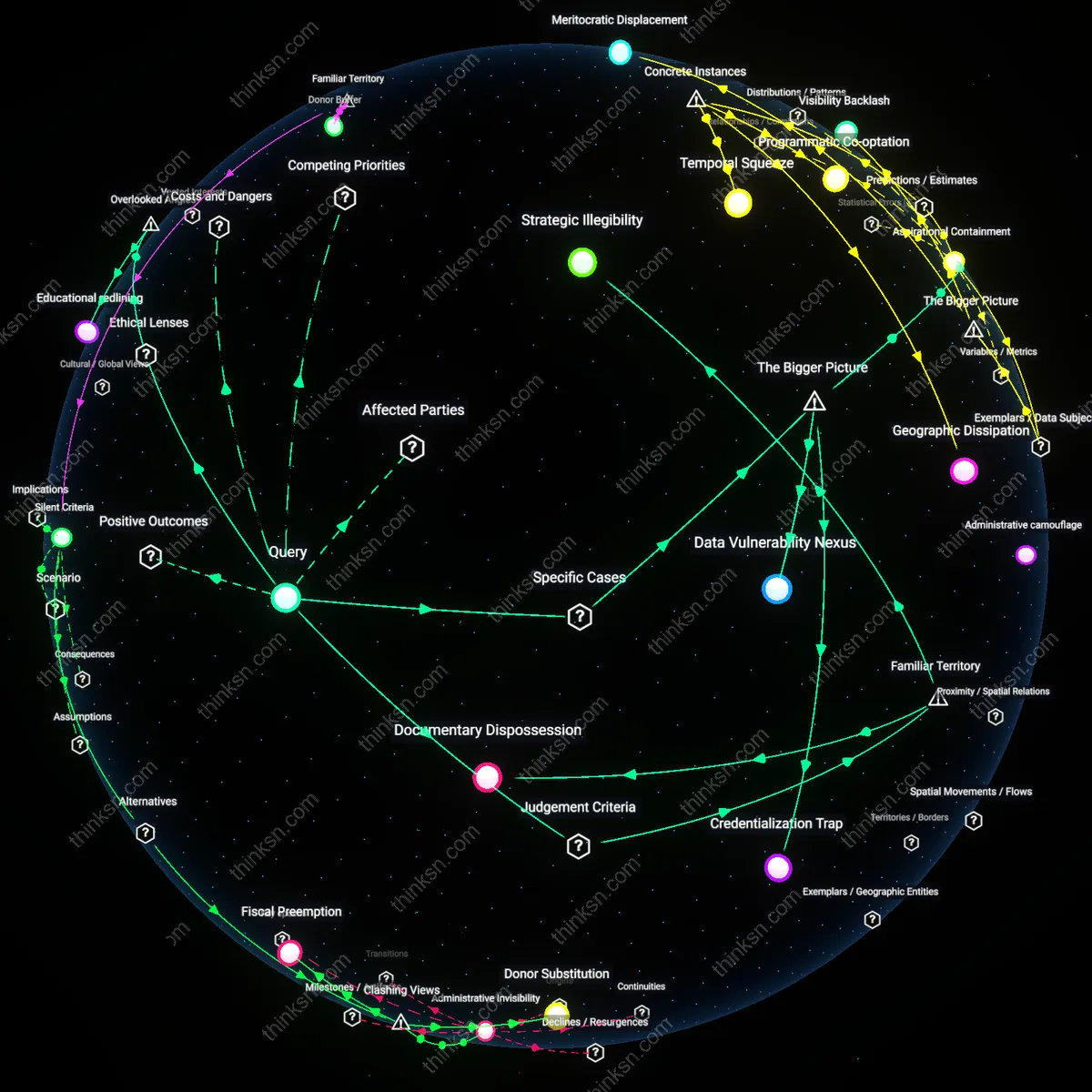
Analysis reveals 8 key thematic connections.
Key Findings
Documentary Dispossession
No, an undocumented student should not accept a scholarship requiring proof of legal residency because doing so risks formal documentation within federal immigration databases, which can trigger enforcement actions through interconnected state and federal systems like DHS's access to school or financial aid records. This risk persists even if the student initially avoids detection, as scholarship applications often require SSNs or tax IDs that link to immigration status, and the act of disclosure creates a traceable administrative footprint. The underappreciated reality is that the very act of seeking upward mobility—through education—can become a mechanism of state surveillance when bureaucratic inclusion requires legal visibility, transforming personal advancement into a hazard.
Moral Asylum
Yes, an undocumented student should accept the scholarship if the primary moral principle is human dignity and educational equity, since denying education based on immigration status violates widely held democratic norms about the intrinsic value of learning and opportunity. Public schools, community colleges, and many universities already operate as de facto zones of inclusion, where presence rather than status enables access, and extending this logic to scholarships reflects a commitment to moral sanctuary over legal exclusion. The overlooked insight is that institutions can function as sites of ethical resistance, where everyday practices like tuition waivers or private funding quietly bypass exclusionary laws, sustaining a parallel normative order based on compassion rather than compliance.
Strategic Illegibility
No, an undocumented student should not accept the scholarship because visibility in any formal system increases vulnerability to automated immigration enforcement infrastructure, such as biometric verification systems or data-sharing agreements between educational institutions and federal agencies under programs like SAVE. Even if the immediate risk seems low, participation reinforces a regime where belonging is conditional on documentation, limiting future options if policies shift. What’s rarely acknowledged is that survival for undocumented populations often depends on strategic invisibility—not as evasion, but as a calculated withdrawal from systems that convert participation into precarity, making non-engagement a form of rational self-preservation.
Normative debt paradox
An undocumented student should accept the scholarship because refusing it reproduces a normative debt paradox, wherein the moral burden of upholding just norms is placed entirely on the most vulnerable, freezing structural change. By forgoing the benefit on ethical grounds, the student performs a kind of symbolic resistance that elites can cite to validate the system’s fairness—‘look, they declined it voluntarily’—while avoiding systemic reform. This dynamic operates through liberal democratic discourse, where individual conscience becomes a safety valve for collective injustice, particularly in states like California that promote inclusion rhetorically but limit material access through legal technicalities. The overlooked dimension is how refusal, though ethically motivated, fuels a narrative of voluntary exclusion that dilutes political pressure, making resistance complicit in stasis.
Educational redlining
An undocumented student should not accept the scholarship because the requirement functions as a form of educational redlining that naturalizes exclusion through administrative design rather than overt statute, operating through decentralized funding architectures like state-authorized private grants that mimic public policy outcomes without legislative oversight. These scholarships, often administered by university-affiliated foundations in states such as Texas, exploit legal ambiguity to maintain de facto racial and class sorting under colorblind criteria, thereby preserving elite institutional demographics without direct liability. The overlooked reality is that compliance risks are not merely personal but systemic—participation reinforces institutional ecosystems built on performative neutrality, where equity initiatives coexist with mechanisms that quietly filter out marginalized groups through nested eligibility layers.
Data Vulnerability Nexus
An undocumented student should not accept a scholarship requiring proof of legal residency because submitting personal information to state-affiliated institutions creates a data vulnerability nexus that can be exploited through interagency data sharing. U.S. Citizenship and Immigration Enforcement (ICE) has repeatedly accessed seemingly unrelated government databases—such as Department of Motor Vehicles and university financial aid systems—through partnerships with the Department of Homeland Security, especially under policies operationalized during the 2017–2021 enforcement expansion. This risk is amplified not by the scholarship itself but by the infrastructural integration of bureaucratic databases, where a single document submission becomes a systemic exposure point. What is underappreciated is that the danger lies not in intentional reporting but in automated, routine data harvesting across systems designed without privacy firewalls between civil services and enforcement bodies.
Credentialization Trap
An undocumented student should avoid such a scholarship because participation in formal credentialing systems reinforces a credentialization trap that ties personhood to state recognition, making non-citizens legible only as threats. In states like Arizona and Texas, public institutions are mandated to report non-compliant enrollment data to legislative oversight bodies, which then frame such cases as policy failures requiring stricter verification laws. This transforms individual survival strategies into legislative justifications for broader exclusion, as seen in the aftermath of Texas House Bill 1403. The non-obvious mechanism is that compliance—even for benefits—feeds a feedback loop where marginalized actors’ attempts to access resources generate political momentum for increased surveillance and restriction.
Aspirational Containment
An undocumented student should decline the scholarship because accepting it functions as aspirational containment—a mechanism by which state systems selectively incorporate marginalized individuals into managed pathways that defuse broader claims for structural inclusion. Federal work-study programs, even when accessible via deferred action status, require renewing compliance with immigration conditions that can be abruptly withdrawn, as occurred en masse when DACA renewals were blocked in 2021. This creates a dependency on precarious legality, steering recipients away from collective advocacy and toward individualized risk management. The underappreciated dynamic is that educational inclusion, when conditioned on enforcement compliance, becomes a disciplinary tool that preserves systemic exclusion by redirecting dissent into bureaucratic channels.