Deferred Action: Pathway or Limbo for Immigrants?
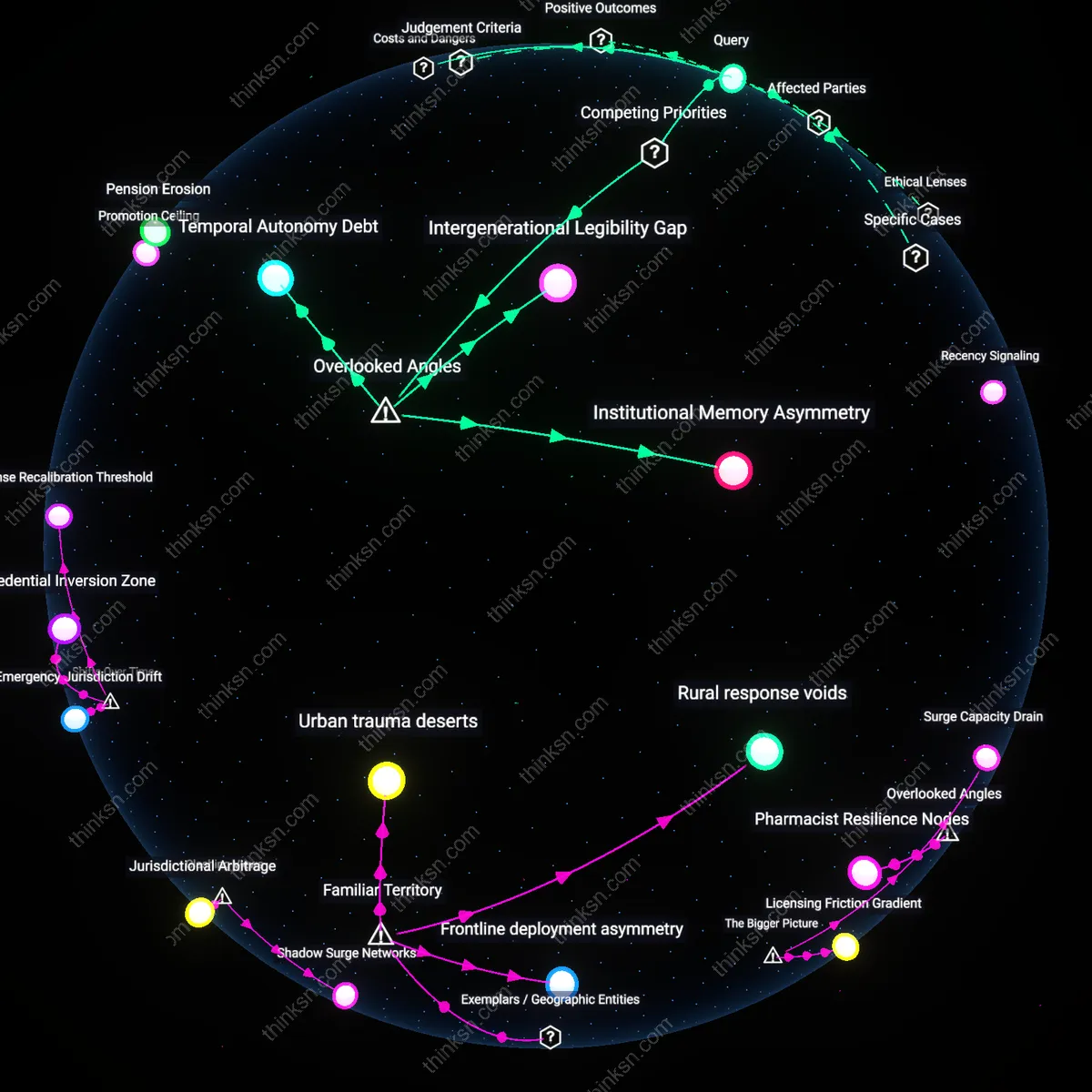
Analysis reveals 6 key thematic connections.
Key Findings
Status Insecurity Paradox
Deferred Action for Childhood Arrivals (DACA) recipients in Texas face blocked access to professional licensure despite federal work authorization, revealing that state-level policy discretion can invalidate federal reprieves for long-term career investment. In 2014, the Texas Board of Nursing denied DACA recipients licenses solely due to their non-permanent status, forcing individuals with approved work permits and nursing degrees to abandon specialty training and long-term healthcare careers. This demonstrates how subnational regulatory authority acts as a veto point against federal deferred action promises, exposing a structural misalignment that makes human capital development irrational even when federal conditions appear stable.
Temporal Arbitrage Trap
In 2017, when Attorney General Jeff Sessions announced DACA’s rescission, Salvadoran beneficiaries enrolled in community colleges in Los Angeles abruptly shifted from four-year degree tracks to vocational certificates, compressing education timelines to preempt expulsion. Though some litigation preserved temporary protections, the recurring legal instability created a time horizon collapse—where individuals optimized for immediate skill monetization over long-term academic investment. This reflects how litigation-dependent policy survival incentivizes short-termism, transforming deferred action into a mechanism that rewards disengagement from durational planning, not stability.
Cross-Status Interdependence
In Miami, DACA recipients married to U.S. citizens have delayed applying for green cards through consular processing because prior unlawful presence triggers multi-year bars to reentry, even though DACA itself does not confer lawful status. As seen in the 2021 case of a Dominican-born DREAMer denied reentry after seeking adjustment abroad, deferred action’s lack of immigration law integration creates entanglement risk—where individuals avoid pursuing permanent solutions due to collateral consequences embedded in separate legal domains. This reveals that deferred action functions not in isolation but as a destabilizing node within a broader immigration enforcement network, where mobility in one area risks collapse in another.
Contingent Futures
Deferred action has increasingly replaced permanent residency as the de facto planning horizon for millions of unauthorized immigrants since the 2012 DACA policy, shifting long-term life decisions—like education, homebuying, or career specialization—from being anchored in legal permanence to conditional temporariness. This transition institutionalized a mode of migrant governance where eligibility for work authorization and protection from deportation depends on executive discretion rather than statutory status, making sustained investment in the U.S. a bet on political continuity rather than legal integration. The non-obvious consequence is that individuals now structure major life choices around policy durability, not just personal ambition, normalizing a form of civic half-membership that did not exist at scale before the Obama-era turn to prosecutorial discretion.
Policy Orphans
The post-2014 expansion and subsequent judicial invalidation of DACA and DAPA exposed a cohort of individuals who had synchronized key life transitions—such as college enrollment or job training—with the anticipated stability of deferred action, only to face retroactive destabilization when courts altered access. This rupture revealed how deferred action, unlike prior temporary protections such as TPS or registry, became uniquely enmeshed in long-term human capital development precisely because of its repeated renewal and public visibility over the 2010s. The underappreciated shift is that the state now indirectly shapes intimate biographical trajectories through reversible administrative grants, producing a class of legally disowned agents whose aspirations were solicited but not honored by the government’s own procedures.
Administrative Limbo
Since the mid-2000s, deferred action has evolved from a rare internal enforcement mechanism used in isolated cases to a mass categorization tool that organizes access to employment, driver’s licenses, and credit—functions once tied to formal immigration status—thereby creating a de facto tier of quasi-legal belonging without a legislative foundation. The transformation accelerated after 2012 when state and local institutions began accepting DACA as proof of identity or eligibility, embedding executive policy into the infrastructure of daily life despite its reversibility. What remains hidden is that this administrative entrenchment generates a false horizon of permanence, luring individuals into investments that appear rational under current conditions but collapse under political shifts, revealing a system where legality is functionally performative rather than juridical.