Is Securing Child Support Worth Emotional Custody Costs?
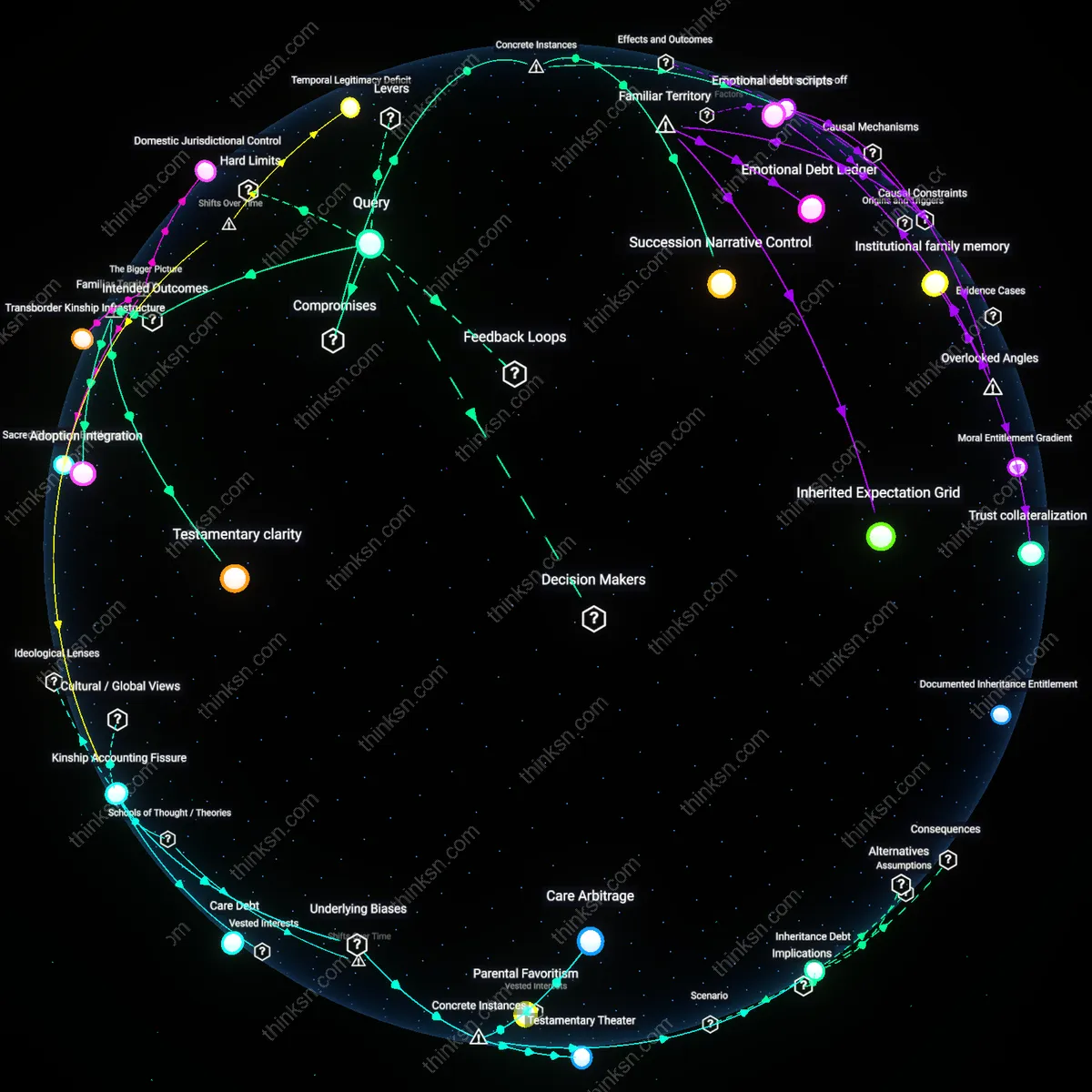
Analysis reveals 8 key thematic connections.
Key Findings
Child-Scale Justice
Prioritize the child’s developmental stability over parental conflict resolution because custody battles inflict cumulative psychological harm that undermines identity formation and emotional regulation; this approach treats the court system not as a venue for enforcing financial obligations but as a steward of developmental time, where the non-obvious cost is the misalignment between legal timelines—built for adversarial procedure—and childhood, which cannot be paused or reimbursed.
Support as Proxy Care
Treat child support not as a financial transaction between ex-partners but as a material proxy for involvement, because in high-conflict separations, consistent payments often become the only foreseeable mechanism through which a child indirectly receives parental investment; what’s underappreciated is that monetary support, despite its impersonal form, can stabilize household routines and educational access in ways that silently compensate for emotional absence, making it a structural substitute for relational care.
Conflict Debt
Measure the long-term burden of custody litigation as accrued relational debt, where each court filing or contested hearing compounds future difficulty in co-parenting and reduces the flexibility needed for children to navigate shifting family roles; this reframes legal victories as potential upstream gains that become downstream liabilities when they erode the informal cooperation necessary for school pickups, medical decisions, and emotional continuity.
Mediation Efficiency
The implementation of mandatory mediation in child custody disputes in Sweden significantly reduced emotional distress for parents and children while preserving child support compliance, demonstrating that structured, state-facilitated dialogue can simultaneously uphold financial responsibility and mental well-being. This mechanism operates through state-sponsored neutral mediators who guide separated parents toward consensual agreements, reducing adversarial court dynamics; what is non-obvious is that enforced collaboration does not weaken financial accountability—rather, in Sweden’s 2008 Family Law Reform, child support registration actually increased post-mediation due to improved communication and perceived fairness.
Procedural Synchronization
In British Columbia’s Unified Family Courts initiative launched in 2009, integrating child support determinations within custody proceedings minimized repeated traumatic testimony and legal whiplash, showing that aligning financial and emotional timelines benefits child development and judicial outcomes. By handling both issues in one forum with shared evidence and timelines, families avoid relitigating emotional trauma across separate venues; the underappreciated insight is that procedural coherence—not just policy intent—acts as a protective factor, as seen in reduced adolescent behavioral issues among litigants tracked by the UBC Justice Research Group.
Parental Agency Preservation
The success of New Zealand’s Family Dispute Resolution system, particularly under the Oranga Tamariki framework, reveals that granting parents early autonomy in designing co-parenting plans prevents emotional erosion even when child support is contested, because self-determined agreements foster long-term compliance and psychological resilience. Operated through accredited, culturally responsive facilitators, the system empowers Māori and Pasifika families to navigate support obligations without state coercion, and the non-obvious finding—evident in Te Puni Kōkiri evaluations—is that perceived agency, not outcome magnitude, most strongly predicts emotional sustainability.
Intergenerational Trauma Compression
The emotional toll of prolonged custody disputes cannot be traded against child support gains because both operate on different generational timeframes—the financial benefit is immediate and individual, while the psychological cost is deferred and collective, shaping attachment patterns across future relationships. When legal processes force children to become evidence or silent witnesses in support negotiations—such as when custodial parents must prove household need or the child’s material deprivation—the experience embeds a latent template of conditional care, where love and support are perceived as contingent on performance or conflict. This transformation of intimate family dynamics into economic disputes is amplified by welfare bureaucracies that require documentation of need, thus normalizing emotional exposure as a gateway to financial aid. The systemic trigger is the fusion of private emotional labor with public fiscal auditing, compressing intergenerational trauma into the present negotiation.
Market-Indexed Care Devaluation
Balancing emotional costs against financial gains in custody battles falsely assumes both are commensurable, when in reality, formal child support calculations actively devalue care work by excluding non-monetized contributions such as emotional regulation, routine stability, and psychological continuity—precisely the elements eroded by legal conflict. State-mandated child support formulas, like those based on the Income Shares or Percentage of Income models, treat parenting as a fungible expense rather than a relational process, thereby institutionalizing a market-centric view that sidelines emotional labor as irrelevant to financial equity. This creates a feedback loop where the parent who provides daily care loses leverage in negotiations unless they accept adversarial tactics that further degrade emotional conditions. The overlooked enabler is the accounting framework itself, which serves as a technical gatekeeper defining what counts as 'valuable' in parenting, thus systematically undercutting the very dimensions it purports to support.