Confronting a Parents Dark Past: Worth It for Family Healing?
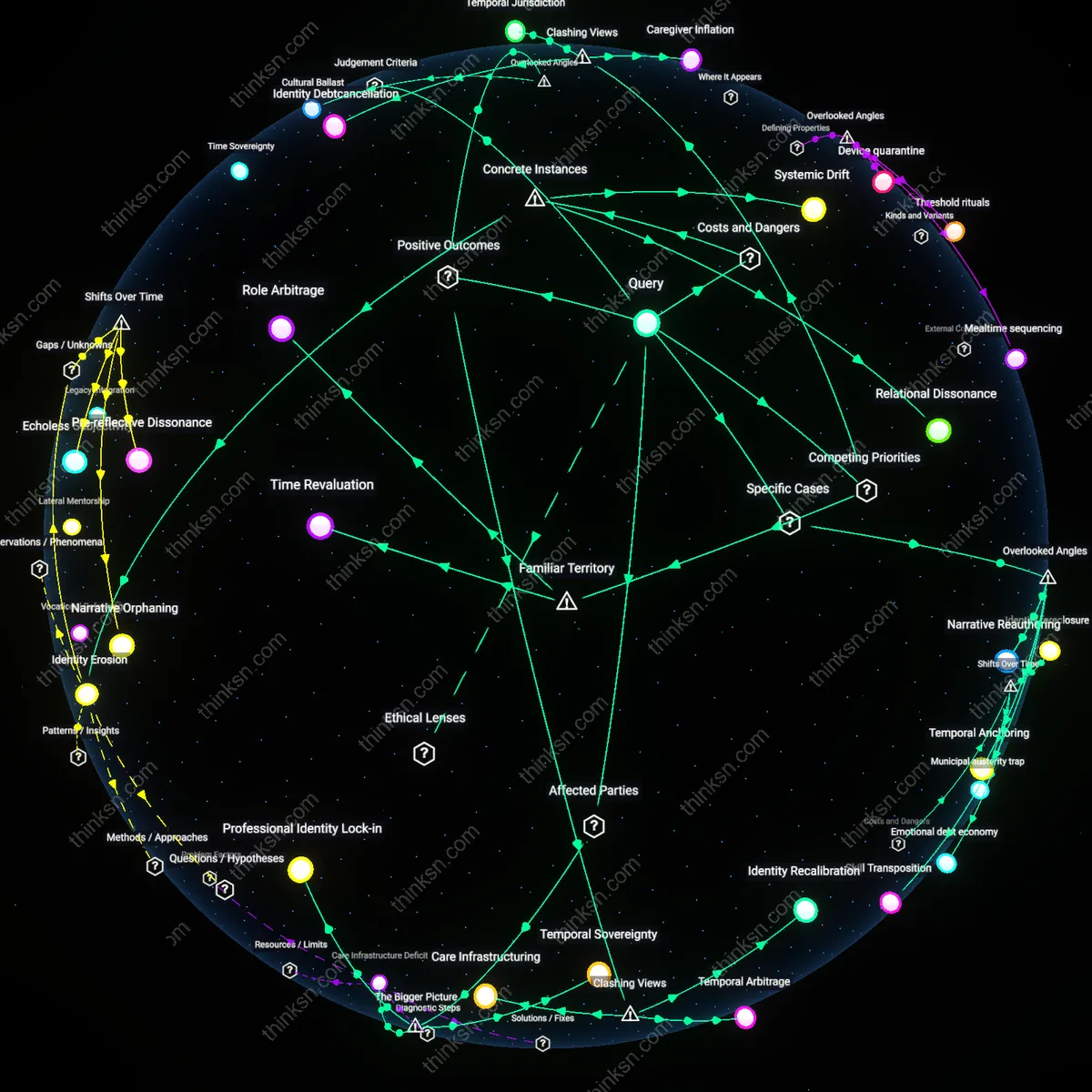
Analysis reveals 11 key thematic connections.
Key Findings
Intergenerational Witnessing
An adult can balance emotional risk and healing by publicly documenting the parent’s hate group involvement through archival testimony, as children of former East German Stasi informants did in the BStU records process, where state-mediated truth mechanisms enabled third-party validation of familial harm; this shifts the confrontation from private reconciliation to civic accountability, reducing retaliatory dynamics while preserving relational possibility through institutional buffer. The non-obvious insight is that healing does not require direct interpersonal resolution—structured external validation can absorb the emotional weight, allowing both parties to disengage from denial without severing ties.
Moral Reframing
An adult achieves balance by redefining the confrontation as an appeal to the parent’s latent values rather than a condemnation of past acts, as journalist Dorothy Thompson did when engaging her brother, a Nazi sympathizer in 1930s Austria, by emphasizing shared Christian ethics over political identity; this leverages cognitive dissonance within belief systems the parent still honors, making moral consistency the pathway to disengagement from hate. The underappreciated mechanism is that ideological exit often precedes emotional rupture—by anchoring appeal in enduring values, the adult avoids triggering defensive tribalism while enabling autonomous moral reconsideration.
Trauma Displacement
Confrontation is balanced when the adult redirects emotional risk into creative testimony that symbolically represents the conflict, such as Japanese-American descendants of WWII internment camp survivors using collaborative theater projects like 'The Tashme Project' to stage multigenerational narratives; here, artistic mediation allows parents and children to engage indirectly with painful histories, transforming personal accusation into collective memory work. The key insight is that healing often bypasses direct dialogue—structured aesthetic distance enables affective engagement without retraumatization, preserving the relationship through representational, not literal, confrontation.
Emotional Fossilization
Confronting a parent about their hate group past risks calcifying the adult’s own unresolved emotions into a permanent affective posture, where the act of accusation becomes a self-reinforcing loop that crowds out alternative narratives of identity and repair. In family systems where ideology was enforced through emotional withholding or conditional love, the adult’s confrontation—intended as catharsis—can trigger reactive entrenchment not only in the parent but also within the adult, locking them into a role of perpetual moral arbiter that forecloses ambiguity and impedes relational nuance. This dynamic is rarely acknowledged because most analyses prioritize reconciliation or truth-telling as inherently redemptive, overlooking how the performance of moral clarity can become a psychological trap that replaces one form of rigidity (the parent’s ideology) with another (the adult’s unyielding judgment), thus replicating the very patterns it seeks to dismantle.
Archival Asymmetry
An adult who confronts a parent about their past in a hate group inadvertently shifts from private witness to de facto archivist of traumatic lineage, burdened with preserving evidence the parent actively suppresses or denies. This creates an uneven epistemic responsibility where the adult holds fragmented, affect-laden memories while the parent controls narrative access—often through evasion, minimization, or silence—so that any healing effort becomes dependent on a dialogue that structurally favors the parent’s ability to withhold. Rarely discussed is how this imbalance transforms the adult into an involuntary curator of a suppressed history, one they are neither equipped nor emotionally safe to steward, thus exposing them to a slow erosion of agency as they become the sole repository of truths no one else will validate.
Generational Debt Transfer
Seeking family healing by confronting a parent about their hate group past risks reframing emotional labor as moral restitution, effectively charging the adult with repaying a social and familial debt they inherited but did not incur. This transfer operates through unspoken expectations that the child—not the parent—must generate the language, endure the discomfort, and produce the forgiveness required to restore equilibrium, positioning the adult as a reparative vessel rather than a stand-alone agent. The overlooked mechanism here is how reconciliation efforts, even when initiated with righteous intent, often default to a moral economy in which the child pays the emotional cost of the parent’s unprocessed legacy, thereby replicating the original power distortion under the guise of healing.
Emotional Debt
An adult must delay confronting a parent about their hate group past to preserve immediate family stability, trading truth for cohesion during periods of intergenerational vulnerability such as late 20th-century de-radicalization waves when former extremists were reintegrating into communities—this deferral institutionalizes silence as a caregiving mechanism, where emotional honesty is sacrificed to maintain household security, revealing how post-conflict domestic life normalizes unresolved moral injury as a condition of belonging.
Legacy Witnessing
Confrontation becomes possible only after the parent enters late-life reflection, a shift intensified by societal transitions like the 2010s rise in public archives of extremist violence, which reframes personal denial as historical evasion—this generational pivot transforms the adult child from silenced observer to legacy witness, activating a duty to testify that overrides fear of rupture, exposing how archival culture repositions familial silence as complicity across temporal regimes of memory.
Reparative Asymmetry
Healing emerges not through mutual reconciliation but when the adult leverages post-2000 therapeutic discourse to reframe the parent’s ideology as pathology rather than identity, thereby unilaterally redefining the relationship’s moral terms—this therapeutic turn severs emotional reciprocity as a prerequisite for resolution, showing how clinical language enables one-sided closure by displacing ethical judgment onto psychological development.
Moral Witnessing
An adult must first testify to harm as an end in itself, regardless of the parent’s response, because ethical frameworks like restorative justice prioritize acknowledgment over reconciliation. This act centers the adult as a moral witness within family dynamics, activating a mechanism seen in truth and reconciliation commissions where personal disclosure functions as civic repair. The non-obvious insight, against the familiar expectation of mutual healing, is that testimony can be complete even when met with silence or denial.
Relational Triangulation
An adult can reduce personal emotional risk by introducing a third-party mediator—such as a therapist or community elder—into the confrontation, a strategy grounded in family systems theory and supported by legal doctrines on facilitated communication in high-conflict guardianships. This shifts the interaction from a binary challenge to a structured ethical space where accountability is distributed. What’s rarely acknowledged in common narratives of one-on-one reconciliation is that healing often requires detouring through institutional or professional roles to defuse intergenerational loyalty binds.