Selling Stable Home for Sun Belt Growth? Weighing Equity vs Community
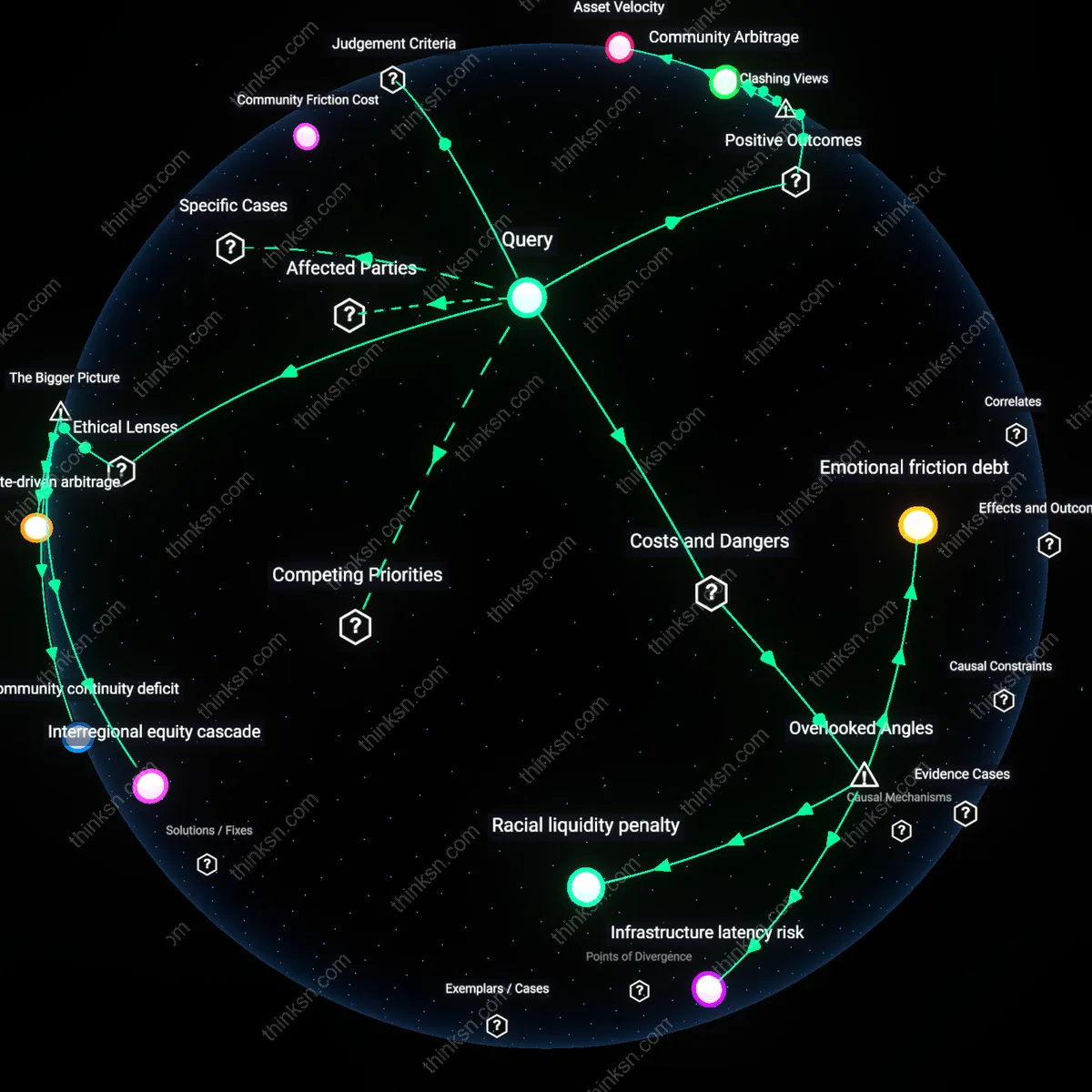
Analysis reveals 10 key thematic connections.
Key Findings
Community Friction Cost
A homeowner should not sell their Midwest home for a Sun Belt investment because the erosion of localized reciprocity networks—once buffered by stable neighborhood institutions like schools, block associations, and place-based credit systems—has made social re-rooting a hidden developmental cost in mobile asset strategies. This transition, marked by the decline of mid-20th-century urban cohesion post-1980 and the rise of transactional suburbanism, means that relocating is no longer just a spatial move but a rupture in interdependent social infrastructure that cannot be priced into ROI calculations. The mechanism operates through informal care exchange, trust-based referrals, and civic participation that accumulate slowly and are specific to place—systems that were more robust in industrial Midwest cities when manufacturing economies supported long-term residency. The non-obvious insight is that the Sun Belt’s growth is often fueled by this inflow of extraterritorial capital, but its communities are structurally thinner, making replacement of lost social yield difficult even for financially successful migrants.
Climate Risk Discount
A homeowner should delay moving capital to the Sun Belt because the region’s growth trajectory, while strong in the early 21st century, is increasingly counterbalanced by a structurally rising climate risk discount—particularly from heat stress, water scarcity, and uninsurable property exposure—that is reconfiguring long-term real estate fundamentals. This shift, crystallizing after 2020 through events like Texas’s grid failure in Winter Storm Uri and sustained drought in Arizona, reveals that earlier models of Sun Belt appreciation did not internalize climate externality costs now becoming actuarially material. The mechanism operates through municipal bond downgrades, insurance withdrawal (e.g., Citizens Property Insurance in Florida), and infrastructural strain in fast-growing cities like Phoenix, where air conditioning demand threatens grid resilience—dynamics absent in the Midwest’s slower-growth but climate-resilient positioning. The underappreciated point is that historical migration patterns toward warmth and low taxes are colliding with a new era where environmental carrying capacity, not just tax rates, defines market durability.
Asset Velocity
A homeowner should sell their Midwest home to invest in a Sun Belt property because faster appreciation in places like Bozeman, Phoenix, or Austin compounds equity growth more than community continuity sustains social capital. Rapid reinvestment cycles in high-demand housing markets turn stagnant ownership into accelerating financial mobility, especially when local Midwest stagnation caps return on capital—this mechanism reveals that residential real estate is not a home first but a wealth engine second, a function rarely acknowledged by homeownership norms.
Community Arbitrage
By selling a Midwest home and buying in the Sun Belt, the homeowner converts underutilized social capital into liquid opportunity, exploiting a blind spot in traditional valuations that treat community ties as inherently stabilizing rather than contextually constraining. In regions with slowing wage growth and aging institutions, like parts of Ohio or Indiana, sustained presence can quietly erode intergenerational mobility—whereas migration leverages dislocation as a necessary disruption, exposing that continuity is often reified inertia disguised as belonging.
Emotional friction debt
A homeowner should not sell a stable Midwest home for a Sun Belt investment because the cumulative emotional friction of severed place-based social contracts generates long-term decision fatigue that undermines financial rationality. This friction emerges not from major losses but from daily micro-estrangements—such as diminished trust in informal caregiving networks, weakened reciprocity with neighbors, and reduced access to embedded local knowledge—that are structurally irreplaceable in newer, transitory Sun Belt communities. Most analyses overlook how the slow erosion of these low-visibility social subsidies acts as a hidden tax on cognitive bandwidth, making ongoing financial and personal decisions less effective over time, which redefines 'market advantage' as temporally discounted by psychic transaction costs.
Infrastructure latency risk
Selling into Sun Belt growth markets amplifies exposure to infrastructure latency risk, wherein municipal systems lag behind population growth by design due to austerity-driven development models, creating multi-year gaps in water stability, grid resilience, and storm drainage. In places like Austin or Phoenix, rapid annexation prioritizes tax-base expansion over proportional public works investment, meaning that new residential investors often subsidize sprawl through higher insurance premiums and emergency mitigation long before public funding catches up. This dynamic is rarely priced into ROI projections, yet it systematically shifts capital from private appreciation to crisis adaptation—transforming apparent growth into deferred public obligation.
Racial liquidity penalty
Moving from a stable Midwest market to a high-appreciation Sun Belt region risks activating a racial liquidity penalty, where homes in predominantly white Midwest neighborhoods sell faster and at lower discount spreads than equivalent-value homes in diversifying Sun Belt corridors due to entrenched lending biases and appraiser mapping conventions. This penalty emerges not from individual prejudice but from algorithmic underwriting systems that equate demographic change with volatility, suppressing refinancing options and insurance terms for otherwise sound investments. It's a hidden drag on portfolio velocity—especially for nonwhite homeowners—that remains invisible in headline appreciation data but degrades long-term capital mobility.
Interregional equity cascade
A homeowner in a stable Midwest market should sell their home to invest in a Sun Belt market because capital reallocation across regional housing markets amplifies national wealth accumulation under neoliberal property regimes that prioritize mobility and appreciation over stability, where Federal Housing Finance Agency policies and secondary mortgage markets incentivize geographic arbitrage of home equity, making localized community loss a systemic externality of macroeconomic growth paradigms—thus revealing how individual homeowners become vectors in an interregional equity cascade, a pattern rarely acknowledged in ethical debates centered on personal loyalty or nostalgia.
Community continuity deficit
A homeowner should not sell their Midwest home for a Sun Belt investment because enduring civic participation relies on spatially embedded relationships that resist commodification, and liberal contractualism—while permitting such transactions—fails to account for the community continuity deficit created when long-term residents exit, a systemic condition where municipal social infrastructure degrades not from population loss alone but from the erosion of relational trust cultivated over decades, a dynamic obscured by market-centric analyses that treat housing as fungible rather than foundational to democratic belonging.
Climate-driven arbitrage
A homeowner should sell in the Midwest to buy in the Sun Belt because climate change is shifting habitability gradients, and real estate investment strategies now align with actuarial assessments made by insurers and developers who price future livability based on water scarcity, heat exposure, and flood risk, creating a climate-driven arbitrage wherein seemingly stable Midwest markets are undervalued not for economic stagnation but for their long-term resilience, a causal shift masked by traditional growth metrics but materialized through reinsurance markets and municipal bond ratings.