Equity imprisonment
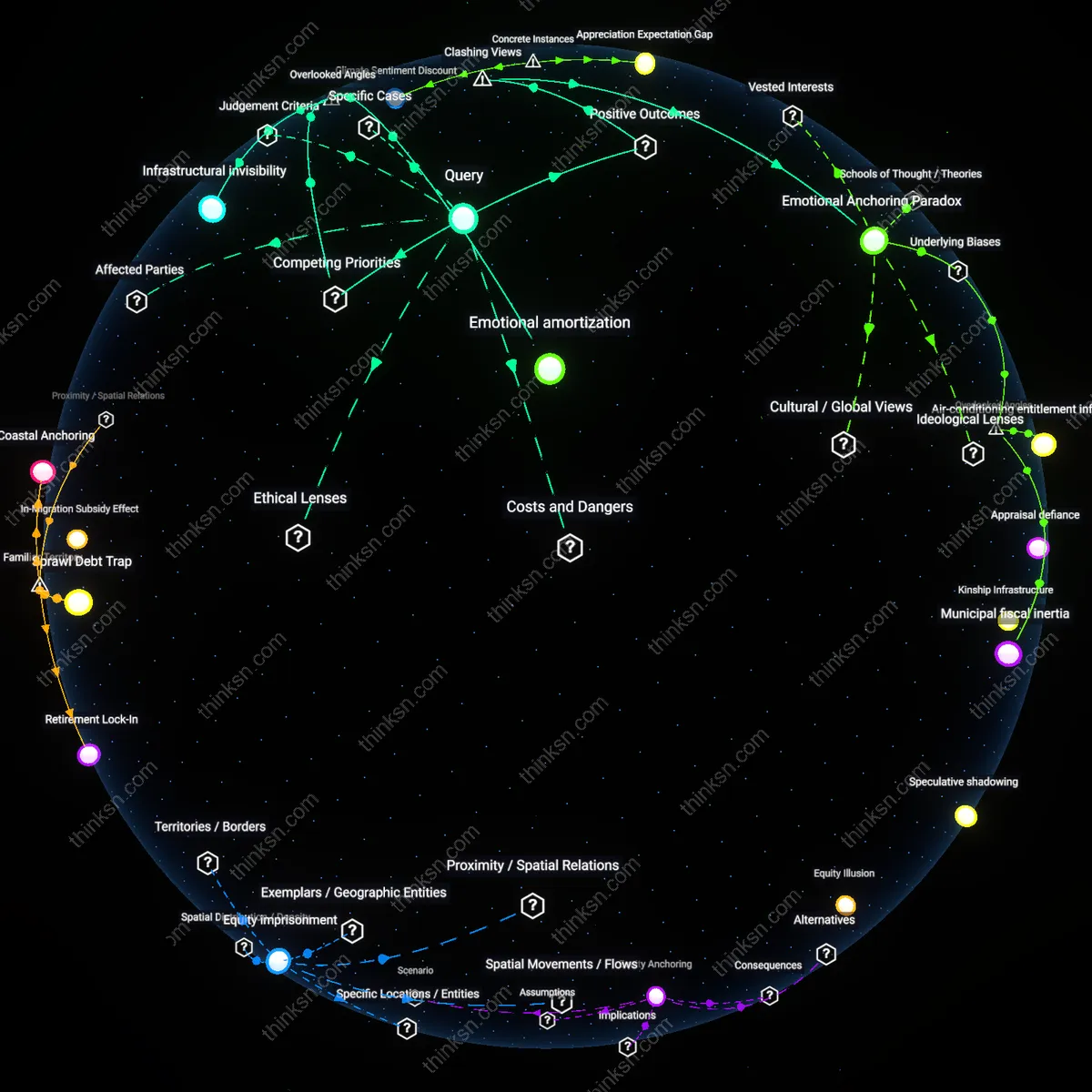
Staying in a home in Mesa became a form of financial entrapment as declining market values erased refinancing options, trapping families in homes they could not sell without triggering personal debt. As the 2008 downturn hit and home values in Mesa dropped 30–40%, many households—particularly those with subprime or high-LTV mortgages—found themselves underwater, where leaving meant covering the shortfall personally; this dynamic intensified during the 2012–2014 plateau, when regional recovery lagged national trends. The overlooked mechanism here is not declining wealth per se but the disappearance of exit liquidity, which transformed the home from an asset with mobility potential into a locked position that enforced stay-in-place resilience, even when economic or family needs demanded relocation. This flips the narrative of 'stability' from choice to structural binding.
Equity Lock
Staying in a home in Mesa shifted from a marker of stability to a constraint on mobility as the 2008 foreclosure crisis erased home equity, trapping families who could not sell or refinance despite deteriorating conditions. Bankruptcy filings and underwater mortgages immobilized households, particularly in formerly speculative neighborhoods like Las Sendas, where developers had inflated lot sizes to justify higher prices during the mid-2000s boom, making post-crash valuation gaps especially severe. This shift reveals how homeownership became a form of involuntary anchoring—where the absence of equity, not ownership itself, enforced continued residence, a mechanism often overlooked in narratives of suburban resilience.
Generational Withdrawal
By the 2010s, repeated market shocks recast staying in a Mesa home as a withdrawal from intergenerational mobility, as adult children deferred moving out due to both their own economic precarity and parents’ reliance on potential future sale value to fund retirement. This dynamic emerged as Maricopa County experienced slower job wage growth compared to population growth, tightening household liquidity while property taxes crept upward, forcing families to preserve homes as latent financial instruments rather than transferable assets. The persistence of residence thus became a signal of deferred futures, exposing how cyclical downturns disrupted not just immediate finances but the long-term domestic succession model once typical of Sun Belt suburbs.
Spatialized Risk Pool
In the post-2020 period, remaining in a Mesa home increasingly functioned as enrollment in a spatialized risk pool, where continued occupation depended on exposure to climate-amplified costs—such as cooling expenses and drought-reduced landscaping viability—that interacted with mortgage distress cycles. As institutional investors acquired distressed properties in bulk after 2012 and again after 2022, they selectively stabilized certain blocks, leaving older owner-occupants in unrenovated homes vulnerable to both market isolation and physical degradation. This reconfiguration reveals that the meaning of staying shifted from asset maintenance to survival within a geographically stratified system of climate-market feedback, a mechanism rarely accounted for in traditional housing policy analysis.
Equity Anchoring
Staying in a home in Mesa came to mean locking in diminished but stable equity after the 2008 crash, as families who retained ownership through underwater mortgages saw their decision reframed from financial risk to long-term security. This shift was driven by lenders’ deferred foreclosures and federal refinancing programs, which turned prolonged occupancy into a default preservation strategy rather than a sign of upward mobility. The non-obvious insight is that staying became less about home pride and more about anchoring to the last known value point before collapse, treating the house as a fixed reference in volatile markets.
Kinship Infrastructure
Housing stability in Mesa acquired new meaning as multi-generational cohabitation became a normative response to the 2010s rent surge and wage stagnation, transforming homes from private family units into kin-based economic shelters. Church networks and extended family compacts formalized informal caregiving and income pooling, embedding the home within a resilient web of social obligation. The underappreciated dimension is that staying wasn’t inertia—it was active reengineering of domestic space into a shared livelihood system, where physical proximity enabled mutual survival amid repeated economic shocks.
Tenure as resistance
In Mesa, Arizona, long-term homeowners in the Franklin Heights neighborhood refused to sell during the 2008 and 2020 downturns despite steep equity loss, treating home possession as a form of intergenerational defiance against market dispossession; this persistent occupancy, rooted in Black and Mexican-American kinship networks, transformed the home from a financial asset into a site of cultural continuity, revealing how marginalized families weaponize occupancy to resist economic erasure even when markets devalue their property.
Equity substitution
The Johnson family, multi-generational residents of East Mesa, maintained home occupancy through both the housing crash of 2008 and the pandemic-era mortgage delinquency surge by replacing market-dependent equity extraction with informal land contracts and familial rent pooling, demonstrating how embedded kin-based financial circuits supplant formal lending systems when market volatility severs credit access, preserving physical occupancy while decoupling it from conventional homeownership metrics.
Appraisal defiance
In 2012, the Mesa Community Land Trust secured permanent stewardship of 43 homes in the Osborn corridor after appraisal values collapsed post-subprime crisis, enabling families to remain through collective deedholding that rejected speculative valuation altogether, exposing how communities can re-anchor home meaning not through personal wealth accumulation but through the deliberate institutional rejection of market pricing logic as a governing principle of belonging.
Equity trap
Staying in a home in Mesa became a forced commitment rather than a choice as successive market downturns erased home equity, leaving families unable to sell without incurring losses. Lenders, appraisers, and declining regional job markets collectively undermined property value recovery, particularly after the 2008 foreclosure crisis and the 2015 energy-sector slowdown that affected nearby employment hubs. This created a condition where physical occupancy persisted despite financial unsustainability, as mobility was blocked by negative equity—revealing how housing stability can invert into economic immobilization when asset-backed autonomy erodes.
Demographic anchoring
Recurrent market instability transformed home occupancy in Mesa into a vehicle for intergenerational risk mitigation, as families increasingly co-resided or passed homes down informally to preserve shelter access amid uncertain wage growth and rental inflation. School district boundaries, pediatric healthcare access, and localized kinship networks reinforced this pattern, particularly among Latino and Indigenous households who faced tighter credit constraints post-2008. The home ceased to be primarily a financial asset and re-emerged as a socio-spatial anchor—demonstrating how economic volatility accelerates the re-domestication of housing under marginalized accumulation regimes.
Speculative shadowing
As institutional investors targeted undervalued Mesa homes during and after downturns—especially following the 2012 wave of REO acquisitions by firms like American Homes 4 Rent—families who remained in their homes inadvertently stabilized micro-markets that would later be exploited for rental yield extraction. Their continued occupancy prevented complete neighborhood disinvestment, maintaining basic demand signals that enabled later speculative re-entrance. This reveals how 'staying put' by vulnerable residents functions as invisible infrastructure for future financialization, where resilience is quietly expropriated by remote capital regimes.
Equity Illusion
Staying in a home in Mesa became a form of financial endurance not because homeowners preserved wealth, but because appraisal inertia masked systemic devaluation during downturns, requiring families to conflate occupancy with equity preservation despite declining market returns. Appraisal systems tied to historical benchmarks rather than real-time comparable sales delayed recognition of value drops, making homes appear as stable assets longer than market fundamentals justified—especially in suburbs like Mesa where assessment cycles lagged behind foreclosure spikes. This mechanism turned continued residence into a performance of solvency, obscuring the reality that staying meant sinking further into negative equity, a non-obvious outcome that challenges the idea of home retention as inherently protective.
Risk Repricing
Repeated market downturns redefined staying in a Mesa home not as an act of stability but as a compulsory assumption of concentrated risk, where families absorbed volatility previously shouldered by financial institutions through mortgage modifications and refinancing exclusions. As lenders recalibrated eligibility post-2008 and again during the 2016 valuation dip, programs like HARP excluded Mesa homeowners whose properties had depreciated below recovery thresholds, forcing continued occupancy without debt relief. This institutional withdrawal transformed residence into a de facto risk retention program for the working class, countering the intuitive narrative that staying reflects commitment or control by revealing it as a condition of financial abandonment.
Spatial Arbitrage
The meaning of staying shifted because families in Mesa were increasingly positioned not as homeowners but as unintentional participants in regional value reallocation, where prolonged occupancy subsidized external investment horizons through tax equity and rental conversion pipelines. As institutional buyers acquired distressed properties in neighboring Phoenix tracts but left similar Mesa homes untouched due to zoning and infrastructure ceilings, continued residence became a silent subsidy—maintaining neighborhood valuations that benefited nearby redevelopment without reciprocated investment. This dynamic reframes staying as passive market labor, a dissonant view that disrupts the moralized ideal of homeownership by showing how persistence functions as invisible economic input to distant capital strategies.