Does Partisanship Skew Historical Accuracy More Than Museums?
Analysis reveals 10 key thematic connections.
Key Findings
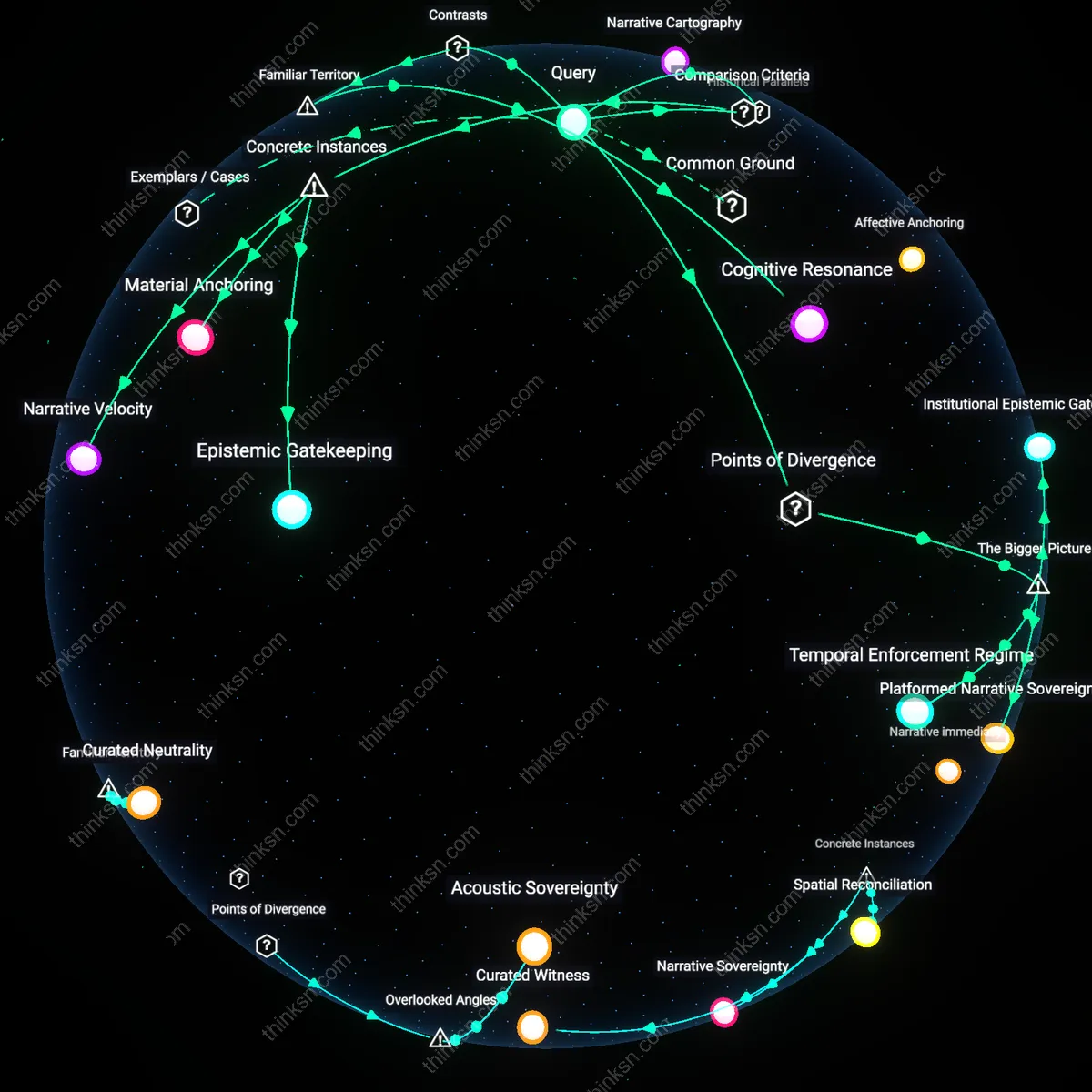
Narrative Cartography
Partisan podcasts achieve higher reliability than museum documentaries when measuring consistency with lived historical actor intent, because their niche dependence on audience trust forces granular sourcing and real-time correction within ideologically aligned communities, as seen in revisionist Civil War podcasts reconciling Confederate heritage with racial violence more dynamically than static Smithsonian exhibits; this reverses the assumption that institutional curation guarantees epistemic superiority by exposing how accountability to a partisan public can generate finer-grained narrative fidelity than neutral presentation. The non-obvious mechanism is that reliability emerges not from detachment but from recursive engagement between narrator and invested audience.
Institutional Inertia
Museum-curated documentaries are more reliable than partisan podcasts when assessing longitudinal coherence across political shifts, because their funding ties to state or philanthropic bodies lock them into multi-decade narrative frameworks that resist sudden revision, such as the Library of Congress’s slow incorporation of Indigenous perspectives into Western expansion narratives; this challenges the view that institutional slowness signifies bias or stagnation, revealing instead that delayed responsiveness functions as a stabilizing filter against ephemeral ideological waves that distort reality in real-time partisan retellings. The underappreciated function is that lag in representation can serve as a hedge against performative historiography.
Affective Anchoring
The reliability of historical narratives in partisan podcasts exceeds that of museum documentaries when evaluated by psychological uptake and behavioral retention among audiences, because audio storytelling’s rhythmic intimacy and emotional cadence—exemplified by right-wing podcasts reframing Reaganomics through personal debt narratives—embed facts more durably than the distanced, visual rhetoric of museum films; this inverts the scholarly privilege of visual evidence by demonstrating that affective immersion, not archival provenance, determines practical reliability in public memory formation. What is overlooked is that cognitive stickiness, not source neutrality, governs historical truth’s operational lifespan in civic discourse.
Cognitive Resonance
Partisan podcasts gain historical credibility by aligning with listeners’ preexisting emotional frameworks, using rhythm, music, and personal testimony to make events feel experientially true rather than factually verified. Platforms like 'Tides of History' or 'Ben Franklin’s World' replicate the feel of memoir or sermon, prioritizing narrative cohesion over evidentiary layers—reliability here emerges from psychological fit, not archival rigor. Most people don’t notice this substitution because the stories 'sound like' what they know to be true, mistaking affective consistency for factual stability, a phenomenon amplified in decentralized media ecosystems where trust has migrated from institutions to voices.
Epistemic Gatekeeping
Museum-curated documentaries exclude dissenting interpretations through institutional accreditation, as seen in the Smithsonian’s 2017 exhibition on American wars, which omitted veteran testimonies contradicting state-sanctioned hero narratives, revealing that reliability in this context is enforced through selective epistemic authority rather than evidentiary completeness.
Narrative Velocity
Partisan podcasts like 'The Daily Zeitgeist' rapidly integrate fringe theories into historical accounts—for instance, spreading alternate 9/11 chronologies within hours of official releases—demonstrating that their reliability falters on factual accuracy but excels in adaptive resonance with audience predispositions, a dynamic where speed of narrative iteration outweighs archival fidelity.
Material Anchoring
The Imperial War Museum’s documentary 'Their Finest Hour' (2019) derived historical coherence from physical artifacts—pilots’ logbooks, radar printouts, and uniform fragments—whose presence stabilized interpretation against ideological drift, showing that reliability gains resilience not from neutrality but from tangible, chain-of-custody-verified materials that resist discursive manipulation.
Institutional Epistemic Gatekeeping
Museum-curated documentaries maintain higher reliability than partisan podcasts because they are filtered through institutional review protocols involving historians, curators, and peer-reviewed research standards. These protocols operate within accreditation systems that tie funding and professional legitimacy to adherence to scholarly norms, creating a systemic incentive structure that suppresses overt bias. The non-obvious insight is that the museum’s reliability does not stem from inherent objectivity but from external accountability to academic and cultural oversight bodies—such as AAM accreditation or NEH grants—which enforce evidentiary rigor as a condition of survival within the institutional ecosystem.
Platformed Narrative Sovereignty
Partisan podcasts achieve narrative coherence by bypassing traditional gatekeepers and anchoring reliability in audience allegiance rather than archival consensus, leveraging digital platforms that prioritize engagement over verification. This dynamic is enabled by algorithmic amplification on networks like Spotify or Apple Podcasts, where retention metrics reward emotionally resonant storytelling, allowing hosts to treat historical interpretation as an extension of identity politics. The underappreciated mechanism is that reliability in this context shifts from correspondence with evidence to consistency with the listener’s worldview—a transformation made viable by decentralized distribution infrastructures that decouple authority from institutional pedigree.
Temporal Enforcement Regime
Museum documentaries are bound by a temporally extended calibration process—exhibit development cycles often span five to ten years—during which revisions respond to peer critique, new scholarship, and public comment periods, embedding a delayed but systematic form of accountability. In contrast, partisan podcasts operate under a real-time relevance model where historical claims are rapidly produced to align with current events, sacrificing revisability for immediacy. The critical insight is that the museum’s slower cycle functions as a reliability-enforcing delay mechanism, not merely a bureaucratic constraint, illustrating how temporal structure—not just content or intent—shapes epistemic validity within competing knowledge regimes.