Why Personal Carbon Calculators Miss Corporate Supply Chain Emissions?
Analysis reveals 5 key thematic connections.
Key Findings
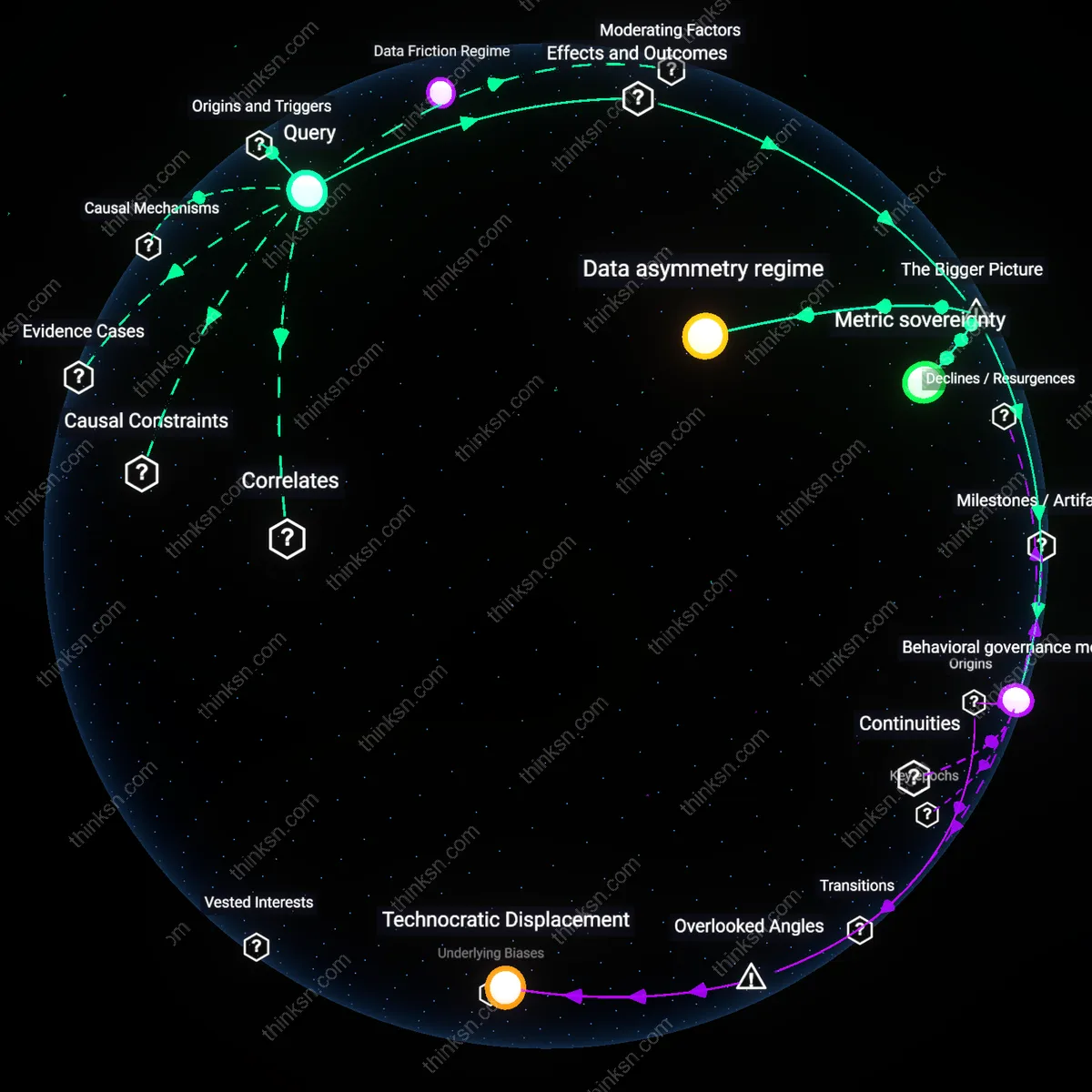
Data Friction Regime
Corporate supply chains are omitted from personal carbon calculators because access to upstream emission data is monopolized by private audit systems like the Carbon Trust or Ecolab, which license it selectively to partners, making integration into public tools legally and technically infeasible. These data gatekeepers emerged from voluntary corporate sustainability programs where transparency was conditioned on competitive advantage, not civic access, creating a frictional landscape where even researchers at institutions like CDP struggle to extract granular lifecycle inventories. As a result, calculator developers at organizations such as Carbonfootprint.com default to proxy models based on consumer spending categories, which inherently truncate accountability at the point of purchase. This reveals that the absence is not a gap but a calculated exclusion enforced by proprietary data ecosystems.
Emissions Boundary Convention
Personal carbon calculators disregard supply chain impacts because their underlying accounting protocols follow ISO 14064-1 guidelines, which codify ‘direct consumer responsibility’ as limited to energy use and transportation, excluding indirect Scope 3 emissions from purchased goods. This standard was institutionalized through consensus bodies like the World Resources Institute and adopted by national agencies including the EPA, normalizing the idea that responsibility ends where visibility begins. The convention persists not due to technical limits but because it aligns with a liberal environmental epistemology that frames change as incremental and choice-based, marginalizing systemic causality. The overlooked truth is that these calculators reproduce a jurisdictional fiction—emissions are real, but accountability is administratively bounded.
Metric sovereignty
Personal carbon calculators exclude corporate supply chains because measurement authority is delegated to consumer-facing platforms that prioritize individual behavioral levers over structural accountability. These tools operate within a governance ecosystem where NGOs, tech firms, and sustainability consultancies define what counts as 'actionable' emissions—typically Scope 3 downstream consumption, not upstream production networks—thereby reinforcing a public rationale that emissions responsibility resides in lifestyle choice, not industrial organization. This enables corporations to avoid transparency mandates by offloading accountability to end users, a dynamic sustained by the depoliticization of measurement standards in climate governance.
Data asymmetry regime
Corporate supply chain emissions are omitted from personal carbon calculators because granular supply chain data is legally and technically inaccessible to third-party developers, who rely on public or consumer-level datasets that lack upstream industrial throughput records. Multinational firms control proprietary access to Scope 3 supplier data and face no regulatory obligation to disclose it at the resolution needed for individualized carbon accounting, creating a systemic blind spot that calculators cannot overcome even when methodologically capable. This data gatekeeping sustains an invisibility cloak around high-emission procurement networks, effectively shielding corporate actors from reputational or behavioral consequences in consumer decision tools.
Behavioral governance model
Personal carbon calculators ignore supply chain impacts because they are designed within a behavioral economics framework that treats climate action as a function of individual habit change, not collective industrial reorganization. Institutions like DEFRA and the EPA, which underwrite or endorse many calculators, prioritize interventions that align with low-friction policies—such as energy-efficient appliances or reduced air travel—over structural critiques of production systems, thus institutionalizing a depoliticized model of environmental responsibility. This model systematically neutralizes demands for supply chain transparency by recasting emissions as personal moral choices rather than outcomes of embedded corporate power.