Flood Exclusions: Worth Risking Home Insurance Protection?
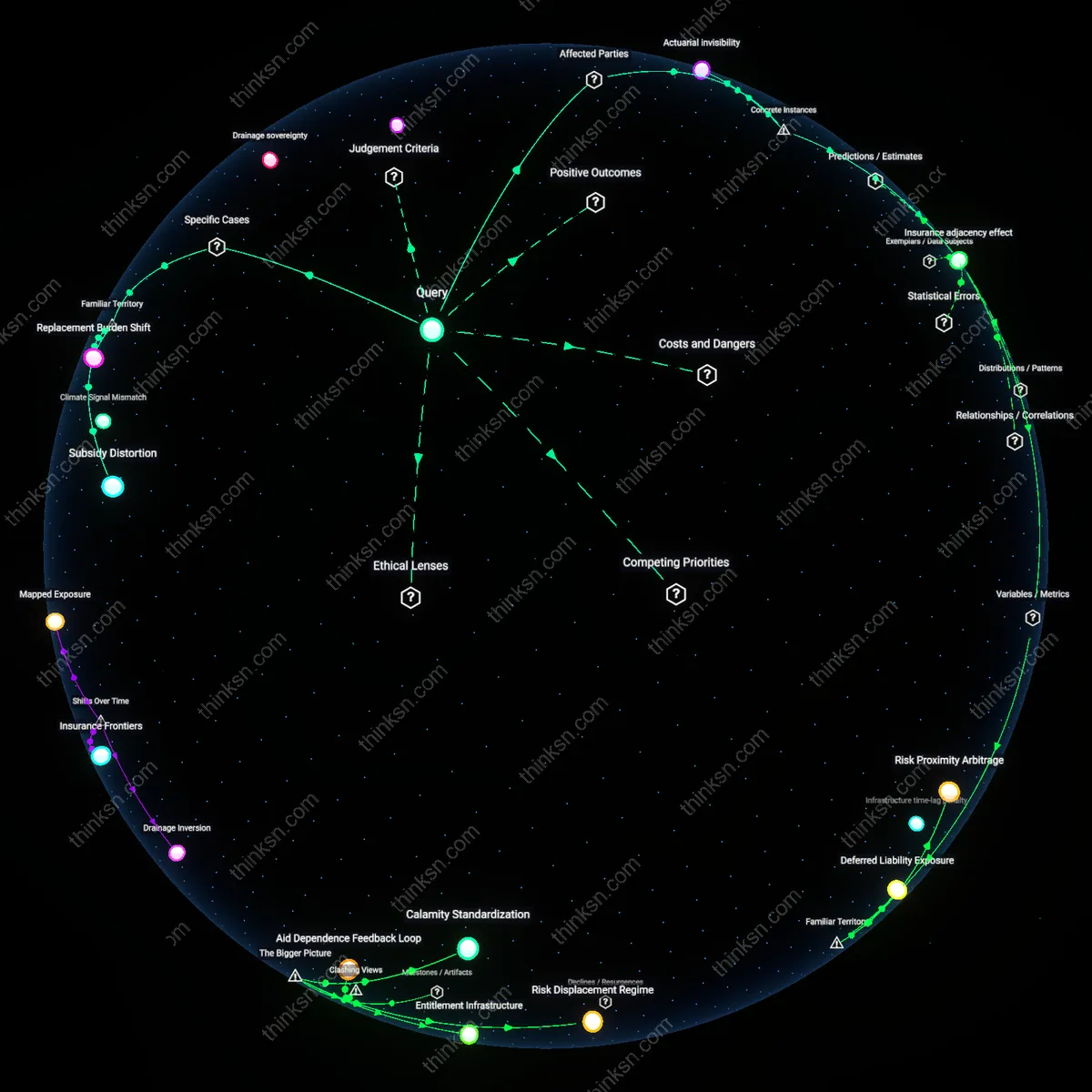
Analysis reveals 6 key thematic connections.
Key Findings
Municipal liability spiral
It is rational to skip flood insurance in low-risk zones because municipalities like Cedar Rapids, Iowa, after the 2008 floods, absorbed rebuilding costs through federal disaster aid, shielding individual homeowners from full financial consequences despite standard policy exclusions—creating a moral hazard where residents underinvest in flood protection because centralized institutions internalize long-term risk. This dynamic reveals how local governments, as primary beneficiaries of continued property development and tax revenue, become de facto underwriters of disaster recovery, weakening incentives for private risk mitigation even in areas recently proven vulnerable, a pattern that sustains urban expansion into marginally safe territories.
Actuarial invisibility
Homeowners in low-risk zones such as Zone X in the National Flood Insurance Program’s maps, like those in Charlotte, North Carolina’s historically excluded neighborhoods, rationally forgo flood insurance because their exclusion from high-risk designations renders them statistically invisible to insurers and policymakers alike—despite experiencing repetitive loss from non-catastrophic, chronic flooding due to aging drainage infrastructure. This condition enables systemic disinvestment in preventive measures and denies access to subsidized premiums, making private insurance prohibitively expensive relative to perceived risk, thereby locking residents into a false sense of security produced by outdated floodplain models.
Insurance adjacency effect
In coastal Charleston, South Carolina, homeowners just outside mapped floodplains—such as in the West Ashley neighborhoods—rationally decline flood insurance because the visible burden of flood risk is displaced onto adjacent, high-risk zones, distorting individual risk assessment even when rising sea levels and stormwater back-ups increasingly affect both. The proximity to insured, frequently flooded properties creates a psychological and financial buffer, where damage responses appear managed by others’ coverage and public interventions, masking the interconnected hydrology of urban watersheds and reinforcing the misperception that policy exclusions equate to safety, not shared vulnerability.
Policy Blind Spots
It is rational to skip flood insurance in a low-risk area because standard homeowners policies exclude flood damage, and in places like Des Moines or Cincinnati—where flood zones are narrowly mapped and historic flooding is rare—residents rely on FEMA’s Flood Insurance Rate Maps to assume minimal exposure, even though these maps often fail to account for localized drainage failures or climate-driven rain events; this creates a false sense of security that is structurally reinforced by the insurance industry’s segmentation of risk, making the omission of flood coverage appear prudent when it may not be. The non-obvious insight is that the very tool used to assess safety—the official flood map—produces complacency by excluding emerging hydrological risks that fall outside traditional models.
Subsidy Distortion
It is rational to skip flood insurance in a low-risk area because the National Flood Insurance Program (NFIP) prices premiums based heavily on designated Special Flood Hazard Areas, meaning homeowners in Zone X, like those in suburban Raleigh or Fort Worth, pay little or nothing extra for flood coverage, while the program's structure incentivizes nonparticipation by making insurance feel irrelevant where it's not actively subsidized or mandated; the result is a market distortion where rational actors avoid paying for a product they’re not nudged toward, even if marginal risk exists. The underappreciated mechanism is that the NFIP’s own pricing logic teaches people to ignore flood risk, not because they misunderstand danger, but because the system signals that risk is negligible if no financial penalty applies.
Replacement Burden Shift
It is rational to skip flood insurance in a low-risk area because when standard homeowners policies exclude flood damage—as with State Farm or Allstate policies in areas like Spokane or Lexington—homeowners internalize that loss recovery falls entirely to personal savings or federal disaster aid, and in communities where FEMA declarations are anticipated as a backstop, the perceived need for insurance evaporates despite its absence in most routine claims; the critical dynamic is that public expectations of federal intervention, shaped by repeated post-storm aid in politically visible events (e.g., Midwest storms in 2019), quietly replace insurance as a risk-transfer strategy. The overlooked truth is that people aren’t miscalculating risk—they’re relying on a social contract that disaster will be collectively financed, not individually insured.