Will Accessory Units Mix Socioeconomics Without Displacing Neighbors?
Analysis reveals 8 key thematic connections.
Key Findings
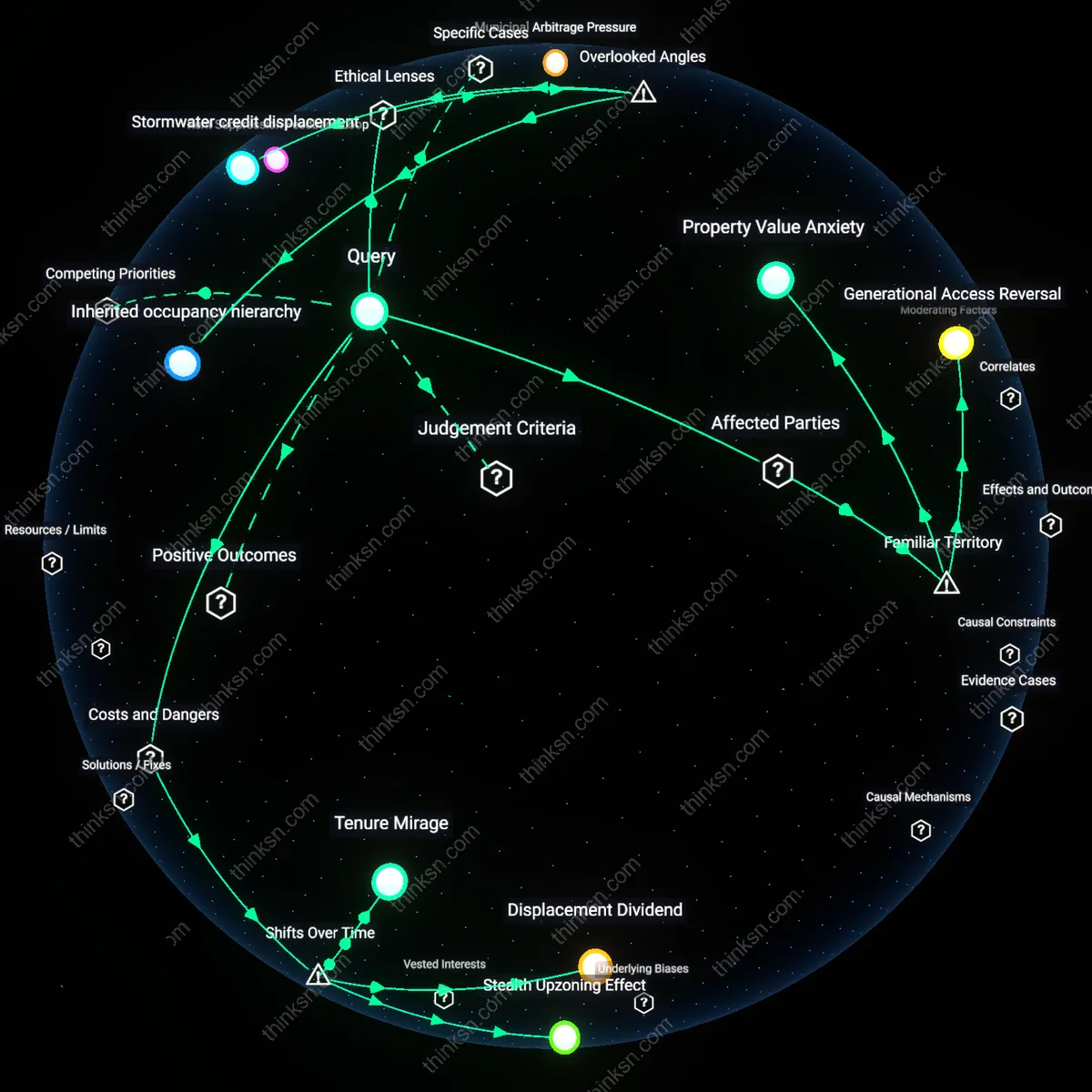
Property Value Anxiety
Increasing accessory dwelling units in established neighborhoods often threatens the perceived stability of home values, making long-term homeowners—particularly middle- and fixed-income families—resist change despite potential affordability gains. This fear is activated when infill housing introduces visible construction or rental activity, which residents associate with neighborhood decline, even though data may show neutral or positive economic effects. The mechanism operates through local zoning boards and homeowner associations that wield veto power over development, revealing how emotional heuristics about property values dominate policy outcomes more than demographic diversity goals. What’s underappreciated is that these reactions aren’t purely about economics but about symbolic boundaries—what kind of people belong in a neighborhood—driving opposition even when financial risk is low.
Rental Profit Conversion
Accessory dwelling units frequently shift single-family homes into de facto rental portfolios, transferring financial benefits to landlords and investors while exposing tenants to market volatility. The mechanism unfolds as homeowners capitalize on zoning reforms to lease ADUs at market rates, disproportionately serving higher-income renters and sidestepping affordable housing mandates, thereby reinforcing income segregation rather than disrupting it. Landlords, both absentee and owner-occupant, become de facto gatekeepers of access, operating through informal rental markets that evade regulatory oversight. The non-obvious insight is that even non-displacing infill can still deepen economic stratification by repurposing housing stock into higher-tier rental enclaves with no tether to community tenure.
Generational Access Reversal
Elderly homeowners in established neighborhoods sometimes deploy ADUs to house adult children or aging relatives, temporarily preserving multigenerational stability without market displacement. This familial use of ADUs creates de facto affordability buffers, utilizing underused square footage to accommodate kin amid rising housing costs, especially in high-pressure metro areas like Los Angeles or Portland. The dynamic operates through informal household economies rather than real estate markets, altering neighborhood demographics organically rather than speculatively. What’s underappreciated is that small-scale, kinship-driven ADU use—though rare—subverts the default narrative that infill development always serves middle-class professionals, instead showing how housing policy can quietly reinforce intergenerational continuity when family needs align with regulatory possibility.
Displacement Dividend
Expanding accessory dwelling units in established neighborhoods systematically converts racialized home equity gains into tools of cultural erasure, as post-Civil Rights era integration efforts gave way to market-driven inclusion policies in the 1990s. The mechanism—from local zoning adjustments to profit incentives for teardowns—enables white middle-class households to move into historically disinvested, predominantly Black and Latino tracts under the banner of 'gentle density,' displacing long-term owners through appraisal inflation and property tax spikes. This shift, solidified in cities like Los Angeles and Portland after 2008 housing reforms, reveals that the promised socioeconomic diversification functions less as integration and more as a racialized wealth extraction phase in post-segregation urban economies.
Stealth Upzoning Effect
The proliferation of accessory dwelling units amplifies hidden class stratification within single-family zones once codified as inclusive middle-class sanctuaries during mid-20th century suburban expansion. As municipal budgets tightened after the 1970s fiscal crises, cities increasingly treated zoning as flexible infrastructure rather than social contract, allowing ostensibly neutral ADU policies to covertly reclassify working-class owner-occupied lots into real estate playlands for investor landlords. The transition—from zoning-as-buffer to zoning-as-opportunity-market after 2010 energy efficiency campaigns masked how deregulation preferentially benefited mobile capital over fixed residency, exposing long-term residents to displacement via incremental densification without community-controlled safeguards.
Tenure Mirage
Policies promoting accessory dwelling units falsely equate physical cohabitation with socioeconomic diversity, disregarding how the post-1980 financialization of housing tenure separated occupancy from security. By reframing ADUs as affordability solutions during the Great Recession's aftermath, cities outsourced integration to individual property owners—transforming racialized homeownership barriers into privatized density experiments that disproportionately recruited elderly, low-income renters into proximity with affluent tenants while leaving ownership structures intact. This shift from public housing obligation to voluntary micro-development obscured how integration under market terms reinforces caste-like hierarchies within shared parcels, where shared walls do not signal shared power.
Inherited occupancy hierarchy
Expanding ADUs in long-established neighborhoods tends to diversify visible demographics while preserving latent socioeconomic exclusion, because occupancy rights are systematically weighted in favor of bloodline occupants and deeded heirs over renters, even within the same family. In practice, elderly homeowners who add ADUs frequently allocate them to adult children over the long-term tenant base, embedding intergenerational wealth transfer into housing access—a mechanism legitimized by familial privacy norms enshrined in property law and tacitly protected by neighborhood associations. This occurs in cities like Los Angeles and Portland, where ADU permits cite “family housing” exemptions to bypass tenant anti-discrimination standards, thereby embedding kinship as a concealed sorting criterion within supposed affordability solutions. Most policy analysis overlooks how familial occupancy rights function as a moralized filter, making inherited occupancy hierarchy a non-market mechanism of exclusion that complicates claims about socioeconomic integration.
Stormwater credit displacement
The proliferation of ADUs in established, low-density neighborhoods can trigger unacknowledged environmental gentrification by altering stormwater management regimes and incrementally raising property maintenance costs for all homeowners. In cities such as Seattle and Austin, code updates permitting ADUs simultaneously impose pervious surface requirements and runoff mitigation mandates, shifting public infrastructure burdens onto individual lot owners—costs that are more easily absorbed by wealthier, newer entrants than by long-term residents on fixed incomes. The ethical tension arises from liberal municipal environmentalism, which uses ecological sustainability doctrines to justify privatization of formerly public infrastructural responsibilities, relying on deontological environmental duties to override equity concerns. Because these hydrological regulations act cumulatively and are spatially uneven, they create a slow-moving displacement pressure masked as environmental stewardship—what emerges is stormwater credit displacement, a mechanism where green governance indirectly reshapes neighborhood demographics through technical code enforcement rather than overt market forces.