Do Upzoning Policies Lower Home Prices or Widen Wealth Gaps?
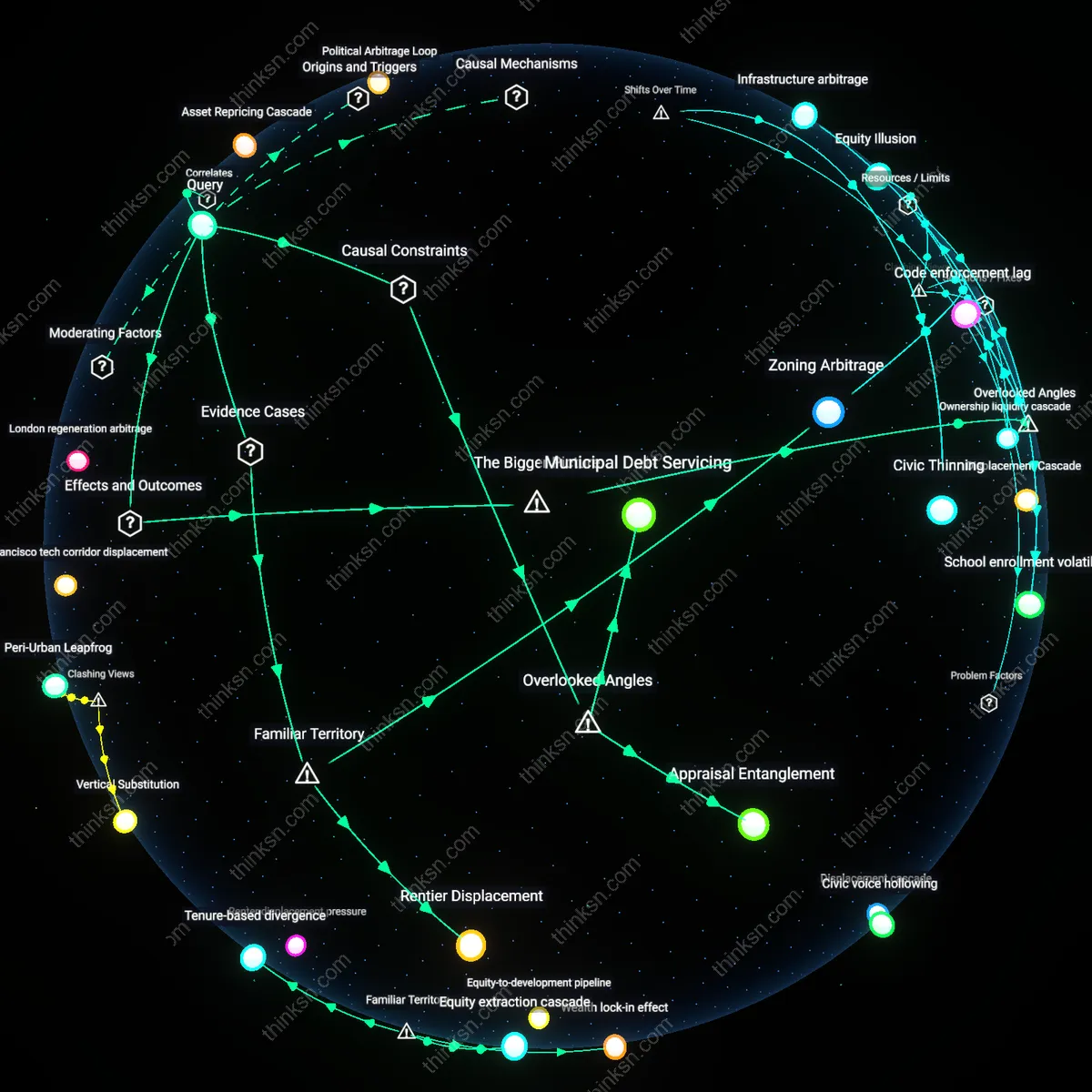
Analysis reveals 8 key thematic connections.
Key Findings
Ownership liquidity cascade
Existing owners near upzoned corridors gain not from price declines but from unlocked equity, enabling mobility into higher-tier housing markets while renting out old units. In cities like Austin or Brooklyn, middle-income households leverage sudden price spikes after rezoning to sell and reinvest, functioning as arbitrageurs in a thickening ownership network. Because wealth inequality grows not from static ownership but from differential access to liquidity events, the ability to monetize residence becomes the new vector of stratification. The underappreciated mechanism is not pricing per se, but the timing of exit opportunities—concentrated among those already positioned to transact.
Asset Repricing Cascade
Aggressive upzoning in Vancouver, Canada, failed to reduce home prices for existing owners and instead amplified wealth inequality because newly designated high-density zones triggered speculative revaluation of adjacent single-family lots. Real estate investors and incumbent homeowners—especially in affluent neighborhoods like Shaughnessy—leveraged anticipated density gains to justify steep price markups, even as new supply remained under construction. This mechanism operated not through immediate rent or sales pressures but through financialized expectations embedded in property appraisals and credit markets, revealing how zoning policy can activate latent asset inflation independent of physical housing output.
Political Arbitrage Loop
In Minneapolis following the 2040 Comprehensive Plan’s upzoning of single-family lots citywide, existing homeowners—particularly in historically privileged North Side and Southwest neighborhoods—gained disproportionate ability to redevelop or sell to developers, while low-income renters in renter-dense areas like Phillips faced displacement without ownership stakes to leverage. The reform correlated with rising neighborhood-level home value disparities because zoning access combined with pre-existing racial wealth gaps and credit access asymmetries, transforming regulatory change into a mechanism for consolidating advantage among those already positioned to exploit it, thus exposing how equity outcomes depend on pre-existing distributions of capital and political access.
Speculative Zoning Premium
After Berlin’s 2019 zoning adjustments allowed denser construction in peripheral districts like Marzahn-Hellersdorf, land prices surged ahead of actual development due to investor bidding on rezoned parcels, benefiting private landholders and corporate entities such as TLG Immobilien while contributing little to near-term affordability. This dynamic reflected a decoupling between zoning permissions and housing delivery, where the mere signal of upzoning became a tradable financial asset, illustrating how regulatory announcements can feed asset inequality via anticipatory markets rather than tangible supply expansion.
Municipal Debt Servicing
Aggressive upzoning can fail to lower prices for existing owners and exacerbate inequality when cities use increased property tax assessments from upzoned areas to secure municipal bond financing for infrastructure, locking future revenue into debt repayment rather than affordability mandates. This mechanism redirects the financial upside of density into credit markets rather than price competition, particularly in fiscally stressed cities like those in California’s inland metros that upzone near transit corridors while assuming future tax windfalls. The non-obvious dependency here is that zoning-induced wealth appreciation becomes a municipal credit signal, not a housing supply signal—elevating land values benefits bondholders, not buyers, and entrenches spatial inequities as older neighborhoods without upzoning forego gains while bearing service cuts.
Appraisal Entanglement
Home prices for existing owners fail to decrease post-upzoning when automated valuation models (AVMs) used by Fannie Mae, banks, and insurers systematically correlate property worth with projected density bonuses rather than realized housing competition, effectively pricing speculative appreciation into lending standards before new units are even built. In cities like Austin or Seattle, where upzoning precedes construction by years, appraisers rely on zoning envelopes as proxies for value, inflating collateral estimates and mortgage eligibility for current owners while making affordable tracts too 'hot' for low-income buyers. The overlooked mechanism is that financial infrastructure—driven by data brokers and secondary mortgage markets—capitalizes zoning changes faster than the physical market can adjust, turning supply intentions into immediate wealth signals.
Rentier Displacement
Aggressive upzoning in cities like San Francisco increases housing supply but disproportionately benefits real estate investors who acquire newly zoned land before construction, allowing them to capture rising asset values without contributing to affordability. Developers and institutional landlords leverage zoning windfalls to reposition rental portfolios, pushing out legacy tenants through market-rate conversions, thus amplifying wealth concentration among property-owning classes. This mechanism contradicts intuition because upzoning is widely framed as a supply-side fix, yet in high-demand urban cores with entrenched speculation, it functions more like a subsidy to capital than a relief valve for homeowners or renters. The non-obvious insight is that zoning liberalization in speculative markets doesn’t neutralize rent extraction—it rechannels it.
Zoning Arbitrage
In cities such as Austin and Nashville, aggressive upzoning enables developers to exploit discrepancies between old zoning restrictions and new entitlements, generating massive paper gains on existing properties without delivering significant affordable units. These windfall profits accrue to early landowners and financial intermediaries—who strategically time sales to capitalize on rezoning announcements—while new housing enters the market at premium price points reflecting capitalized land costs. The public assumes upzoning dilutes prices through competition, but in practice, the arbitrage opportunity strengthens hold-power for those with access to capital and information, reinforcing wealth divergence between asset holders and non-owners. The core dynamic is not supply saturation but revalued ownership stakes in urban space.