Report Landlord’s Rent Increase: Ethical Dilemma or Tenant Harm?
Analysis reveals 11 key thematic connections.
Key Findings
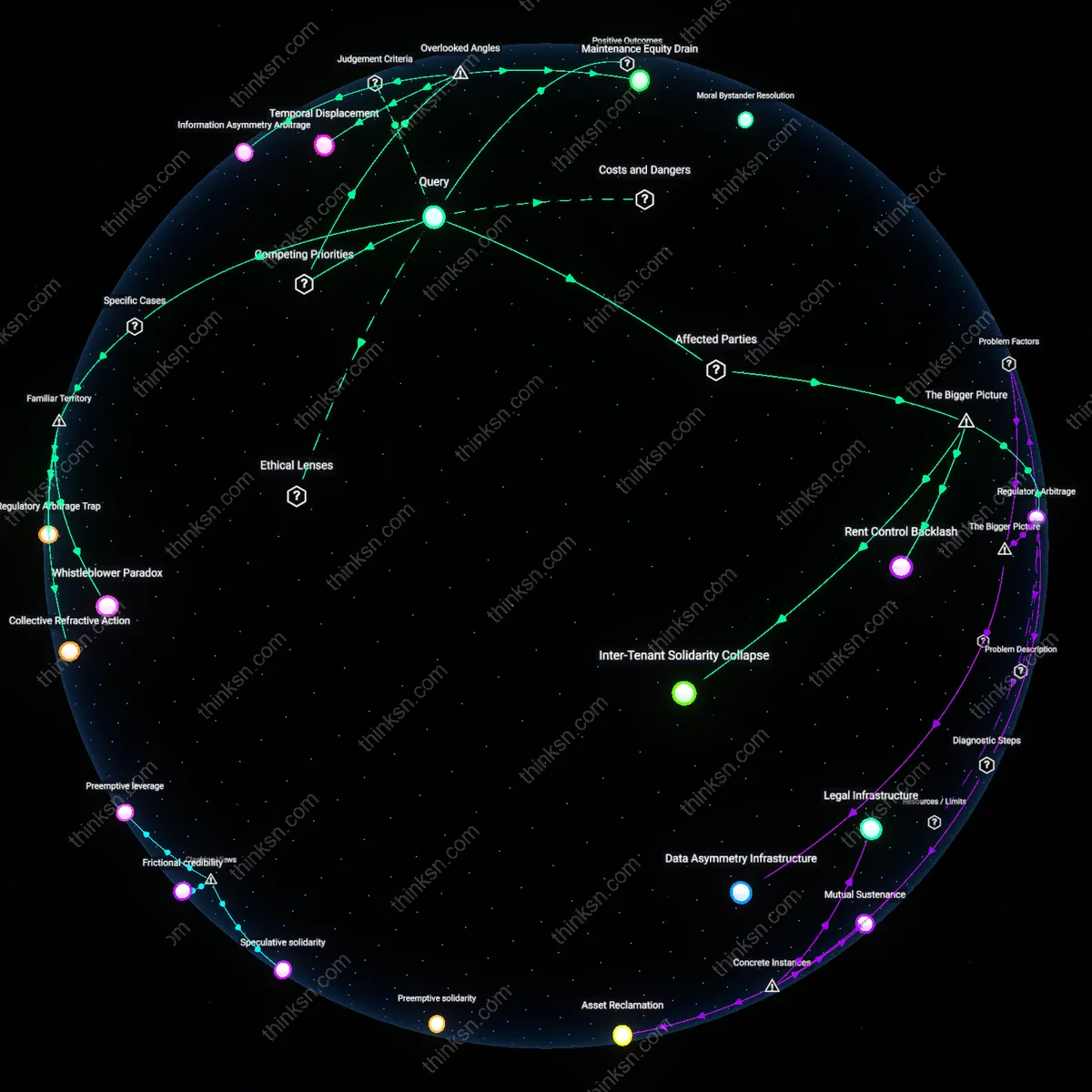
Rent Control Backlash
Report the violation to housing authorities to uphold legal standards, because the systemic suppression of tenant organizing by landlords creates a false equilibrium that only formal intervention can disrupt. When rent increases exceed legal limits—such as in cities with rent stabilization like New York or Berlin—silent compliance entrenches landlord discretion and erodes collective tenant power; reporting forces institutional transparency, exposing enforcement gaps that benefit all tenants in the long term. The non-obvious consequence is that administrative scrutiny can catalyze broader policy refinement, especially when data from individual reports aggregate into patterns of exploitation that housing agencies are mandated to address.
Inter-Tenant Solidarity Collapse
Delay reporting and instead organize tenants collectively to negotiate or resist the increase, because the fragility of informal tenant coalitions in high-turnover urban housing markets makes unilateral action a destabilizing force. A single report risks fracturing trust among tenants—a key enabler of future collective action—since fear of retaliatory neglect or selective eviction is well-documented in low-income rental buildings in cities like Los Angeles or Chicago. This mechanism reveals that short-term legal compliance can undermine the social infrastructure necessary for sustained resistance, making tenant cohesion a higher-order stabilizer than isolated enforcement.
Regulatory Arbitrage
Withhold reporting unless accompanied by policy advocacy, because landlords in mixed-regulation markets such as Portland or Toronto exploit uneven enforcement to test legal boundaries, using isolated overcharges as probes into jurisdictional tolerance. These actions are not random violations but calibrated experiments in regulatory capacity, where the absence of coordinated tenant response signals permission for further encroachment. The deeper dynamic is that episodic reporting without systemic pressure merely feeds landlord risk assessment models, allowing them to adjust tactics without altering underlying profit structures.
Moral Bystander Resolution
In 2018, a tenant in San Francisco’s Mission District reported a landlord’s $3,000 rent hike—an illegal 80% increase over local median growth—leading to an investigation by the Rent Board that not only froze rents but exposed a pattern of harassment and serial T.I.A. (Tenant in Apartment) filings used to destabilize residents, and ultimately triggered enhanced city oversight of eviction abuse. The reporting individual faced social isolation but catalyzed citywide policy refinements that better protected over 100 similarly situated tenants in adjacent buildings, revealing that local enforcement agencies remain dormant without conscientious reporting. The non-obvious insight here is that ethical discomfort from being a 'bystander' can be productively resolved not through internal deliberation but through initiating structural scrutiny, where one act of disclosure unlocks systemic responsiveness.
Regulatory Clarification
When a tenant in Portland, Oregon, contested a landlord’s imposition of ‘climate adjustment fees’ in 2021, a previously untested gray zone in the city’s Residential Landlord-Tenant Ordinance, the subsequent hearing before the Portland Housing Bureau led to an official ruling that such fees constituted illegal rent increases, establishing binding precedent that shielded thousands of renters from similar schemes across the metro area. This clarification emerged solely because one tenant advanced a specific challenge, demonstrating that enforcement actions can refine vague laws into actionable protections through adversarial interpretation. The underappreciated dynamic is that regulatory ambiguity benefits landlords by default, and only targeted reporting forces the institutional resolution that elevates clarity into collective defense.
Temporal Displacement
One should delay reporting illegal rent increases when immediate enforcement would compress future housing stability into a short-term compliance win, because rent control mechanisms often bind adjustments retroactively, freezing not just the illegal hike but subsequent market-aligned increases, which starves landlords of capital needed for maintenance across buildings in rent-regulated neighborhoods like those governed by NYC’s Rent Guidelines Board. This dynamic disproportionately burdens long-term tenants who rely on habitability provisions, as deferred upkeep becomes a hidden tax on shared infrastructure; most ethical analyses overlook how timing the report manipulates the temporal distribution of harm, turning a violation into a catalyst for intergenerational maintenance scarcity.
Information Asymmetry Arbitrage
One should condition the report on collective coordination because individual whistleblowing in deregulated housing markets reveals pricing data that management can exploit to recalibrate eviction risk models, as property tech firms like RealPage use algorithmic rent optimization that depends on isolated tenant behavior to identify pressure points. When one tenant triggers a freeze, ownership may preserve portfolio yields by accelerating displacement through non-rent pathways (e.g., renovation evictions or amenity tolling) in adjacent units, a shift obscured because tenant networks rarely monitor ownership’s data feedback loops; this transforms ethical reporting into an unintended intelligence leak, a dimension absent from moral discussions fixated on justice rather than informational capital flows.
Maintenance Equity Drain
One should weigh reporting against the likelihood of deferred repair cascades, because municipal enforcement of rent freezes often withdraws landlord justification for sinking equity into building-wide improvements, particularly in limited-profit syndicates managing Section 8-adjacent properties in cities like Chicago, where capital budgets are tied to anticipated rent growth. Once growth is capped, HVAC upgrades or structural repairs are rationed, and the burden falls uniformly across tenants regardless of income tier—creating a stealth transfer from vulnerable renters to the strictly rent-bound, a cost rarely attributed to compliance; this exposes how rent regulation decouples repair value from occupancy duration, an invisible redistribution that corrupts the equity assumptions behind reporting.
Whistleblower Paradox
Report the illegal increase to housing authorities because transparency enforces legal compliance, as seen in New York City’s Rent Guidelines Board cases where tenants’ reports triggered investigations into landlords like SL Green Realty, exposing systemic deregulation schemes masked as renovation fees; the mechanism operates through public complaint-triggered audits in rent-stabilized buildings, revealing that individual moral action inadvertently punishes collective occupancy by inviting freezes no one can afford to sustain; this exposes the paradox that the most socially familiar form of ethical resistance—speaking truth to power—becomes self-undermining when the system uses compliance as a pretext for scarcity.
Collective Refractive Action
Coordinate with tenant unions before reporting, as occurred in San Francisco’s Mission District during the 2015-2018 tech-driven rent spikes, where groups like the Anti-Eviction Mapping Project enabled tenants in buildings managed by large equity landlords to synchronize disclosures only after securing interim rent caps via collective bargaining; this works through pre-emptive political articulation of joint demand, transforming isolated ethical dilemmas into negotiated power plays; the underappreciated truth here is that the moral clarity of ‘doing the right thing’ is socially coded as solitary conscience, while survival increasingly depends on organized discretion—the refusal to act alone refracts ethical responsibility into durable group strategy.
Regulatory Arbitrage Trap
Withhold individual reporting and pressure city inspectors to initiate sweeps, a pattern visible in Berlin’s 2021 rent freeze aftermath where tenant associations lobbied Mietervereinigung to shift enforcement from reactive complaints to city-wide audits of corporate landlords like Vonovia, avoiding tenant-against-tenant blame while sustaining downward pressure; this leverages municipal capacity to absorb backlash, operating through the principle that regulation gains legitimacy when it appears systemic rather than retaliatory; the overlooked core is that the familiar moral image of the ‘good citizen reporting wrong’ obscures how granular enforcement enables bad actors to exploit procedural loopholes, making ethical action most effective when it dissolves the individual into the machinery of broad oversight.