Coordinated Care Infrastructure
Integrate family support services into existing primary care clinics to automatically trigger bundled interventions upon pediatric visits. This shift leverages established patient flows and electronic health records to reconstitute fragmented visits into a single access point, operated by medical assistants trained in social service navigation. The mechanism works through the clinical authority and scheduling density of federally qualified health centers, which already track developmental milestones and immunization schedules—making them systemic hubs where home-visiting functions can be operationally rebundled without requiring new bureaucracies. What is underappreciated is that pediatric visit attendance often exceeds primary care for adults in low-income families, creating a natural coordination node that bypasses the need for outreach campaigns or behavioral adherence to standalone visits.
Civic Service Rechanneling
Redirect returning AmeriCorps VISTA slots toward locally managed family equity teams that combine home visits with appointment concierge functions. These teams, embedded in municipal human services departments but staffed with national service participants, can rebundle services by aligning state-level eligibility systems with on-the-ground logistics managed by community-based organizations. The leverage lies in the federal-state compact governing workforce development funds, which permits local redesign if performance metrics shift to outcomes like reduced no-show rates or increased benefit take-up. What is rarely acknowledged is that the dissolution of home-visiting programs did not eliminate staffing capacity but dispersed it—repurposing national service placements can reaggregate this expertise without new legislation or budgeting cycles.
School-Linked Scheduling Regime
Mandate school districts to serve as centralized scheduling coordinators for all publicly funded family services tied to children under 12. By authorizing school-based coordinators to access interoperable state data systems for health, housing, and early education programs, appointments are automatically aligned with school calendars and parent-teacher contact points. This works through the institutional reach of public schools, which maintain near-universal enrollment and communication infrastructure even in areas with low service uptake. The overlooked dynamic is that schools already function as de facto administrative hubs for families—using them for appointment bundling exploits an existing coordination monopoly that does not depend on caregiver initiative to assemble services.
Anchor Institution
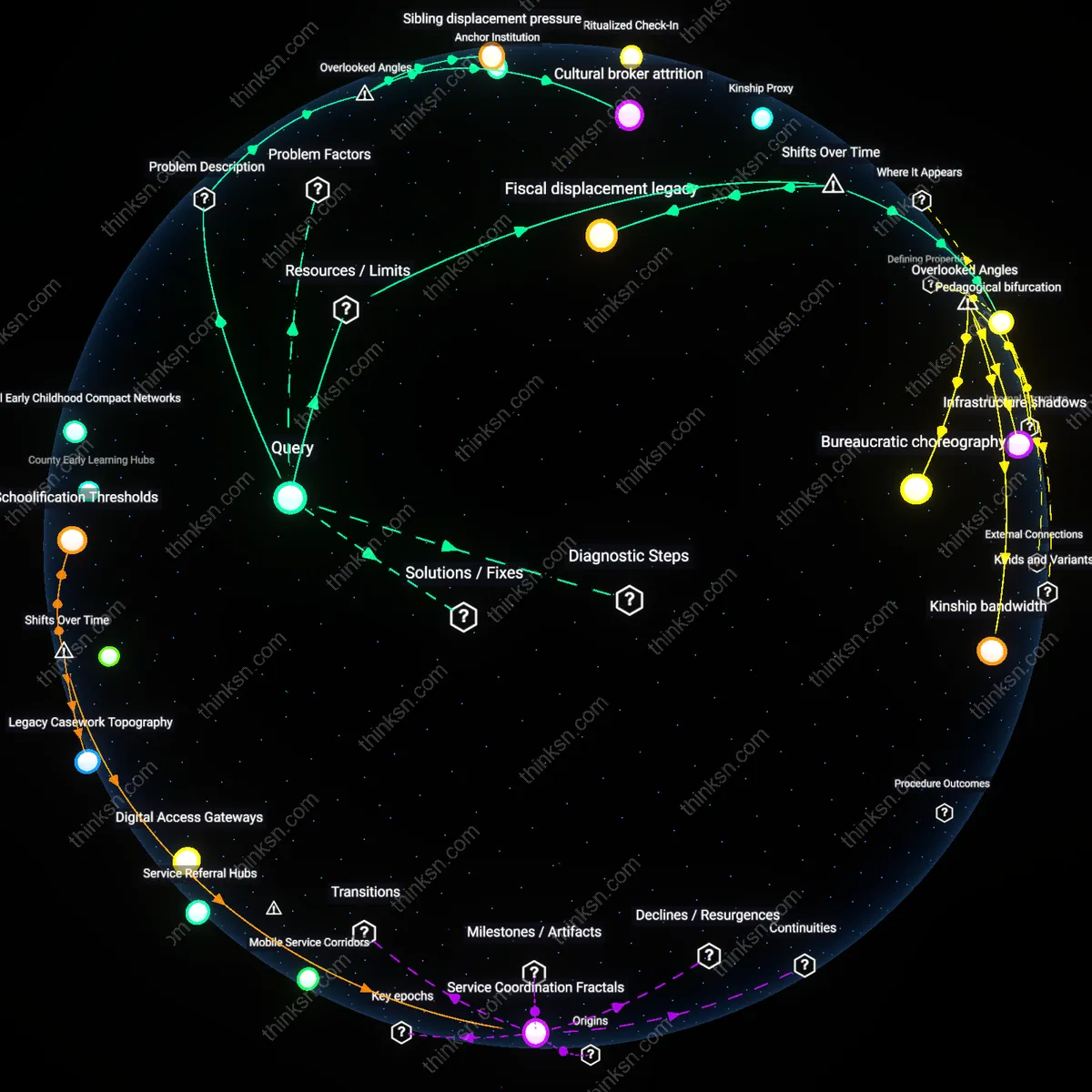
Designate schools as primary hubs for re-coordinated family support services to stabilize access. Schools are fixed, trusted, and proximate institutions that already host disparate services like meal programs and special education—embedding home-visiting equivalents there closes referral gaps by leveraging daily physical attendance as a reinforcing loop; when services fail, children still return to school, enabling persistent re-engagement without relying on family mobility or transport stability. This is underappreciated because public imagination frames schools narrowly as academic sites, not as feedback-stabilizing anchors in family service ecosystems.
Ritualized Check-In
Replace one-time assessments with age-locked developmental milestones tied to universal health visits to reactivate interrupted supports automatically. Pediatric well-child visits at standard intervals (e.g., 18- and 24-month checkups) act as balancing loops, detecting service gaps when families face instability and reintegrating them without self-referral; this embeds continuity in a system people already recognize. The non-obvious insight is that families aren’t lost due to disinterest but because common pathways collapse without ritualized triggers tied to developmental time, not calendar time.
Kinship Proxy
Certify and train trusted community members—like grandparents, aunts, or longtime neighbors—to deliver basic developmental screenings and referrals, making care continuity independent of formal health workers. In neighborhoods where extended family remains a de facto caregiving infrastructure, kinship proxies reactivate service feedback loops when formal access frays, because people already turn to them during distress; this leverages pre-existing trust architecture instead of replacing it. The overlooked point is that the public assumes professionalization is necessary for validity, missing how recognized familial roles can carry clinical signaling if lightly structured.
Administrative Inheritance
Rebuilding bundled family support requires leveraging the residues of pre-1980s public health infrastructure, when visiting nurses and social workers operated under centralized municipal auspices. In cities like Baltimore and Cleveland, the shift from integrated home-visiting systems to fragmented post-1996 welfare reform services created a latent administrative substrate—paper trails, interagency protocols, and territorial assignments—that persists in public records and retired personnel memory; reactivating these enables modest reintegration without new funding. What’s underappreciated is that the withdrawal of services didn’t erase operational blueprints, but rather transformed them into dormant assets accessible only through institutional recall.
Parental Labor Surplus
The re-aggregation of dislocated services depends on offloading coordination tasks to parents themselves, whose intensified time commitments emerged as a silent complement after home-visiting programs declined in the 2000s. As clinics, early education, and behavioral health shifted toward opt-in models tied to electronic enrollment and transportation logistics, low-income families absorbed the invisible work of stitching together care—work that could now be reverse-engineered into formalized peer navigator roles. The non-obvious insight is that what appears as system fragmentation has generated a de facto reserve of experiential expertise, produced not by policy design but by necessity under austerity.
Clinician Opportunism
Post-2010 healthcare consolidation enabled fragmented family services to be re-bundled within hospital systems not through social policy but through clinical revenue cycles. As federally qualified health centers expanded under the ACA, staff in urban safety-net hospitals began folding developmental screenings, housing referrals, and WIC signups into pediatric visits—not to restore pre-1990s visiting models but to meet quality metrics and reduce readmissions. The overlooked dynamic is that clinical efficiency incentives have become an unexpected historical vector for re-embedding social care, repurposing clinical encounters as hubs of de facto service bundling once reserved for home-based programs.
Coordinated Service Hubs
Integrate home-visiting functions into neighborhood health-social service hubs, as demonstrated by the Harlem Children’s Zone’s Pipeline program in New York City, which colocated early childhood screenings, parenting support, and family case management under one roof to eliminate fragmented service navigation. This integration replaced appointment juggling with longitudinal, place-based care coordination managed by community-employed navigators, revealing that proximity and institutional collocation reduce cognitive and logistical burdens more effectively than digital referrals or transport subsidies. The non-obvious insight is that geographic bundling—backed by sustained local infrastructure investment—can substitute for families’ fragmented self-advocacy, making service continuity a structural rather than behavioral outcome.
Embedded Proxy Advocates
Assign cross-agency family advocates embedded within public benefit systems, modeled on the Health Access Navigators deployed during Denver’s 2015-2018 Medicaid expansion, who operated jointly within county health, housing, and early intervention programs to proactively track and broker services for high-risk families. These advocates used shared data platforms and institutional access to initiate home-visiting-equivalent supports automatically upon enrollment in any linked program, revealing that bureaucratic navigation can be outsourced to hybrid-role professionals who inhabit interstitial spaces between siloed agencies. The underappreciated mechanism is that these intermediaries function not as informants but as authorized surrogates who act within procedural thresholds to preempt disconnection.
Automated Eligibility Chaining
Implement rules-based eligibility triggers across public programs so that enrollment in one automatically initiates screening for others, as piloted in California’s CalHEERS system during its 2020 Integrated Care Initiative, where a child’s participation in Special Education services triggered preregistration for home-to-school behavioral support and caregiver counseling. This created a procedural rebundling of supports without requiring family reapplication, exposing how administrative sequencing—rather than human outreach alone—can reconstruct continuity lost when direct services end. The key insight is that policy automation, designed around life-stage transitions, can mimic the bundling function of home visitors by making entitlement pathways recursive rather than discrete.