Why No‑Contact Divorce Clauses Hurt Co‑Parenting?
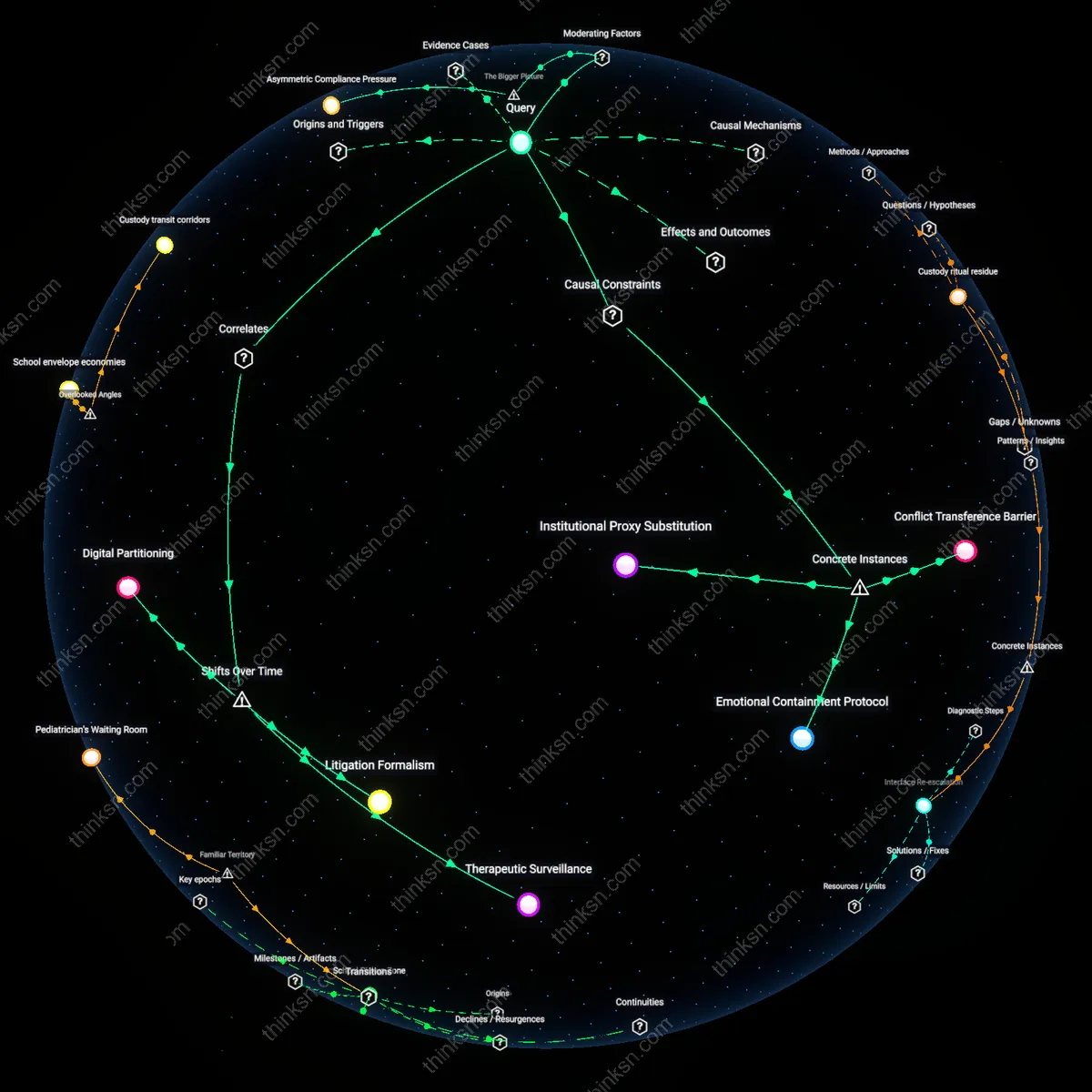
Analysis reveals 8 key thematic connections.
Key Findings
Institutional Shielding
No-contact clauses reduce co-parenting conflict by legally insulating communication through third-party platforms like court-approved apps, thereby shifting interaction from emotional to transactional modes; this works primarily when family courts mandate digital custody of exchanges, making informal contact risk-laden for both parties. The significance lies in how judicial systems, by elevating procedural compliance over relational continuity, inadvertently reconfigure parenting coordination as a regulated compliance task rather than a collaborative one—activating institutional infrastructures that depersonalize contact to prevent escalation. The non-obvious outcome is that these clauses do not merely restrict communication but actively re-route it through formal systems, altering the power geography of post-divorce parenting.
Asymmetric Compliance Pressure
No-contact clauses intensify co-parenting strain when one parent has greater access to legal resources or social leverage, enabling them to weaponize the clause by filing infractions over minor violations while shielding their own noncompliance; this dynamic emerges in jurisdictions with punitive enforcement mechanisms and uneven access to legal representation. The broader system at work is the feedback loop between privatized legal advantage and public enforcement systems, where family courts become arenas for power consolidation rather than conflict resolution—revealing how procedural neutrality can amplify existing inequalities. The overlooked mechanism is that the clause’s effectiveness pivots not on its content but on the imbalance in capacity to invoke state enforcement.
Litigation Formalism
No-contact clauses became prevalent in divorce settlements during the 1980s legal transformation when family courts began treating parental conflict as a procedural risk to be managed through formalized legal constraints rather than resolved through mediation, embedding a presumption of adversariality that prioritized procedural efficiency over relational continuity. This shift, driven by rising caseloads in urban family courts and the standardization of custody templates, institutionalized non-contact mandates as safeguards against perceived contempt risks, even in co-parenting cases with no history of abuse. What is underappreciated is that this procedural rationality decoupled clause inclusion from actual harm prevention, making the clauses a default rather than a remedy—reflecting not parental danger but administrative habit. The mechanism operates through standardized divorce decree templates in jurisdictions like Los Angeles County and Cook County, where boilerplate language now includes no-contact unless explicitly struck, revealing how bureaucratic efficiency reshaped family law’s normative logic.
Therapeutic Surveillance
The rise of mandatory mental health evaluations in divorce proceedings after the 1990s linked no-contact clauses to diagnostic gatekeeping, where courts began conditioning co-parenting rights on psychological certification, thereby transforming the clauses from legal tools into instruments of therapeutic oversight. This shift emerged when statutes like California’s Family Code §3044 temporarily presumed unfitness for parents accused of abuse, triggering automatic evaluations that often recommended no-contact regardless of eventual findings. Clinicians, drawn into legal compliance rather than therapeutic advocacy, began treating contact resumption as contingent on therapeutic progress, thus embedding psychological normalization as a prerequisite for family interaction—altering the temporal structure of co-parenting from negotiation to phased rehabilitation. What is non-obvious is that this medicalization rerouted parental autonomy through clinical authority, making psychological conformity the de facto currency of reintegration.
Digital Partitioning
Since the 2010s, no-contact clauses have increasingly functioned as digital firewalls in co-parenting, evolving beyond physical separation to include bans on surveillance through shared apps, social media monitoring, or location tracking, a shift accelerated by the proliferation of parenting coordination software like OurFamilyWizard and Cozi. This transformation emerged when courts began recognizing digital overreach as coercive conduct, reframing the clauses not as responses to past violence but as preemptive measures against data-based harassment enabled by ambient connectivity. The mechanism operates through reinterpretation of 'contact' to include algorithmic presence—where a parent logging a child’s meal in a shared app could violate a no-contact order if messages were implied—revealing how digital mediation alters the definition of interaction itself. What is underapprecimed is that these clauses now manage informational asymmetry rather than emotional safety, producing a new norm where co-parenting demands data silence to preserve legal compliance.
Emotional Containment Protocol
In the 2016 California case of *M.M. v. J.M.*, a no-contact clause was imposed after one parent repeatedly used visitation exchanges at schools to re-initiate romantic dialogue, demonstrating that direct communication acts as a bottleneck preventing emotional boundary maintenance; the clause functioned by rerouting all exchanges through a third-party app, thereby enforcing emotional containment through structural exclusion, revealing that minimizing interpersonal contact is not about parenting capacity but about managing residual intimacy.
Institutional Proxy Substitution
When the Ontario family court mandated in 2019 that communication between divorced parents in the *Hamilton-Wentworth District School Board* custody arrangement occur exclusively via the school’s administrative portal, the no-contact clause shifted parental coordination from interpersonal channels to institutional infrastructure; this substitution worked only because the school had both authority and record-keeping capacity, showing that co-parenting continuity depends not on direct interaction but on the availability of trusted institutional proxies to absorb relational friction.
Conflict Transference Barrier
In post-divorce proceedings following the 2020 dissolution of the public co-parenting arrangement between New Zealand influencers Jenna and Ben Lythe, repeated conflict escalation during handovers led Family Court Wellington to impose a no-contact clause requiring transfer of children at a police station; this measure reduced conflict not by improving communication but by eliminating opportunities for grievance transference through affective cues—revealing that physical and emotional separation functions as a causal prerequisite for de-escalation when prior relational scripts are trauma-embedded.