Does a Family Covenant Weaken Formal Estate Plans?
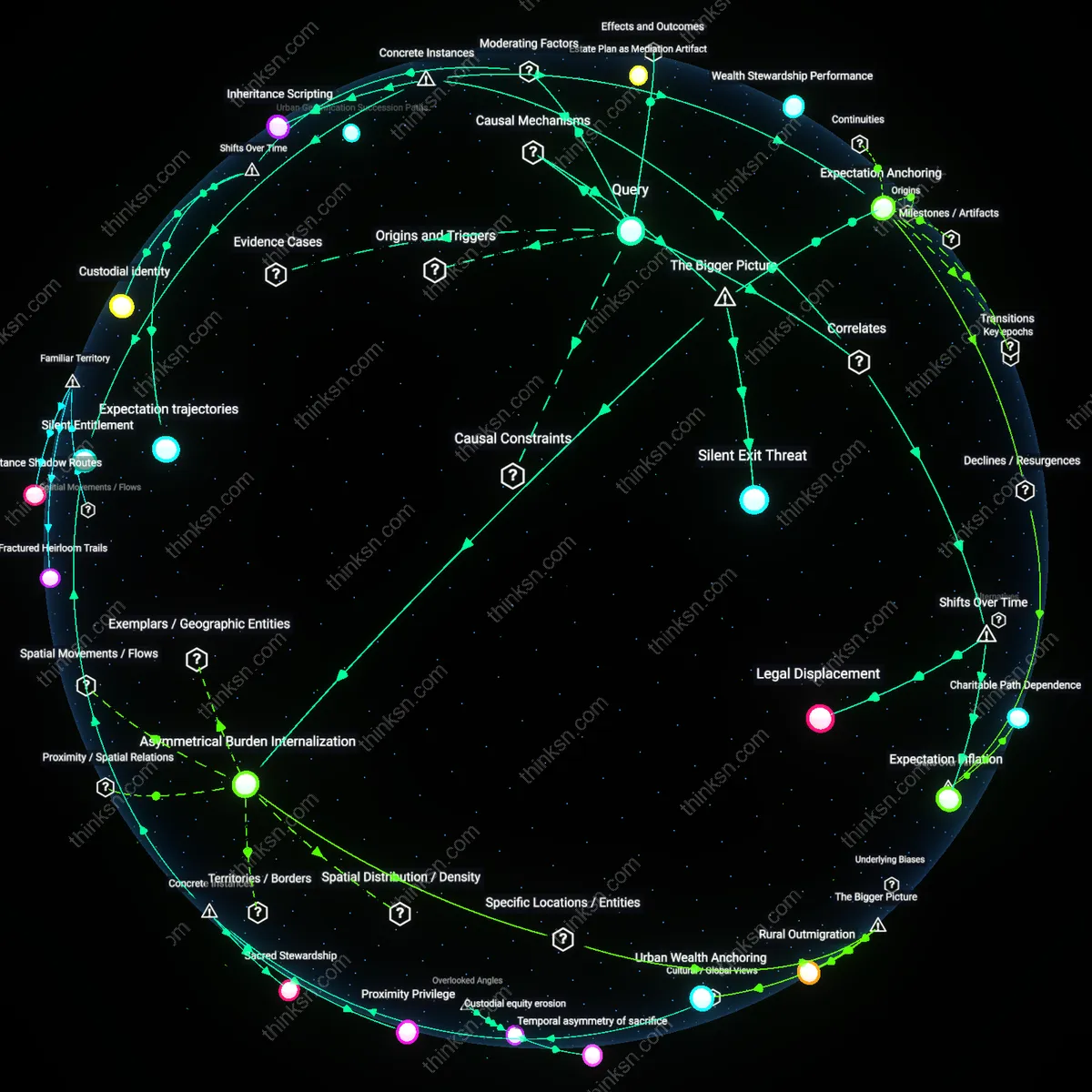
Analysis reveals 13 key thematic connections.
Key Findings
Expectation Anchoring
Informal family covenants set implicit benchmarks for fairness that redefine the moral baseline for what counts as an acceptable formal estate distribution. When siblings collectively anticipate equal or needs-based disbursements through years of verbal agreements or observed parental behavior, these expectations become internalized as entitlements, altering how legal arrangements are interpreted—rendering even legally equitable plans ‘unfair’ if they deviate from social consensus. This mechanism operates through kinship networks where repeated interactions reinforce shared norms, and it is significant because it reveals how non-legal consensus can override formal authority in wealth transmission, destabilizing executor decisions even when legally sound.
Asymmetrical Burden Internalization
Siblings who informally assume long-term caregiving roles in exchange for anticipated inheritance develop a sense of earned claim, which later pressures testators to codify unequal distributions to honor perceived moral debts. This shift occurs not through explicit contracts but through gradual normalization of obligation within family routines, where emotional and labor contributions accumulate as invisible equity. The broader system of intergenerational care—underfunded in public policy—enables this dynamic, making estate plans reactive to informal reciprocity structures that formal law does not recognize, thereby embedding hidden inequalities into legal instruments.
Silent Exit Threat
The unspoken possibility of relational withdrawal by siblings who feel wronged by estate outcomes gives informal covenants coercive power, forcing testators to align legal documents with familial consensus to preserve cohesion. This threat operates not through litigation risk but through the fear of kinship rupture—such as exclusion from future family events or caregiving reciprocity—enforced by diffuse social sanctions rather than formal penalties. The mechanism is sustained by the high emotional cost of isolation in tight-knit family systems, making estate planning a negotiation with affective consequences, where compliance is extracted through anticipated social punishment rather than legal accountability.
Inheritance Expectation Gap
Informal understandings among siblings in the 1980s Kennedy family circle that wealth and political legacy would be shared equitably—particularly around Joseph P. Kennedy’s estate—created enduring friction when formal trusts favored certain heirs, revealing that unstated familial norms can generate psychological entitlements that destabilize legal arrangements. The disparity between presumed collective benefit and actual asymmetric disbursements triggered long-term estrangements, such as those between Ted Kennedy’s branch and Joseph Jr.’s descendants, illustrating how implicit covenants operate as shadow contracts that override fiduciary clarity. This dynamic exposes the risk of uncodified fairness norms in high-visibility families, where symbolic equity carries more relational weight than asset distribution mechanics.
Estate Plan as Mediation Artifact
In the late 1990s, the Walmart heirs—including Alice Walton and Rob Walton—navigated decades of quiet agreements about equal influence and income sharing from their inherited stock, which predated and ultimately shaped the formal restructuring of the Walton Family Holding Corporation in 2000 to institutionalize decision-making parity. Because the siblings operated under a tacit covenant of balanced control despite differing public roles, the estate planning process became less about asset division and more about codifying an existing equilibrium to prevent future conflict. This instance reveals that in some ultra-wealthy families, formal estate instruments do not dictate outcomes but instead ratify prior relational settlements, transforming legal documents into diplomatic tools rather than mere financial blueprints.
Wealth Stewardship Performance
Among the Rockefeller family descendants in Westchester County during the 1950s–70s, informal expectations that heirs would live modestly and reinvest surplus into family philanthropy reshaped the structure of formal estate plans, which increasingly channeled wealth into dynastic foundations like the Rockefeller Brothers Fund rather than direct individual bequests. The covenant of restraint—transmitted through family retreats and internal newsletters—functioned as a normative filter on legal design, pressuring trustees to align disbursement rules with demonstrated lifestyle commitments rather than equal cash distributions. This case uncovers how performative adherence to shared values can become a de facto eligibility criterion for inheritance, embedding behavioral surveillance within dynastic wealth governance.
Expectation trajectories
Informal family covenants established during the postwar wealth expansion era (1950s–1970s) intensified intergenerational expectations of equitable inheritance, which later destabilized formal estate plans when siblings encountered divergent life outcomes in the 1990s and 2000s. These covenants, often verbalized during family rituals in suburban middle-class homes, functioned as normative scripts that prescribed fairness not as a legal standard but as a moral one, making later deviations—such as favoring a caregiving sibling—feel like betrayals. The shift from an era of perceived limitless upward mobility to one of growing economic insecurity exposed the fragility of these implicit agreements, revealing how the temporal lag between promise and execution amplified resentment. The non-obvious insight is that it was not the absence of plans but the decay of their assumed context—stable growth and shared futures—that turned equity into a source of conflict.
Custodial identity
The transition from agrarian to professional-service economies in late 20th-century urban populations redefined which sibling was seen as 'deserving' of wealth, shifting informal covenants from birth order to post hoc contributions like eldercare or emotional labor, thereby altering estate allocations and formal trusts. In families where one sibling left a high-earning career to care for aging parents, informal moral claims emerged that reconfigured expected shares—claims that lawyers then encoded into formal bypass clauses or lifetime gifts. This renegotiation was most pronounced in metropolitan areas between 1995 and 2010, where caregiving disparities became visible against the backdrop of rising professional opportunity costs. The underappreciated mechanism is how shifts in labor value reshaped kinship meritocracy, converting care into a form of moral capital that could override testamentary equality.
Temporal legitimacy
Since the 2008 financial crisis, rising housing costs and intergenerational wealth compression have caused younger siblings to treat early, informal family wealth-sharing agreements as binding over time, even when those promises were made in economically unrepresentative boom years, thereby straining estate planning when parents lack sufficient assets to fulfill them. These promises—such as 'everyone will get a down payment'—gained moral weight through repetition across family gatherings in the 2000s, but lost feasibility in the austerity that followed the crash, particularly in high-cost regions like coastal California or the Northeast corridor. The resulting disputes arise not from greed but from a mismatch between the temporal legitimacy of promises made in one economic regime and their enforceability in another. The overlooked dynamic is that informal covenants accumulate affective authority over time, making their collapse feel like personal betrayal rather than economic necessity.
Inheritance Scripting
In the Vanderbilt family’s estate transitions from the 1880s through the 1940s, elder generations informally designated certain assets—like the Biltmore Estate—to specific heirs through verbal assurances and social performance at family gatherings, which created de facto assignment scripts that later pressured estate lawyers to deviate from equal distribution models in wills, showing how ritualized familial discourse functions as a pre-legal allocative mechanism that siblings interpret as binding commitments.
Silent Entitlement
The Walton family’s pattern of informal business role allocation among siblings during the 1970s and 80s—where certain brothers were informally positioned as 'stewards' of Walmart governance while others were steered toward peripheral ventures—created asymmetrical entitlement perceptions that later distorted formal equity transfers, as those excluded from operational influence still claimed equivalent wealth shares during estate negotiations, exposing how functional exclusion from informal power networks generates covert claims that destabilize legal succession plans.
Expectation Inflation
Informal family covenants established during the postwar boom era, when rising household wealth created optimism about intergenerational stability, now distort formal estate planning by embedding unspoken assumptions of equal distribution that did not exist in pre-1950 agrarian or industrial families, where primogeniture or apprenticeship typically allocated assets. These covenants, often verbalized during family gatherings in expanding suburbs, institutionalized emotional promises—like 'everyone will be taken care of'—that conflict with legally precise instruments such as trusts or wills, especially when asset values grow beyond original expectations. The mechanism operates through intergenerational memory and affective norms rather than legal enforceability, making them potent yet invisible stressors in estate administration. What is underappreciated is that the very idea of 'fairness' in wealth sharing today reflects mid-century middle-class ideals, not timeless familial ethics, and this historical shift has produced a gap between affective expectations and legal realities. This gap manifests when siblings perceive disinheritance not by actual dollar amounts but by deviations from emotionally coded promises made decades earlier.
Legal Displacement
As family wealth shifted from land and trade goods to financial instruments and retirement accounts after the 1980s, informal covenants about shared inheritance began to erode the authority of formal estate instruments, not by overriding them legally, but by altering how siblings interpret their validity and moral standing. The rise of jointly held brokerage accounts, payable-on-death designations, and digital estate access—tools designed for efficiency, not equity—created execution paths that bypassed wills, yet families continued to assume collective entitlement based on earlier verbal agreements. This dynamic is especially pronounced in professional-class families where parents, avoiding 'awkward conversations,' rely on convenience-driven estate mechanisms that inadvertently privilege access over intent. The historically significant transition—away from probate-centric planning toward administrative expediency—has displaced legal documentation as the primary reference point for sibling justice, making emotional betrayal, not legal standing, the dominant frame for conflict. The result is not contested wills per se, but contested interpretations of loyalty and recognition among siblings.