Financing an Abortion: Legal Risks for Friends Supporting Out-of-State Procedures?
Analysis reveals 9 key thematic connections.
Key Findings
Chilling Network Effect
Criminalizing aid for out-of-state abortions deters interpersonal support by expanding prosecutable conduct to include minor financial contributions among friends, a shift accelerated after the 2022 Dobbs decision. Previously, such assistance operated in a legal gray zone shielded by Roe’s federal protections, but with state sovereignty restored over abortion, jurisdictions like Texas and Idaho have retrofitted accessory statutes to target transport and funding, thereby transforming routine acts of friendship into potential felonies. This legal transformation generates a chilling effect that extends beyond formal prosecution—individuals self-censor assistance due to uncertainty about extraterritorial enforcement, revealing how criminalization disrupts informal care networks even in the absence of widespread convictions.
Jurisdictional Arbitrage
Friends aiding abortion access increasingly operate through decentralized, cross-jurisdictional funding tactics that exploit legal asymmetries between states, a strategic adaptation that emerged prominently between 2020 and 2023 as red states pre-emptively criminalized aid. Where once abortion support involved direct reimbursement within a single state, groups now route donations through intermediaries in states like Illinois or Vermont to insulate donors from liability in restrictive states, leveraging the lack of federal criminalization of abortion aid. This shift reveals an emergent form of legal improvisation—where personal networks adopt structural features of transnational advocacy organizations—to maintain care under asymmetric federalism, a practice previously rare in domestic reproductive support.
Moral Liability Transfer
The criminalization of aiding abortions has relocated ethical responsibility from the pregnant person to their support network, a transformation made visible in grassroots abortion funds post-2020, which now require liability waivers and anonymized giving to protect volunteers. Historically, such funds framed assistance as collective care under shared moral purpose, but the threat of accessory charges under statutes like Oklahoma’s 2022 trigger law has institutionalized risk-aversion, reframing friends’ contributions as legally perilous acts rather than extensions of bodily autonomy. This inversion—where assistance itself becomes a regulated and morally fraught intervention—exposes how criminalization reconstructs interpersonal ethics through the anticipatory governance of legal exposure.
Punitive Relational Chilling
Criminalizing aid for out-of-state abortion procedures directly deters interpersonal financial assistance among friends, not because the law is regularly enforced, but because its ambiguity creates a pervasive fear of prosecution, which alters private behavior more effectively than actual arrest records. This operates through the psychological mechanism of anticipatory compliance, where individuals internalize legal risk even in jurisdictions with no precedent of charging such acts, as seen in states like Texas under SB8’s vigilante framework, which leverages civil liability to privatize enforcement. The non-obvious outcome is that the law functions more as a social deterrent than a punitive tool—reshaping intimate networks through imagined consequences rather than actual ones, revealing how criminalization can collapse private solidarity into legal suspicion.
Jurisdictional Arbitrage of Care
Friends who assist with out-of-state abortions are increasingly operating within extralegal care networks that exploit gaps between state enforcement capacities, not because they believe they are immune, but because they calculate that cross-state logistical complexity inhibits prosecution, as demonstrated by mutual aid groups coordinating travel via encrypted apps and cash transfers. This functions through the decoupling of moral obligation from legal jurisdiction, where aid is reframed as medical logistics rather than criminal facilitation, allowing actors to navigate gray zones between states like Missouri and Illinois. The counterintuitive effect is that criminalization does not eliminate assistance but territorializes it, generating new forms of organized, mobile care that treat state borders as operational variables—a shift that exposes how repression can institutionalize underground systems rather than suppress them.
Moral Substitution Effect
Criminal penalties on aiding abortion access provoke a shift in how friends provide support—not by stopping aid, but by substituting financial assistance with less traceable forms of help, such as offering childcare, housing, or transportation, which are legally indistinct from general caregiving and thus insulated from prosecution. This operates through the reclassification of aid into socially normative behaviors that evade forensic scrutiny, as observed in clandestine networks in Alabama where friends document rides as 'family visits' to obscure intent. The unappreciated consequence is that criminalization does not reduce support but distorts its form, privileging plausible deniability over direct intervention and thereby transforming friendship into a covert infrastructure—one that reveals how legal pressure can mutate care into camouflage.
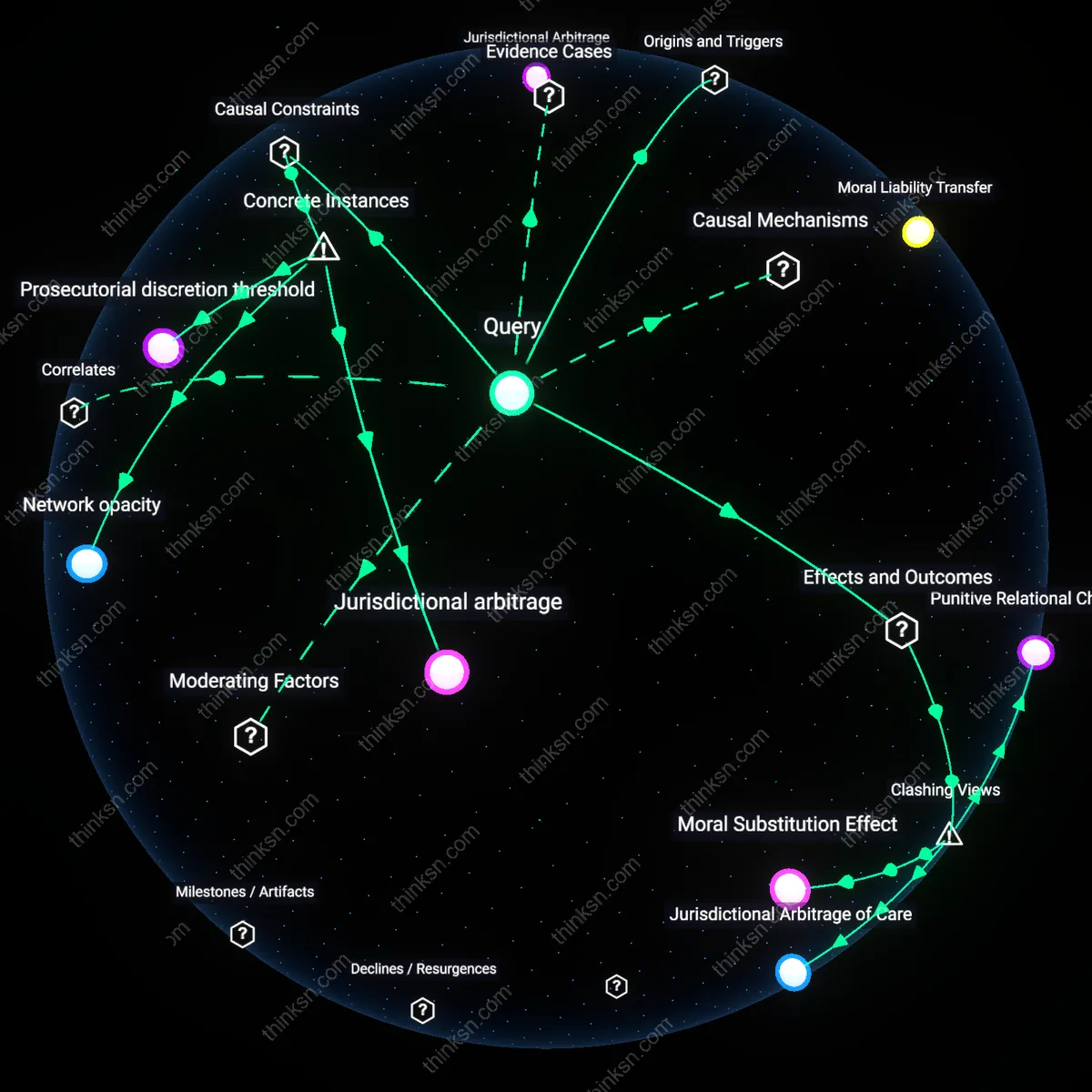
Jurisdictional arbitrage
Texas friends who send money to an Oklahoma acquaintance to cover a clinic fee in New Mexico operate outside prosecutable reach because state criminal statutes cannot enforce extraterritorially without interstate cooperation, revealing that geographic dislocation severs the chain between financial aid and criminal liability. The 2023 unsuccessful Travis County attempt to prosecute a Houston resident for funding an Albuquerque procedure failed due to lack of statutory jurisdictional attachment, underscoring that enforcement mechanisms require legislative reciprocity absent in current anti-abortion frameworks. The non-obvious insight is that criminalization depends not on moral intent but on enforceable territorial boundaries, making physical distance a structural shield.
Network opacity
A Minneapolis mutual aid group used untraceable Venmo aliases and layered gift card exchanges to fund a Sioux Falls patient’s travel to Vermont, evading monitoring because digital financial surveillance systems cannot reliably detect abortion-related transactions without explicit metadata tagging. When South Dakota attempted in 2022 to trace donors under aiding-and-abetting statutes, the absence of transactional identifiers blocked evidentiary linkage, demonstrating that payment infrastructure design—not intent or action—determines prosecutorial feasibility. This reveals that technological anonymity in peer-to-peer finance acts as a de facto legal immune layer, a constraint overlooked in moralized legislative debates.
Prosecutorial discretion threshold
In 2021, a Jacksonville woman who reimbursed her sister’s flight to Maryland for an abortion was named in a Florida sheriff’s referral but never indicted, because state attorneys prioritized direct providers over peripheral actors, exposing that enforcement depends on resource allocation and political risk calculus rather than statutory breadth. The State Attorney for the Fourth Judicial Circuit avoided such cases to prevent backlash and litigation overload, illustrating that criminalization threats are functionally inert without institutional willingness to activate them. The underappreciated dynamic is that legal consequence hinges on bureaucratic triage, not merely the existence of a law.